
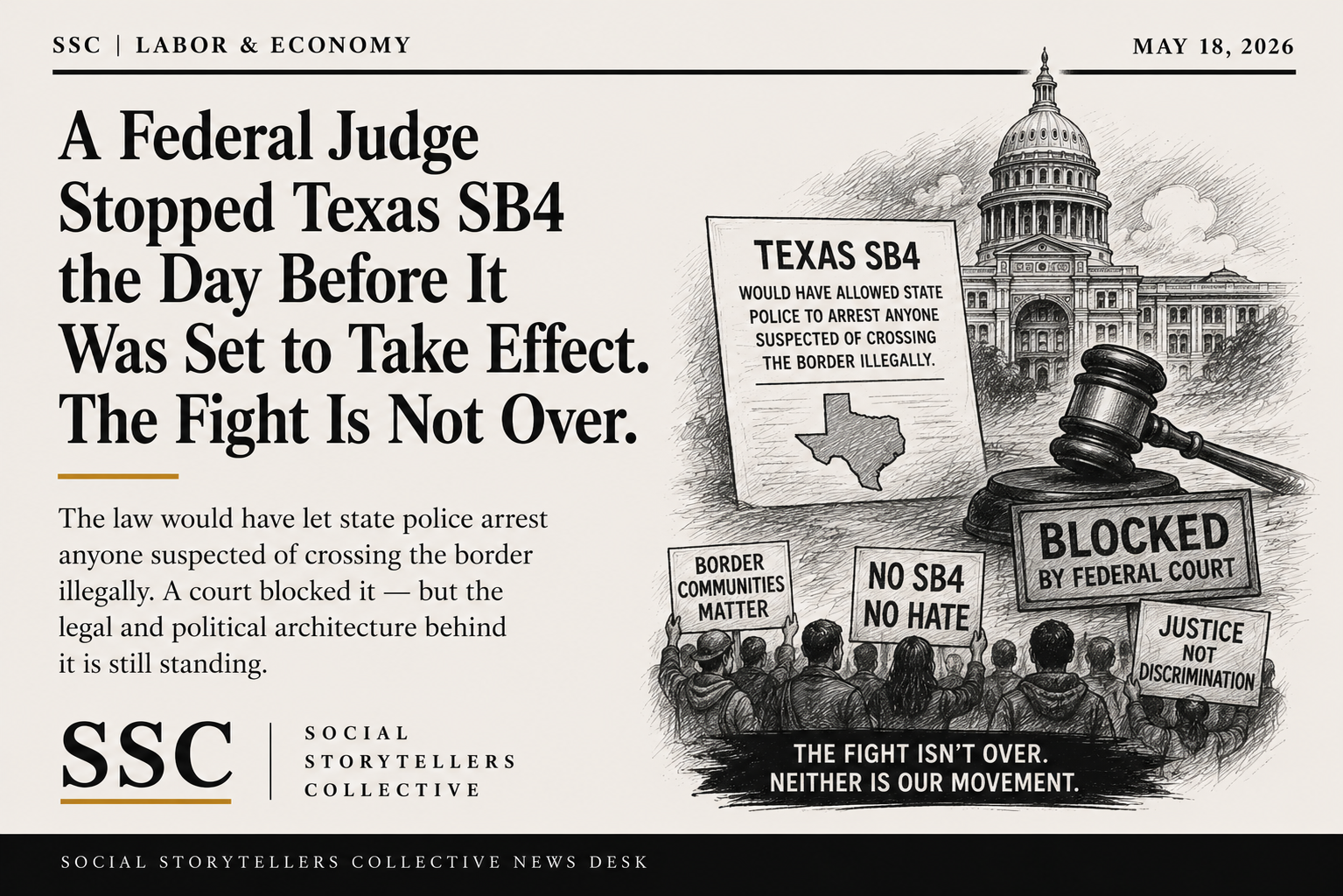
On Thursday, May 14 — one day before Texas Senate Bill 4 was scheduled to go into effect — U.S. District Judge David Alan Ezra granted a preliminary injunction blocking its central provisions. The law, which would have created a state-level crime for crossing the U.S.-Mexico border without authorization and empowered local police to arrest people suspected of doing so, will not take effect while the legal challenge proceeds. The injunction is a pause, not a resolution. And the argument Texas made in writing this law is not going away.
SB4 represents the most aggressive attempt by a state government to assume direct enforcement authority over federal immigration law since Arizona’s SB 1070 in 2010 — and it reaches further. Where Arizona’s law directed police to check immigration status during otherwise lawful stops, Texas SB4 created an independent state crime for unauthorized border crossing, established a pathway for state magistrates to order deportations, and required prosecutors to continue cases even when a defendant had a pending federal immigration proceeding — including an asylum claim.
The constitutional problem is foundational. Immigration law in the United States is, by constitutional structure, exclusively a federal domain. The federal government negotiates treaties, administers visas, operates immigration courts, and maintains the enforcement apparatus that determines who enters, who stays, and who is removed. A state cannot maintain a parallel deportation system. Texas argued that the federal government’s failure to control the border creates a state of invasion that triggers the state’s constitutional right to self-defense. That argument has not found purchase in federal courts — and Judge Ezra’s injunction signals it did not here either.
But the injunction addresses the legal mechanism, not the political logic that produced it. The ACLU, the ACLU of Texas, and the Texas Civil Rights Project filed a class-action challenge on May 4, identifying specific provisions whose practical operation would be impossible to administer without racial profiling. The law provided no defense for people who had federal authorization to enter the country or who had pending immigration status — meaning someone with an active asylum case or a green card in process could be arrested, charged with a state crime, and brought before a state magistrate without the federal immigration proceedings that protect their rights ever pausing to acknowledge it.
That is not a hypothetical concern. It is the documented operating condition of immigration enforcement at scale. When state police are empowered to arrest people for suspected immigration violations — without the training, legal standards, or constitutional safeguards built into federal immigration procedures — enforcement patterns follow existing racial lines. The population most likely to be stopped, questioned, and arrested is not randomly distributed across the state. It is concentrated among communities whose appearance, language, or neighborhood flags them for enforcement attention regardless of their actual legal status.
The broader pattern matters beyond Texas. At least a dozen states have moved to expand state-level immigration enforcement authority since the beginning of 2025, pursuing varying versions of the same structural argument: that federal inaction justifies state action. The legal challenges have had mixed results. The political pressure driving the legislation has not slowed. Each state bill that gets filed, debated, and partially blocked trains the next wave of legislators on what language survives and what doesn’t. SB4’s injunction is a legal win. It is not a strategic one.
What is also worth tracking is what happens to the people these laws are designed to reach while the legal challenges proceed. The injunction stops arrests under SB4 — for now. It does not stop the enforcement expansion happening through other channels. ICE detention is running at record levels. Deportation flights have accelerated. The federal system that Texas argued was failing to act is operating at a scale it has never operated at before. The argument that states need to fill a federal enforcement vacuum is increasingly hard to sustain empirically — but it does not need to be empirically accurate to be politically effective.
The next step for SB4 is a fuller hearing on the merits. Texas has signaled it will continue litigating. The law is blocked. The logic behind it has a dedicated legal and legislative infrastructure that one injunction does not dismantle.