
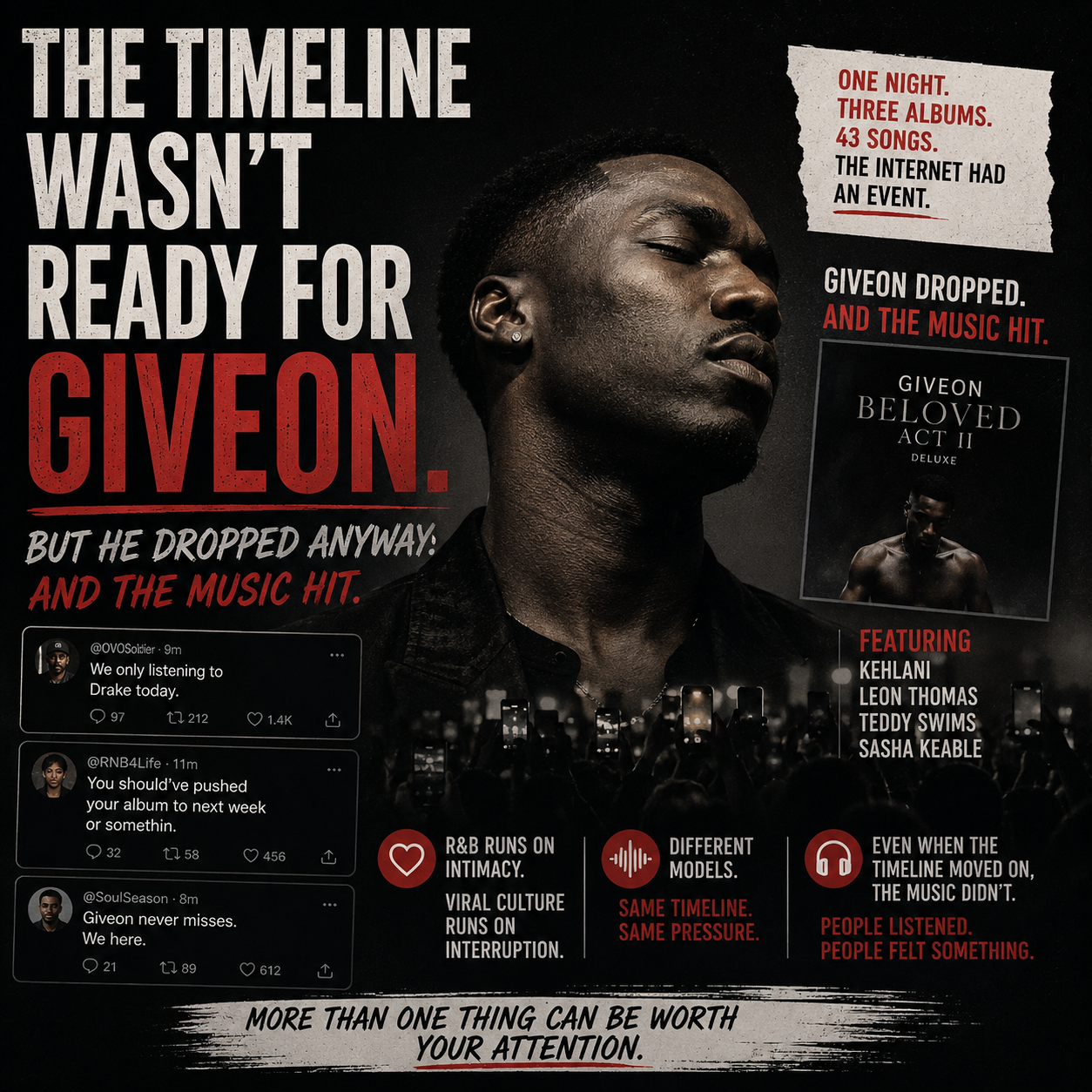
Early this morning, Giveon released the deluxe edition of BELOVED: ACT II into one of the most crowded release nights in recent memory. At midnight, Drake simultaneously released three albums — Iceman, Habibti, and Maid of Honour — delivering 43 songs across three projects on the same night Giveon entered the cycle. The internet didn’t just have a favorite. It had an event.
And still, Giveon dropped.
Within minutes, posts were already circulating. “We only listening to Drake today.” “You should’ve pushed your album to next week or somethin.” The comments were playful, but they were also revealing. Because Giveon is not a small artist hoping to catch a break. He is a Grammy-nominated R&B singer with one of the most distinctive voices of his generation, a loyal fanbase, and a project stacked with features from Kehlani, Leon Thomas, Teddy Swims, and Sasha Keable. By any traditional measure, this was a major release.
But the timeline doesn’t operate by traditional measures anymore.
What happened this morning was a live demonstration of how concentrated music culture has become online. Platforms no longer let releases exist side by side — they force everything into a hierarchy. Who’s winning the day. Who owns the cycle. Who should have waited. Fans now openly debate release windows like military strategy, as if an R&B album is collateral damage in someone else’s war for attention. When one artist drops three albums and 43 songs in a single night, that war feels impossible to compete with.
The irony is that underneath all the Drake jokes, something else was happening entirely — people were genuinely excited. Excited for slow music. Intentional music. Records built around vocals, atmosphere, emotional pacing, and restraint. In an era where most releases are engineered for clips and memeability, Giveon still makes music that asks you to sit inside a feeling. That’s not an accident. That’s a choice. And audiences keep showing up for it.
That tension — between what platforms reward and what listeners actually crave — is one of the defining stories in music culture right now. R&B runs on intimacy. Viral culture runs on interruption. They are fundamentally different consumption models operating inside the same ecosystem, and artists like Giveon are caught in the middle every single time they release.
But here’s what Thursday actually proved: even when the timeline tried to move on, the music didn’t let it. People showed up. They listened. They felt something. And that may ultimately matter more than who owned the cycle for a few hours.
Giveon didn’t drop at the wrong time. The internet just forgot, for a moment, that more than one thing can be worth your attention.