
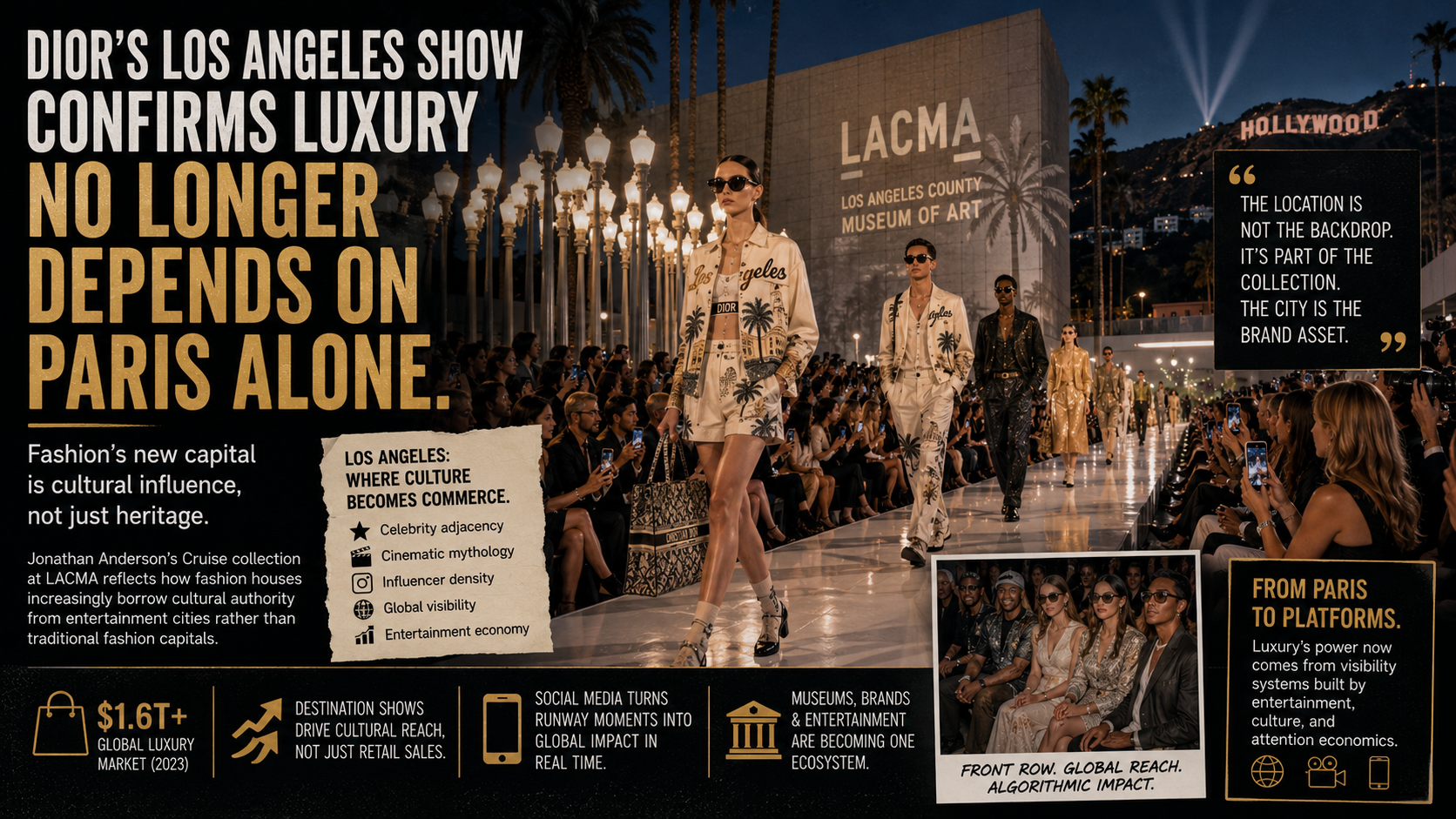
Jonathan Anderson unveiled Dior’s latest Cruise collection at the Los Angeles County Museum of Art this week, surrounding luxury fashion with Hollywood symbolism, California nostalgia, celebrity proximity, and cinematic references deeply tied to the mythology of Los Angeles itself. Cruise shows were once designed primarily as retail-focused resort collections for wealthy clients traveling between seasons. They have since evolved into large-scale destination spectacles used by luxury houses to embed themselves inside globally recognizable cultural landscapes. Dior choosing Los Angeles matters because it confirms how much luxury fashion now depends on entertainment geography to maintain relevance.
The economics behind these shows explain why the industry continues escalating them. The global luxury market surpassed approximately $1.6 trillion last year, while high-end brands increasingly compete for cultural attention rather than simple product demand. A runway show alone no longer generates sufficient impact. The location must now function as narrative infrastructure. Los Angeles offers something Paris cannot fully replicate: celebrity adjacency, film mythology, influencer density, and constant visual circulation through entertainment media ecosystems. Luxury brands increasingly treat cities as branding assets capable of transferring symbolic value directly onto collections.
That strategy mirrors broader shifts across media and entertainment industries. Fashion once depended heavily on editorial gatekeepers, magazine covers, and seasonal runway calendars to shape prestige. Social media reorganized that system around perpetual visibility and audience participation. Today, a runway image may reach millions through Instagram reposts, TikTok analysis, celebrity paparazzi coverage, or fan edits before traditional critics even publish reviews. In that environment, geographic symbolism becomes commercially useful. Los Angeles communicates aspiration, celebrity access, and entertainment relevance immediately at a global scale. The city itself becomes part of the product being sold.
The choice of LACMA also reflects luxury’s growing relationship with cultural institutions outside fashion. Museums increasingly function as prestige amplifiers for brands seeking artistic legitimacy while institutions benefit from sponsorship dollars and audience expansion. Similar partnerships have emerged across New York, Dubai, Seoul, and London as luxury houses attempt to position themselves closer to architecture, fine art, cinema, and cultural preservation rather than pure consumption. The lines separating cultural institution, marketing venue, and entertainment spectacle continue collapsing into one another. Fashion is no longer simply borrowing from culture. It is embedding itself directly into cultural infrastructure.
Los Angeles specifically carries additional significance because it represents a shift in where elite influence now concentrates. California’s entertainment economy still shapes global celebrity production even as technology platforms increasingly dominate distribution. Dior’s show effectively merged both systems together: old Hollywood symbolism layered onto contemporary platform culture. The front row matters almost as much as the collection because celebrity attendance generates algorithmic reach. Fashion houses now design events with social circulation in mind from the beginning. The audience extends far beyond buyers, editors, or critics. The real target is mass digital visibility.
The broader implication is that luxury no longer depends solely on craftsmanship narratives or European heritage to sustain authority. Those elements still matter, but cultural positioning increasingly drives commercial value. Cities themselves are becoming collaborators in the luxury economy because geography now carries symbolic meaning audiences instantly recognize online. Los Angeles offers spectacle, celebrity, and entertainment mythology at industrial scale. Dior’s Cruise show was not simply a runway presentation staged in California. It was another example of luxury fashion reorganizing itself around visibility systems built by entertainment culture, platform circulation, and global attention economics.