
Fulshear, Texas added more than 11,000 residents in a single year and grew roughly 21% between 2024 and 2025, according to new U.S. Census estimates reported this week. Since 2020, the Houston-area suburb has expanded by approximately 276%, making it one of the fastest-growing cities in the United States.
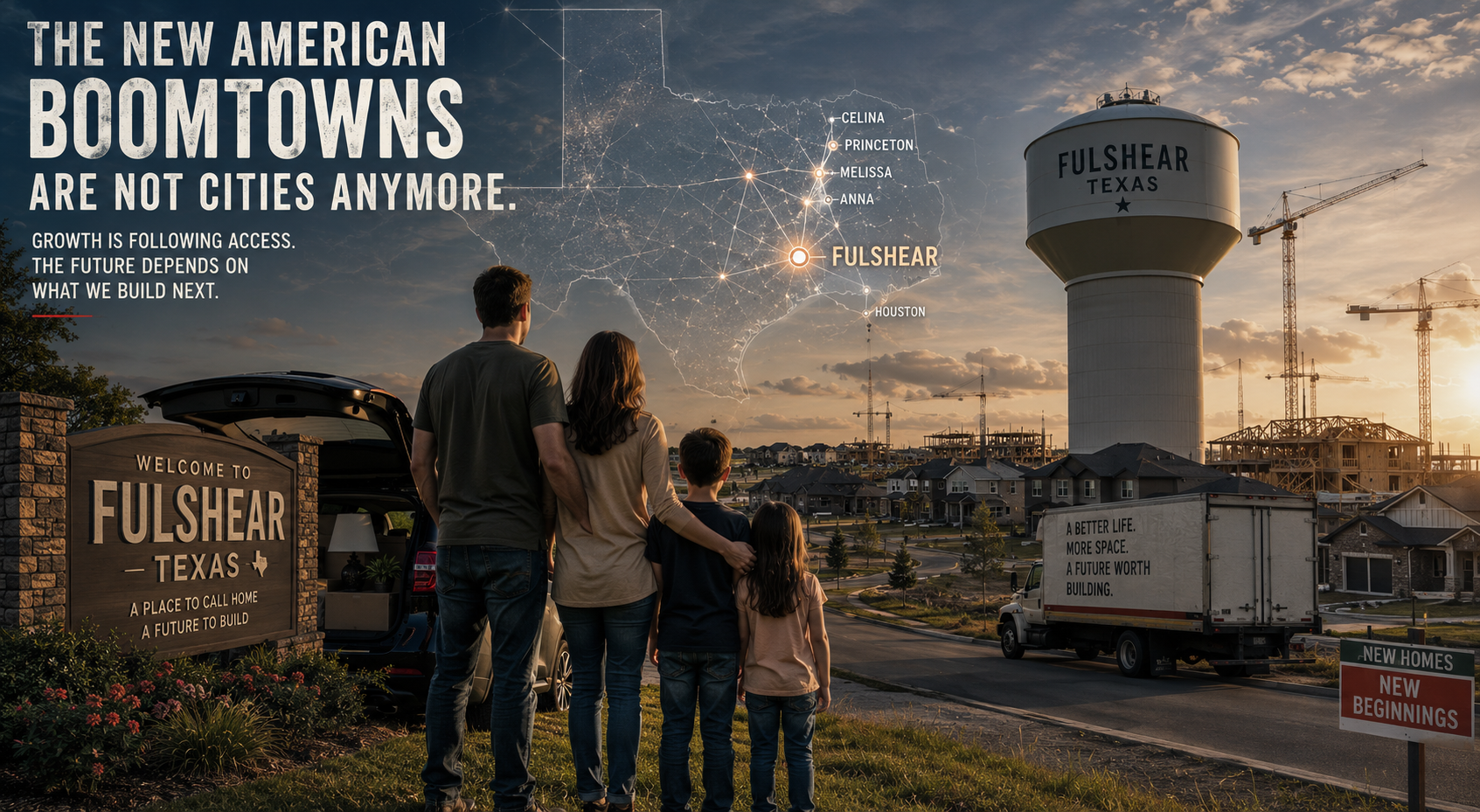
North Texas communities like Celina, Princeton, Melissa, and Anna also landed near the top of the national growth rankings, confirming that the center of American population expansion is no longer concentrated inside major urban cores. The growth story is now unfolding on the outer edges of metropolitan regions, where land is cheaper, homes are larger, and local governments are struggling to absorb the pace of migration fast enough to keep systems functional.
The numbers arriving out of Texas matter because they are reframing what Americans are actually chasing when they relocate. For years, cities marketed density, culture, walkability, and proximity as premium forms of modern life. But the post-pandemic economy shifted the equation. Mortgage rates remain elevated, median home prices in major urban centers continue to pressure middle-income earners, and hybrid work has weakened the requirement that workers remain geographically tethered to downtown business districts. In Houston specifically, population growth inside the city slowed dramatically this year, with the city adding only about 11,500 residents after adding more than 40,000 the year prior. The people did not stop coming to the region. They simply stopped choosing the urban core at the same rate. What looks like suburban growth is actually a redistribution of access.
The deeper structural shift underneath this migration pattern is financial rather than cultural. Americans are not suddenly abandoning cities because they dislike urban life. They are recalculating where stability still feels mathematically possible. In many metro areas, the cost of remaining close to economic opportunity has outpaced wage growth for years. The median price of a home in many desirable urban neighborhoods now requires household incomes that increasingly resemble upper-management salaries rather than middle-class earnings. Suburbs like Fulshear operate as pressure-release valves for people attempting to preserve ownership, space, school access, or family formation without exiting a regional economy entirely. What is happening in Texas resembles a quieter version of what happened historically around New York, Los Angeles, and Washington, D.C., except accelerated by remote work and digital labor flexibility.
The contradiction is that many of these fast-growing communities were never designed to absorb this level of expansion. Roads, drainage systems, schools, hospitals, utility infrastructure, and emergency services are now being forced to scale in real time. The same affordability drawing residents outward can quickly erode once infrastructure strain arrives. Houston’s outer-ring suburbs have already faced recurring concerns around traffic congestion, flood mitigation, school overcrowding, and rising insurance costs tied to climate exposure. Population growth is often discussed politically as proof of economic vitality, but growth without synchronized infrastructure investment can create a second-tier access crisis. The promise of affordability begins to collapse when commutes expand by hours, public services lag behind demand, and housing prices rapidly inflate in the very places marketed as alternatives.
There is also a labor story embedded inside this migration pattern that mainstream coverage often understates. Many of these communities are not generating enough high-paying jobs internally to match the incomes of incoming residents. Instead, they function as residential satellites connected economically to larger metropolitan labor markets. That means workers are carrying longer commutes, hybrid schedules, or fragmented professional routines to preserve affordability elsewhere. The result is a new geography of professional life where the workplace and the place people can actually afford to live are increasingly disconnected. In practice, this means many households are trading proximity for ownership and time for stability. The suburban expansion is not simply about where Americans want to live. It is about where they can still construct a future that feels materially sustainable.
Texas is becoming one of the clearest case studies for how population growth now follows perceived access rather than traditional prestige. For decades, major cities competed through image: skyline development, corporate recruitment, luxury housing, entertainment districts, and cultural capital. The new competition is more practical and more unforgiving. Families are evaluating school districts, property taxes, commute patterns, flood risk, insurance costs, and square footage with the intensity investors once reserved for financial portfolios. The migration patterns unfolding around Houston and Dallas suggest Americans are increasingly organizing their lives around risk management rather than aspiration. Even the phrase “cost of living” no longer fully captures what people are calculating. They are measuring the emotional cost of instability itself.
What is emerging across Texas is not anti-urbanism. It is a restructuring of how access gets distributed geographically in the modern economy. The boomtowns growing fastest are not replacing cities culturally or economically, but they are absorbing the people who feel increasingly priced out of participating fully inside them. That distinction matters. America’s next population map may not be defined by whether cities grow or shrink, but by whether ordinary workers can still afford to remain connected to the systems that generate opportunity in the first place.