
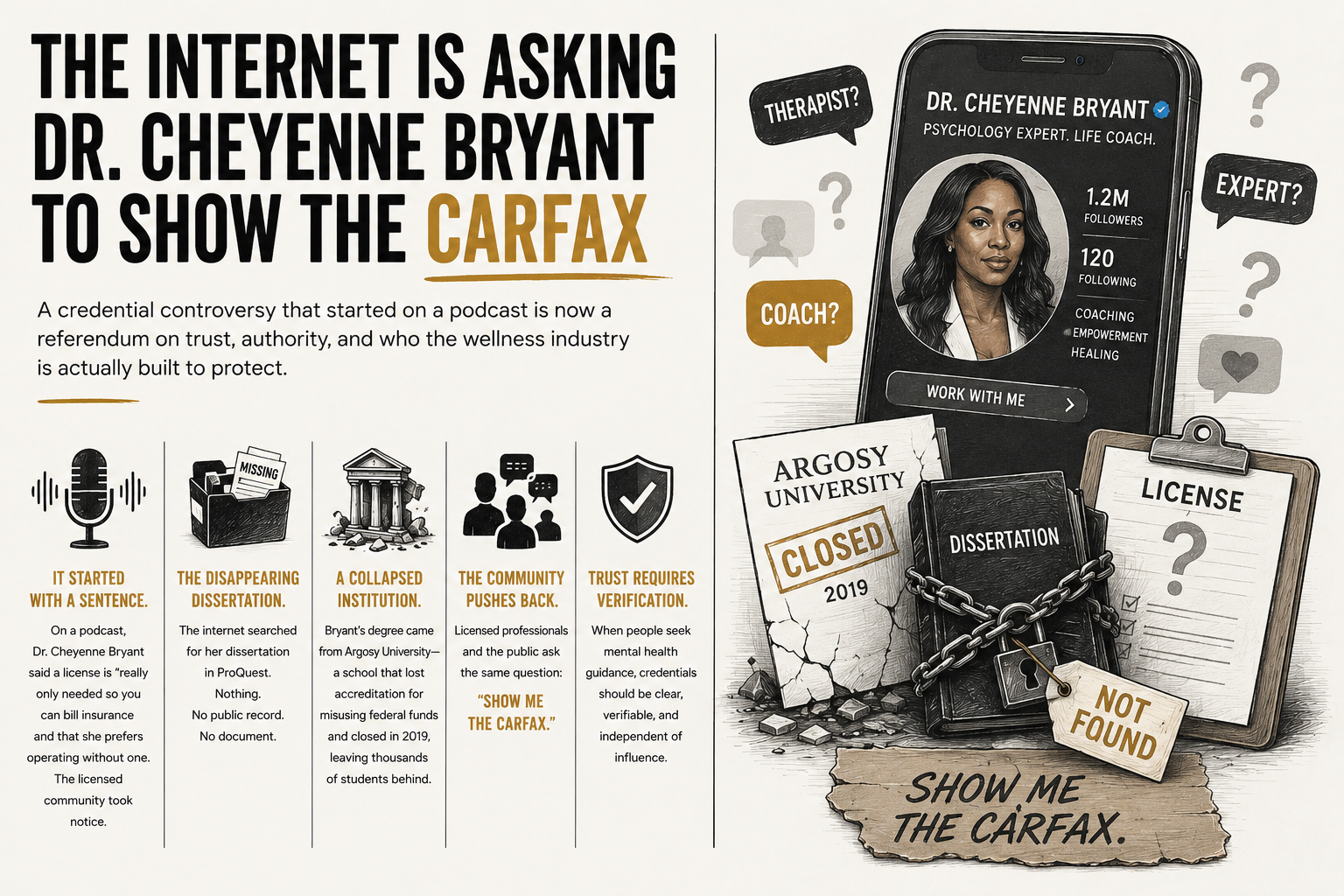
The moment that started everything was not a scandal in the traditional sense. It was a sentence.
During an appearance on The Joe Budden Podcast, Cheyenne Bryant — who has built a substantial public platform under the title “Dr. Cheyenne Bryant” — said plainly that a license is “really only needed so you can bill insurance” and that she prefers operating without one because she is “not bound by ethics boards and regulations.” The licensed mental health community heard that and reacted the way any professional community would when someone publicly dismantles the infrastructure that protects the people they serve. They started asking questions. And when the questions got specific enough, the answers got complicated.
The internet went looking for Bryant’s dissertation. A doctoral dissertation is not simply a university record. It is a public document, filed independently with ProQuest — the national dissertation database — regardless of what happens to the institution that granted the degree. You can lose a transcript. You cannot lose a dissertation the same way. When people searched, they found nothing publicly accessible.
Bryant’s explanation, delivered during a subsequent appearance on The Breakfast Club, introduced a detail that raised more questions than it resolved. She said she received her doctorate from Argosy University — and that when Argosy closed, the holder of records only maintained credentials for two years before that window expired. What Bryant did not address is that Argosy University’s collapse was not a quiet institutional transition. It was a documented federal failure. The Department of Education found that Argosy had misused student aid funds, redirecting money meant for students to cover operating expenses. The university lost its accreditation and shuttered in 2019, leaving thousands of students — many of them Black and brown graduate students who had taken on significant debt — without verified pathways to complete their degrees or recover their investments. Argosy is not simply a closed school. It is a cautionary tale about what happens when institutions serving underrepresented communities operate without adequate oversight.
That context matters here because Bryant is not simply defending a credential. She is explaining a gap using an institution whose own legitimacy was contested before it closed.
The Breakfast Club appearance did not resolve the debate. It amplified it. Licensed therapists and clinical psychologists began calling in and posting responses in real time — and the phrase that kept circulating across social media captured the community’s position with precision: show me the Carfax. It is the language of consumer protection applied to professional credentialing. Before you trust someone with your mental health, your trauma, your most vulnerable interior experiences — you should be able to verify what they are. The licensed community is not asking for perfection. They are asking for documentation that should exist independently of any university’s operational status.
Bryant has responded by repositioning her identity entirely. She now describes herself as a “Psychology Expert and Life Coach” and has maintained that her platforms never explicitly called her a therapist. That is a defensible technical argument. It is also a distinction that her audience — many of whom referred to her as their therapist, sought her guidance during personal crises, and trusted her with the kind of vulnerability that clinical ethics boards exist to protect — was not necessarily equipped to make on their own. Dr. Raquel Martin, a licensed clinical psychologist who has been vocal in her criticism, put it plainly: we give a lot of weight to social capital and follower counts, but celebrity and expertise do not always overlap. The confusion has become so widespread that even public figures like SZA have disclosed they believed they were seeing a therapist when they were actually working with a life coach.
That confusion is not accidental. It is structural. The wellness industrial complex has spent years collapsing the distance between clinical authority and lifestyle content — between the licensed professional bound by ethics codes and the coach whose entire value proposition is that they are not. Titles, aesthetics, language, and platform architecture all work together to create the impression of clinical legitimacy without the legal accountability that comes with it. For communities that have historically faced real barriers to licensed mental health care — communities where therapy was stigmatized, where providers were scarce, where cost made access nearly impossible — social media wellness figures filled a genuine gap. The problem is that filling a gap is not the same as closing it safely.
What makes the Cheyenne Bryant controversy something more than a credential dispute is what it reveals about the community that trusted her. Black audiences in particular have had complicated relationships with institutional mental health infrastructure — shaped by historical abuses, cultural stigma, provider shortages, and an insurance system that has never adequately covered mental health parity. In that environment, a Black woman with a doctorate title, a large platform, and the language of psychological expertise represented something meaningful. Not just content. Access. The feeling that someone who understood the specific texture of Black pain was also qualified to help navigate it.
That trust is not naive. It is the product of a system that failed to provide better options. And when that trust gets built on a foundation that cannot be verified, the damage does not stay contained to one person’s reputation. It spreads into the broader credibility of Black wellness professionals — the ones with the licenses, the supervised hours, the dissertations in ProQuest, the ethics board obligations — who now have to work harder to distinguish themselves from a category the internet has spent two weeks collapsing into suspicion.
The Carfax request is reasonable. Not because credentials are the only measure of someone’s ability to help people. But because in a space as high-stakes as mental health, the person sitting across from you — virtually or otherwise — should be able to tell you exactly who they are and prove it. The infrastructure that makes that possible exists for a reason. And operating outside it, while wearing the language of the profession it regulates, is not a technicality. It is a choice with consequences that extend well beyond the person making it.