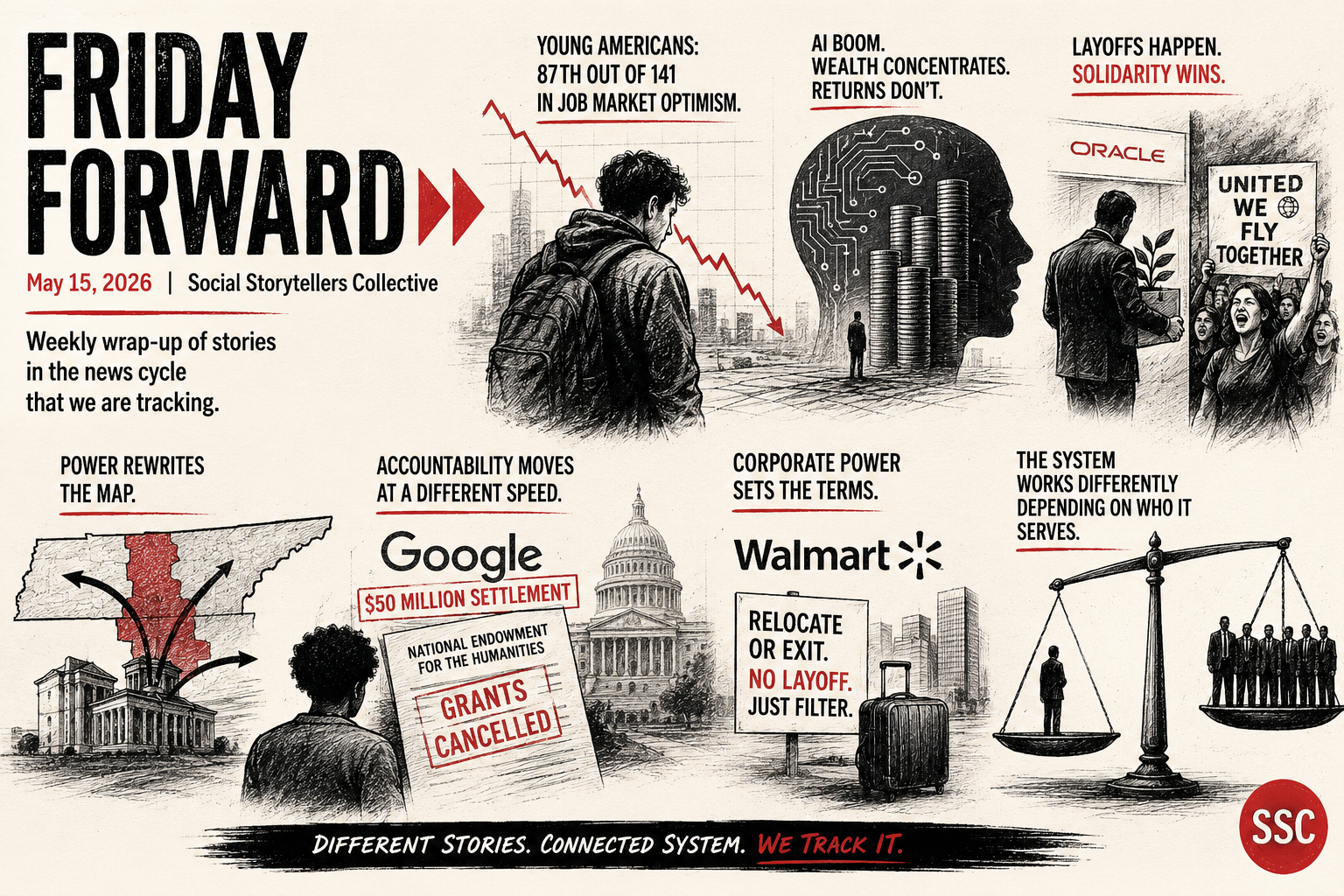
Friday Forward
May 15, 2026 | Social Storytellers Collective
What a week.
Not in the breathless way. In the way where you sit down Friday afternoon and realize everything that happened between Monday and now was actually the same story told twenty-four different ways. The economy is being restructured in real time. The people setting the terms are moving faster than anyone can negotiate, audit, or push back. And the people absorbing the disruption are doing so — largely — alone.
That was the week. Here’s how it actually went.
The Rollout Is Over. Now Comes the Hard Part.

Drake’s ninth studio album Iceman dropped today. The rollout is over. The music is now the only thing left to defend — and that transition is exactly what SSC has been tracking since before the campaign began. As documented in The Rollout Is the Story Now, the ICEMAN campaign restructured the album release itself around the logic of attention: a block of ice in downtown Toronto, a streamer retrieving a date from the melt, four episodic livestreams, a deliberate drip that made waiting into content. The campaign did exactly what it was designed to do. It centered Drake in conversation before the music had to defend anything. Now the music has arrived. What we’re watching is not whether the album is good. It is what the reception reveals about where hip-hop’s cultural authority actually sits in 2026. The Wall Street Journal framed Iceman as a referendum on rap’s commercial cold streak — whether one release could reset an industry that has been underperforming against its own expectations. The first 72 hours of streaming data, critical response, and social reaction will do more to shape Drake’s next three years than anything on the tracklist. SSC’s full breakdown is in Iceman Is Here. Now Comes the Hard Part.
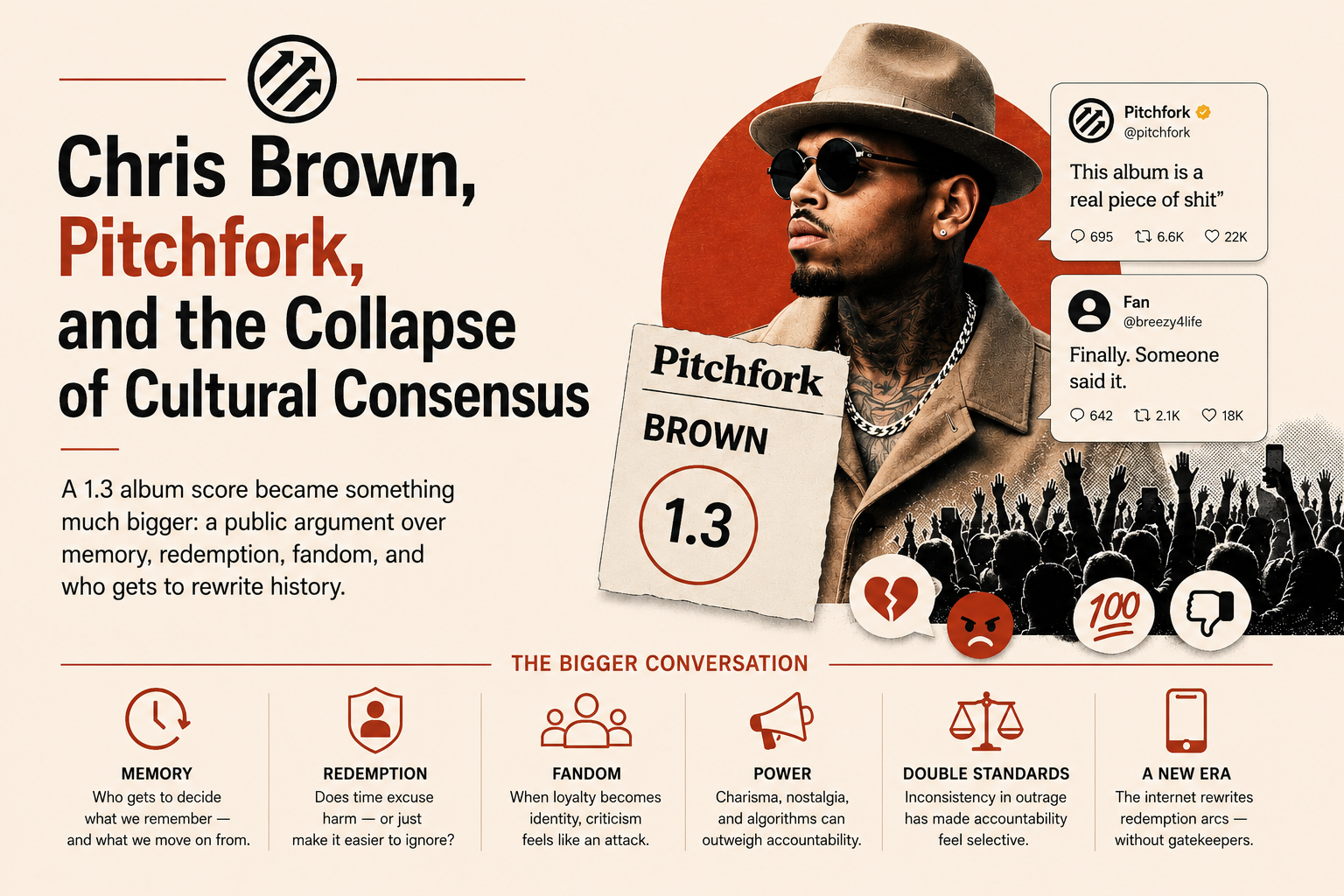
The music conversation didn’t stop with Drake. In Chris Brown, Pitchfork, and the Collapse of Cultural Consensus, SSC’s Will Davison examines how when Pitchfork gave Chris Brown’s BROWN a 1.3, the score traveled faster than the review — and then the publication posted to X calling the album a real piece of shit, pulling 1.6 million views by midday before escalating again, shifting what Pitchfork was doing from criticism into something closer to a campaign. What spread fastest on social media wasn’t the tweets themselves. It was the screenshots: Sexyy Red’s 8.0 for Hood Hottest Princess placed next to BROWN’s 1.3 — a comparison that stopped being about lyrical complexity almost immediately and became something larger, a proxy for a longer argument about whose culture gets taken seriously by institutions that still position themselves as arbiters of taste. SSC’s Leena Alridge takes the argument further in Music Criticism No Longer Feels Neutral — And the Internet Noticed, tracing how the internet has fundamentally restructured how public redemption operates — where gatekeepers once controlled rehabilitation arcs through magazine covers and institutional access, platforms now allow celebrities to bypass that mediation entirely, and fan communities themselves operate as reputational defense systems strong enough to outlast criticism cycles. Audiences noticed the difference between criticism and participation immediately. The publication did not seem to.
The Numbers Nobody Wants to Talk About
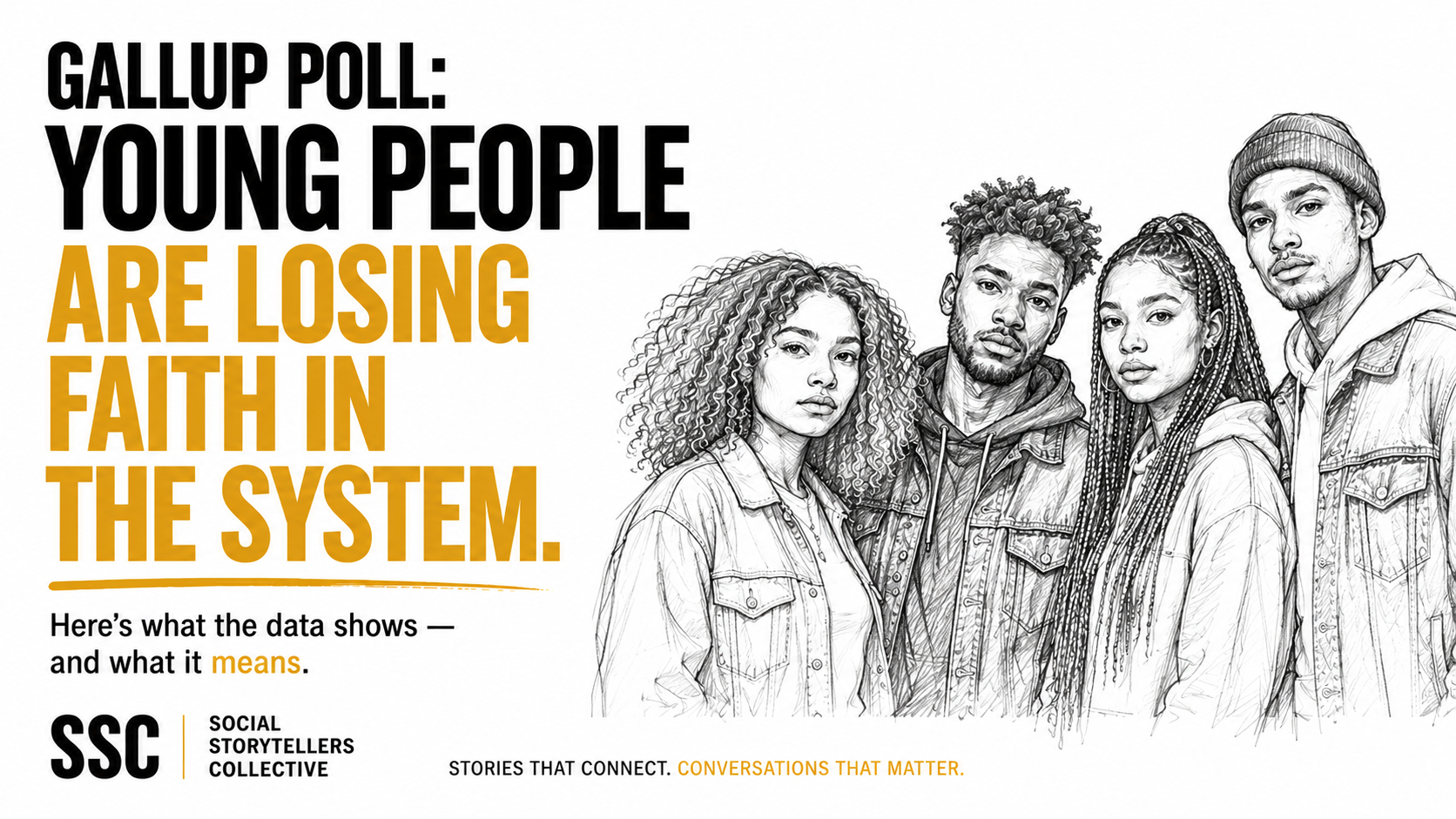
We started Monday with a number that reframes everything else: young Americans are 87th out of 141 countries in job market optimism — not because they’re soft, not because they lack ambition, but because they are the first generation actively trying to enter a labor market that is openly restructuring around their elimination. SSC examined the full picture in American Young People Aren’t Pessimistic. They’re Paying Attention. Gallup’s data showed the largest generational confidence gap of any country on earth. In most advanced economies, young adults are more optimistic than older ones. The US has inverted that entirely. The steepest pessimism sits among the most educated young Americans who haven’t yet found full-time work — the people who did everything right and found the rules had changed while they were studying for the test.
That pessimism makes more sense when you look at what the labor market is actually doing underneath the headline. In The Numbers Look Fine. That’s the Problem. SSC breaks down why the April jobs report — 115,000 jobs added, unemployment steady at 4.3% — looked fine on the surface while the U-6, the broader measure that captures discouraged workers and involuntary part-timers, sat at 8.2%, nearly twice the headline figure. The people who feel left behind by a strong jobs report are not misreading the data. They are reading the part of it that was never designed to be seen. And underneath that, Black unemployment hit 7.6% in Q1 — not because of a broad downturn, but because of federal workforce reductions, DEI rollbacks, and contracting changes that concentrated job loss in specific communities while the headline rate barely moved.
The AI Money Is Already Gone
The AI story this week was not about technology. It was about money — and who is capturing it. In America Thinks It’s Winning the AI Race. It’s Ranked 21st. SSC examines how America ranked 21st in AI adoption at 31.3% while the UAE led the world at 70.1%. The country that built the most powerful AI systems in the world is not leading their deployment. Meanwhile Anthropic is racing toward a $900 billion valuation — and the 1,500 employees generating that revenue are on four-year vest schedules while institutional investors hold preferred stock in a far more protected position. The valuation tripled in three months. The gains concentrated at the top.
OpenAI made it even more explicit. In Even the Companies Building AI Are Starting to Publicly Warn About the Labor Impact, SSC documents how more than 600 employees cashed out $6.6 billion during October’s financing round — 75 people took the maximum $30 million each — while 84% of companies haven’t yet redesigned roles around AI. The wealth is concentrating inside the cap table long before the public gets access. And here’s the part that should stop everyone citing AI as the reason for their layoffs: 95% of corporate AI investments have not delivered expected returns. The workers are already gone. The efficiency gains used to justify the cuts have not arrived at the scale or timeline being used to announce them. The cuts are real. The returns are still theoretical.
Alone vs. Together: The Labor Stories That Explain Everything
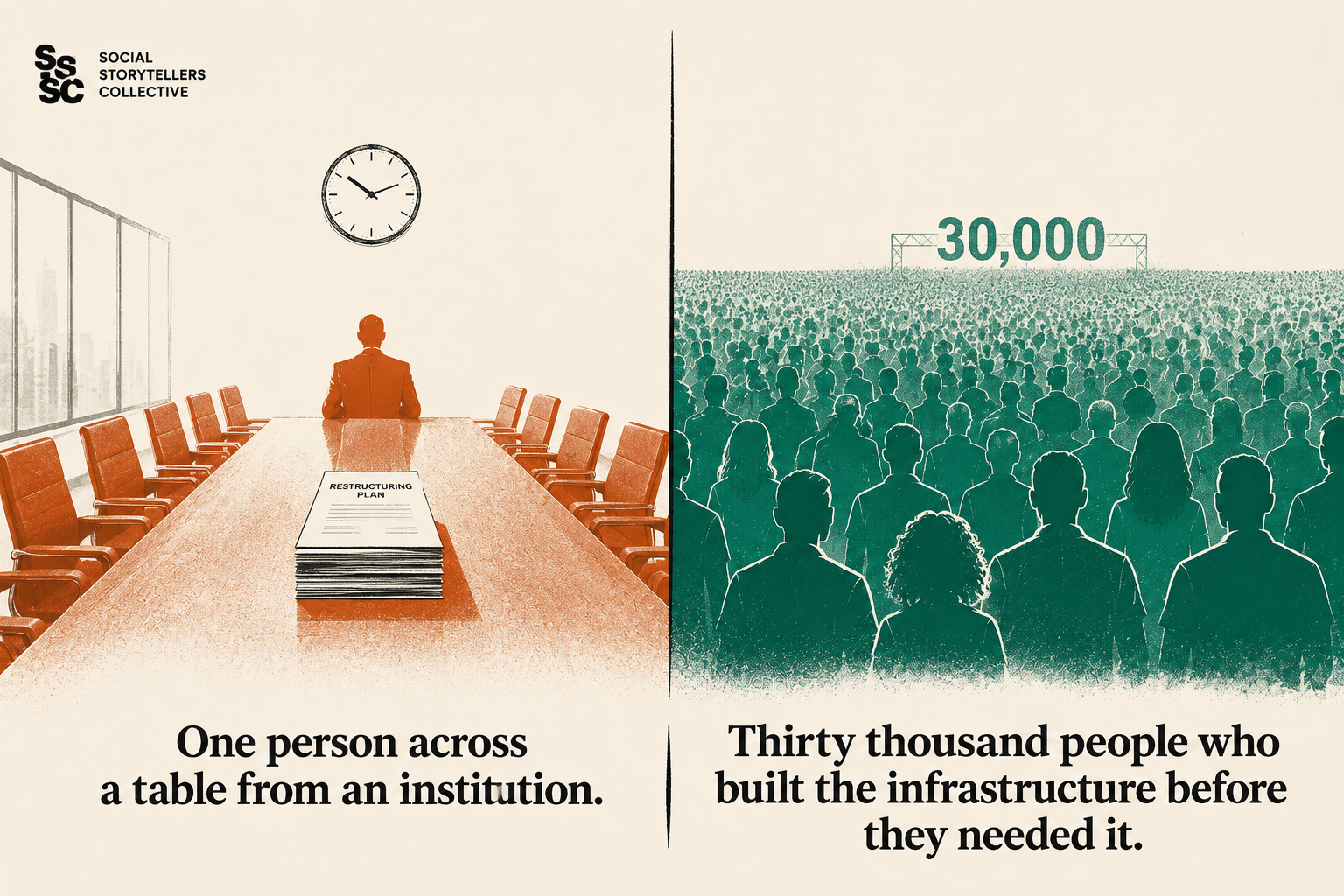
The labor stories this week belong next to each other — because the contrast is the argument. In Oracle Workers Tried to Negotiate. United Flight Attendants Just Won. The Difference Is One Word: Together. SSC tracks how Oracle cut between 20,000 and 30,000 workers globally while several tried to negotiate — for stronger severance, for unvested stock, for WARN Act clarity. Oracle declined across the board. One worker forfeited approximately $1 million in stock that was months from vesting. The negotiations failed not because workers asked for too much. They failed because they asked alone. In the same week, 30,000 United Airlines flight attendants ratified a new contract approved by 82% of union voters — $741 million in back pay, a 31% pay increase, and pay for boarding time, something the industry had resisted for decades. Same economy. Same week. Opposite outcomes. The variable that explains the gap is not industry or company size or the reasonableness of the ask. It is whether the workers asking were alone or together.
Walmart generated $680 billion in revenue last year and is asking roughly 1,000 corporate employees to relocate to Bentonville, Arkansas, or Sunnyvale, California — or exit quietly. SSC examined the mechanics in Walmart Is Not Calling It a Layoff. It Is a Layoff. Relocation requirements are not logistical. They are a filtering mechanism. The employees who can’t move — because of family, cost, caregiving — exit voluntarily. The company reduces headcount without calling it a layoff. The people who stay are the people the company chose. The people who leave are the ones the requirement was designed to remove.

The pattern kept repeating. As SSC reported in LinkedIn Is Cutting 1,000 Jobs. Its Revenue Just Hit a Record High. — LinkedIn cut approximately 5% of its global workforce, roughly 1,000 positions across engineering, product, and marketing, on the same day parent company Microsoft reported LinkedIn crossed $5 billion in quarterly revenue for the first time, with annual growth accelerating to 12% year-over-year. The platform where people publicly process layoffs and celebrate new roles is quietly executing its own. And in Cisco Announces Layoffs on the Same Day It Posts Its Best Quarter in Years — Cisco cut nearly 4,000 people on the same day it posted $15.84 billion in quarterly revenue, beating Wall Street expectations, and projected as much as $16.9 billion for next quarter. Oracle. LinkedIn. Cisco. The message from Big Tech in 2026 is consistent: the numbers have never been better, and that’s exactly why we can afford to do this. The tech sector has now shed more than 100,000 jobs this year — roughly 880 every single day.
Power Moves Without Permission
The power stories this week had a common architecture: institutions moving faster than accountability. SSC covered the full scope in They Drew the Map, Then They Erased the People — Tennessee’s Republican supermajority erased the state’s only majority-Black congressional district in 48 hours, carving up majority-Black Memphis into three rural Republican districts. The NAACP filed an emergency lawsuit within three hours of the governor’s signature. A federal judge ruled the same week that DOGE used keyword filtering to eliminate NEH grants — targeting Black history, Holocaust testimony, Jewish women, Asian American experiences, Native communities, and women-focused scholarship. The map was redrawn in Nashville. The grants were filtered in Washington. The architecture is the same.
Google settled a racial discrimination lawsuit for $50 million — at a company that generated more than $350 billion in revenue last year. SSC’s analysis in Google Agrees to $50 Million Settlement in Racial Discrimination Lawsuit makes the case that the number is not the story. The lawsuit centered not on isolated incidents but on patterns — compensation structures, promotion pathways, evaluation systems that reproduced existing gaps. The settlement resolves the legal claim. It does not touch the system. You can settle a claim. You cannot settle a system.
And then there’s the $1 billion ballroom. In The White House Wants a Billion-Dollar Ballroom While the Economy Hollows Out, SSC frames what the proposal actually is — not a modernization effort, but a values statement rendered in concrete and square footage. Housing relief is infrastructure. Wage floors are infrastructure. Accessible healthcare is infrastructure. A ballroom is a room where people who already have power gather to confirm that they still have it.
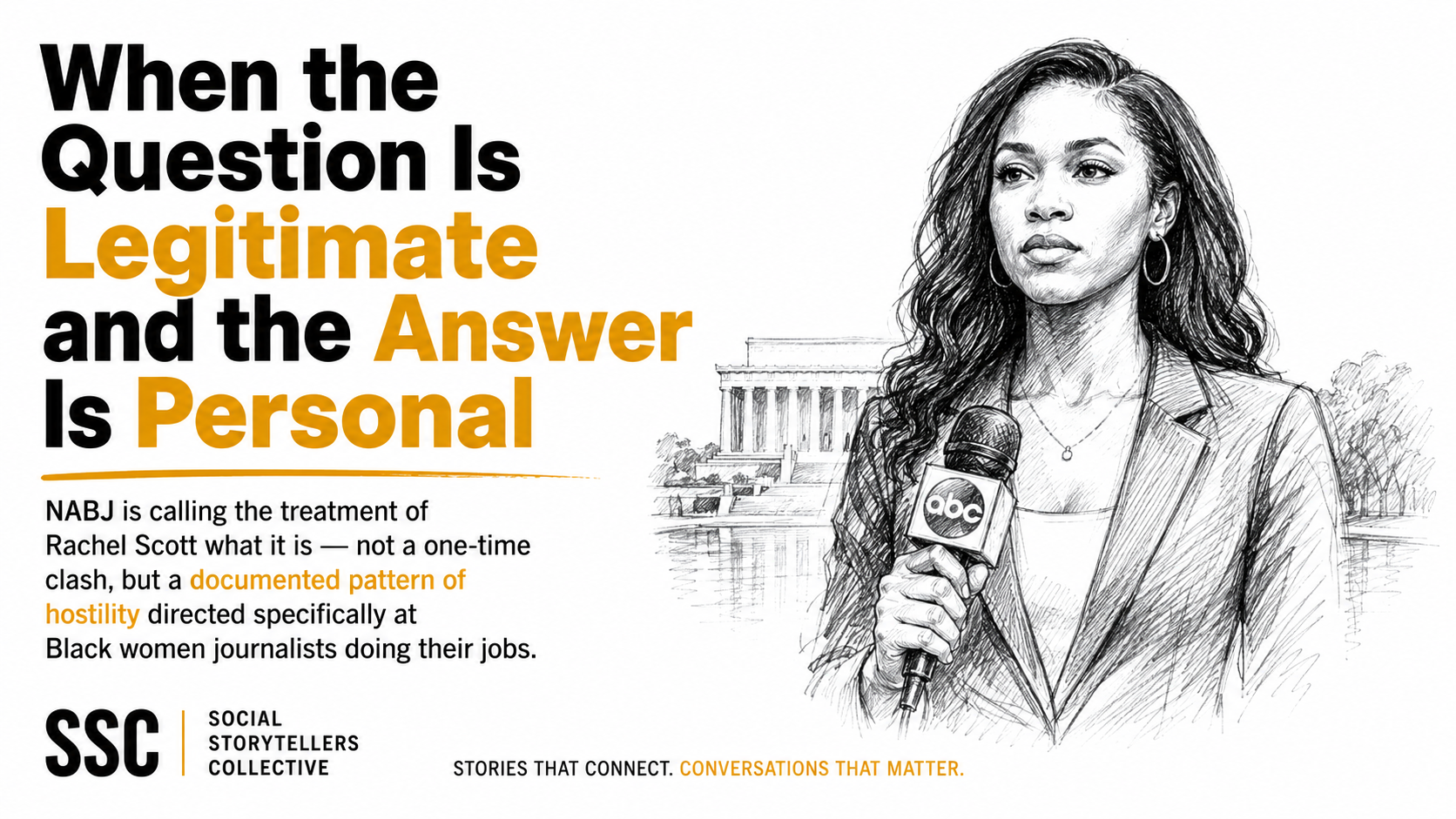
The week’s sharpest accountability story came from a press conference. In When the Question Is Legitimate and the Answer Is Personal, SSC places the moment inside a longer pattern — Rachel Scott, ABC News Senior Congressional Correspondent, asked President Trump why he was focused on Washington construction projects during the Iran war. He called her “a horror show,” told her she “can understand dirt,” and turned construction workers into his audience for a public attack on a 33-year-old reporter doing her job. NABJ responded immediately, placing the exchange inside a documented pattern: April Ryan. Yamiche Alcindor. Jemele Hill. Jasmine Wright. The attacks are not responses to inaccurate reporting. They are responses to questions. The question Rachel Scott asked is still unanswered. That too is part of the pattern.
The Culture Had Notes
Kevin Hart has 100 million followers and a company once valued at $650 million — and this week reports emerged of layoffs, stalled productions, and internal tension at HartBeat Productions. SSC examined what it actually signals in The HartBeat Stress Test. The piece is not really about Kevin Hart. It’s about the celebrity entrepreneur model reaching its stress test in a cooling entertainment economy. Ryan Reynolds structured his exit before the scaling pressure arrived. Jay-Z handed complexity to LVMH. Rihanna’s Fenty worked because institutional infrastructure ran underneath it. The celebrities who built lasting enterprises understood early that visibility and operational durability are not the same thing.
Byron Allen acquired 52% of BuzzFeed for $120 million — the same week NABJ had to issue a public statement reminding the country that Black women journalists deserve to do their jobs without being publicly humiliated for asking legitimate questions. SSC’s full analysis is in The Room Where It Happens: Byron Allen, the AJC, and Who Actually Controls American Media. Who owns the infrastructure that shapes American media coverage determines what gets covered, whose stories get resources, and whose journalists get protected. Byron Allen just changed the composition of that answer.
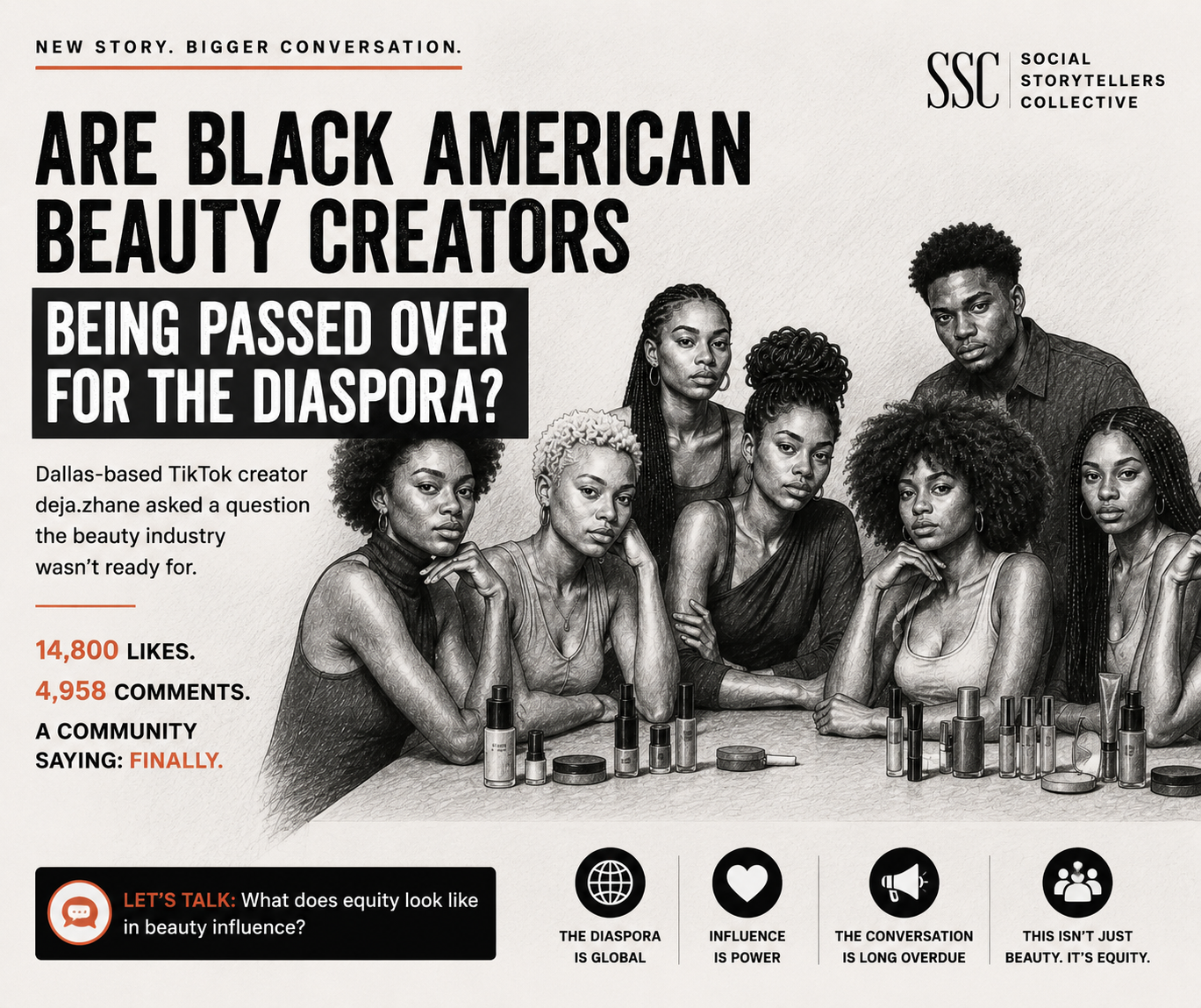
Dallas-based TikTok creator deja.zhane asked a question the beauty industry wasn’t ready for — why do brand deals, campaign placements, and creator economy dollars consistently bypass the community whose $9.4 billion in annual beauty spending built the market in the first place? The video got 14,800 likes and nearly 5,000 comments. SSC covers it in Are Black American Beauty Creators Being Passed Over for the Diaspora? Not because she started a fight. Because she named something creators had been calculating quietly for years.
IShowSpeed went to the Dominican Republic to make content. The internet turned it into a referendum on race, diaspora politics, and anti-Blackness. SSC examined what the moment revealed in When the Stream Becomes the Story: IShowSpeed, the Dominican Republic, and What the Internet Did Next. The Dominican Republic simultaneously exports globally recognized Black cultural influence while facing sustained scrutiny over racial politics internally. That contradiction is why a single livestream became a symbolic debate larger than the creator himself. The stream ended. The conversation it activated did not.
And a viral Red Media clip asked why so much cultural energy gets spent debating LGBTQ visibility in Black spaces while far less attention goes to the systems that have spent decades narrowing acceptable versions of Black manhood down to rapper, athlete, drug dealer, or entertainer. SSC unpacks the full argument in The Loudest Debates in Black Cultural Spaces Are Rarely About What They Appear to Be About. Who benefits when Black boys grow up believing their value comes primarily from dominance, entertainment, or survival performance? The platforms are deciding what gets amplified — and that decision is never neutral.
Before You Go
Before we get to the closer — one story for every parent who needed it this week. Derick Hall was born at 23 weeks without a heartbeat — given a 1% chance of survival. His mother Stacy Gooden-Crandle was handed a do-not-resuscitate form in a Gulfport, Mississippi NICU. She refused to sign it. SSC has the full story in The 1% Chance. Twenty-five years later she was on the Super Bowl field watching her son hold the Vince Lombardi Trophy. This one is for every parent who ever decided their child’s story wasn’t over.
Friday Closer
There are currently 7.37 million Americans officially unemployed. The broader figure — the one that captures discouraged workers and people stuck in involuntary part-time work — sits closer to 13.9 million. The technology sector alone has shed 128,270 jobs so far in 2026. Roughly 1,000 workers every single day. SSC named what that actually feels like in The Weight Nobody Talks About.
This piece is not about the data. It is about what sustained uncertainty actually does to a human nervous system. The 10 o’clock feeling — waking up with nowhere to go. The loop that runs at 2am when the thoughts come loudest. The performance of okayness in public while carrying the weight privately. The way the people who love you don’t know what to say so they offer advice instead, and you smile and say thank you and feel more alone than you did before the conversation started.
Private weight, carried alone, compounds.
If this is where you are right now — this piece was written for you. Not to fix it. Not to reframe it as an opportunity. Just to name it. Because what you are experiencing has a name. It is not weakness. It is what sustained uncertainty does to a human nervous system that was designed for shorter-term threats with clearer resolutions.
The silence is not permanent. Even when it feels structural. Even when it has been going on long enough that you have started to forget what the other side felt like.
You are still in the room. That matters more than you know right now.
That’s the week. See you Monday.
— SSC
Subscribe to the SSC End of Day Closing Note — daily analysis at 3PM, every weekday. socialstorytellers.substack.com
Join SSC Systems & Signals — our private LinkedIn group for deeper conversation. linkedin.com/groups/20390015