
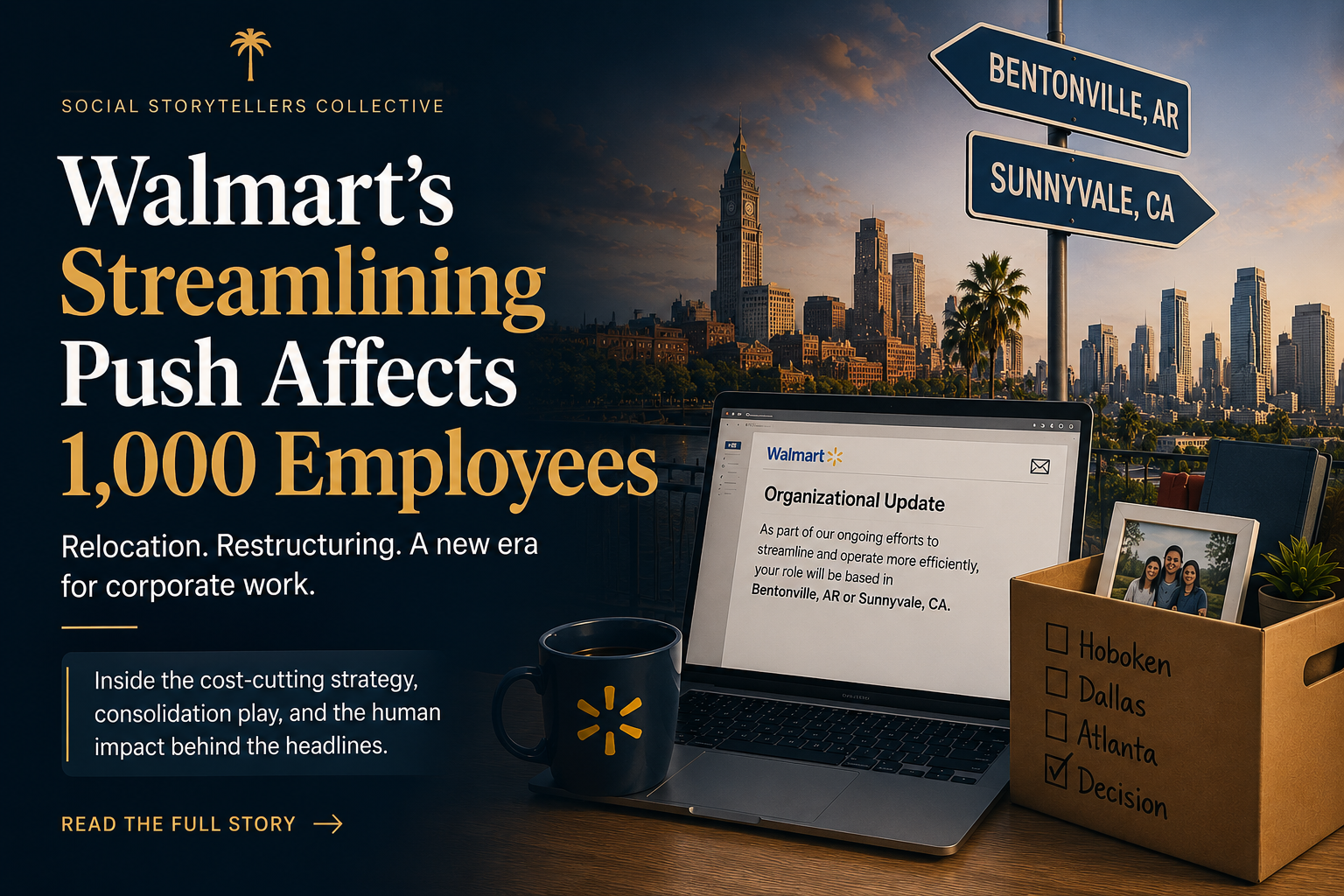
Somewhere in Hoboken, Dallas, or Atlanta, a Walmart product manager opened an email this week and learned their job still exists — in Bentonville, Arkansas, or Sunnyvale, California. They have a choice: uproot their family, absorb the cost of relocating to one of the most expensive zip codes in the country, or exit quietly. Walmart calls it streamlining. The people absorbing it will call it something else.
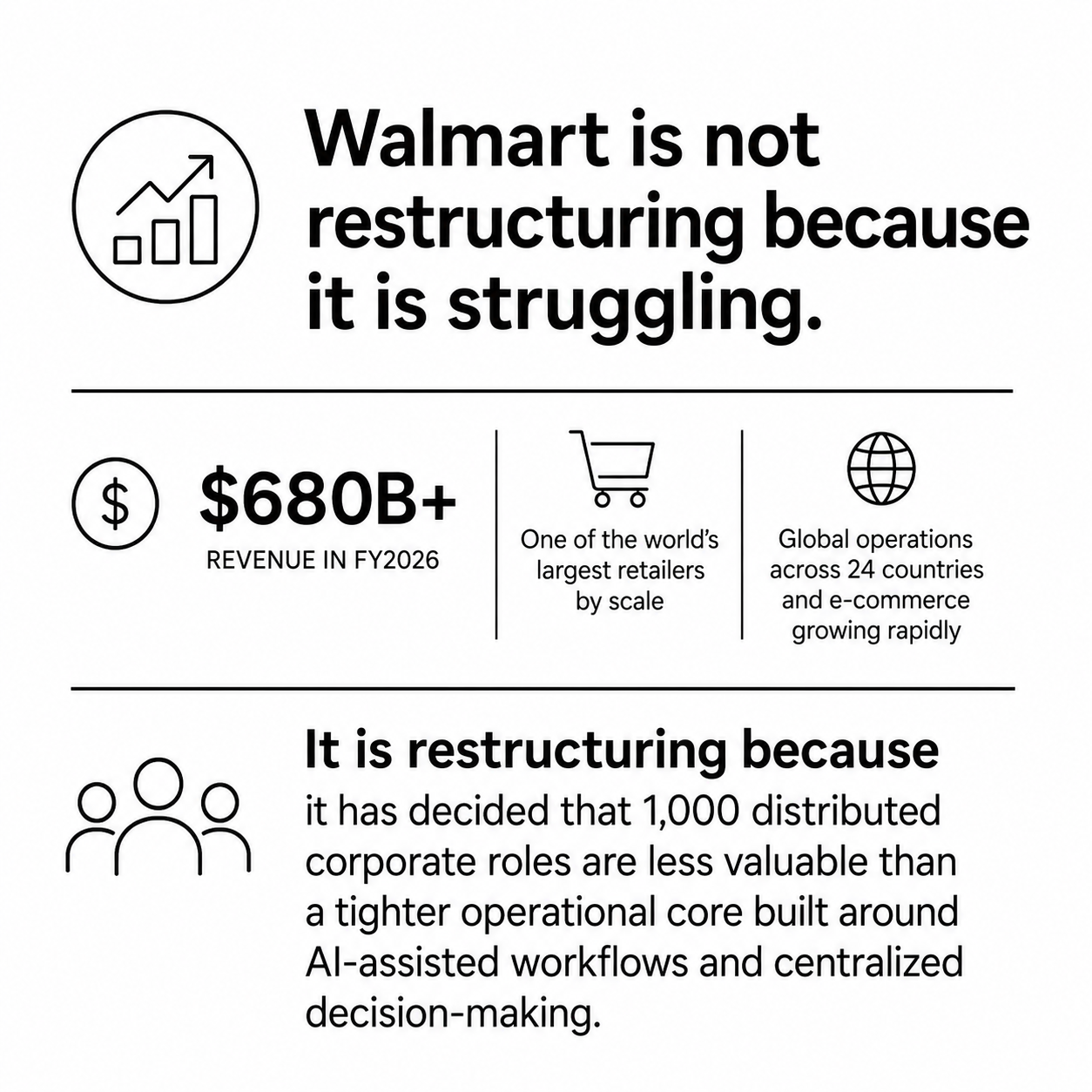
The retailer generated more than $680 billion in revenue in fiscal year 2026. It is not restructuring because it is struggling. It is restructuring because it has decided that 1,000 distributed corporate roles are less valuable than a tighter operational core built around AI-assisted workflows and centralized decision-making. The geography of employment is quietly becoming part of workforce risk assessment — and Walmart just made that calculus visible.
The changes follow an internal operational review led by Walmart U.S. Chief Technology Officer and Chief Development Officer Suresh Kumar — one of the key architects behind the company’s aggressive modernization strategy. Employees affected are being encouraged to relocate to Walmart’s core hubs in Bentonville or Sunnyvale. That geographic consolidation says as much about power as it does about efficiency.
Relocation requirements are not simply logistical. They operate as a filtering mechanism. Employees who cannot uproot families, absorb higher living costs, or reorganize caregiving responsibilities often exit voluntarily — allowing corporations to reduce headcount without framing the move exclusively as a layoff strategy. The language of streamlining consistently obscures how often these restructurings are also exercises in workforce selection. The people who stay are the people the company chose. The people who leave are the ones the relocation requirement was designed to remove.
The contradiction is that many of the same companies demanding physical consolidation spent years promoting remote flexibility as a defining feature of modern work. During the pandemic-era expansion cycle, corporations aggressively hired distributed talent, expanded virtual collaboration systems, and publicly framed location independence as evidence of innovation. Now many executives view centralized proximity as more valuable again — particularly as AI tools reduce the coordination labor previously required across distributed teams.
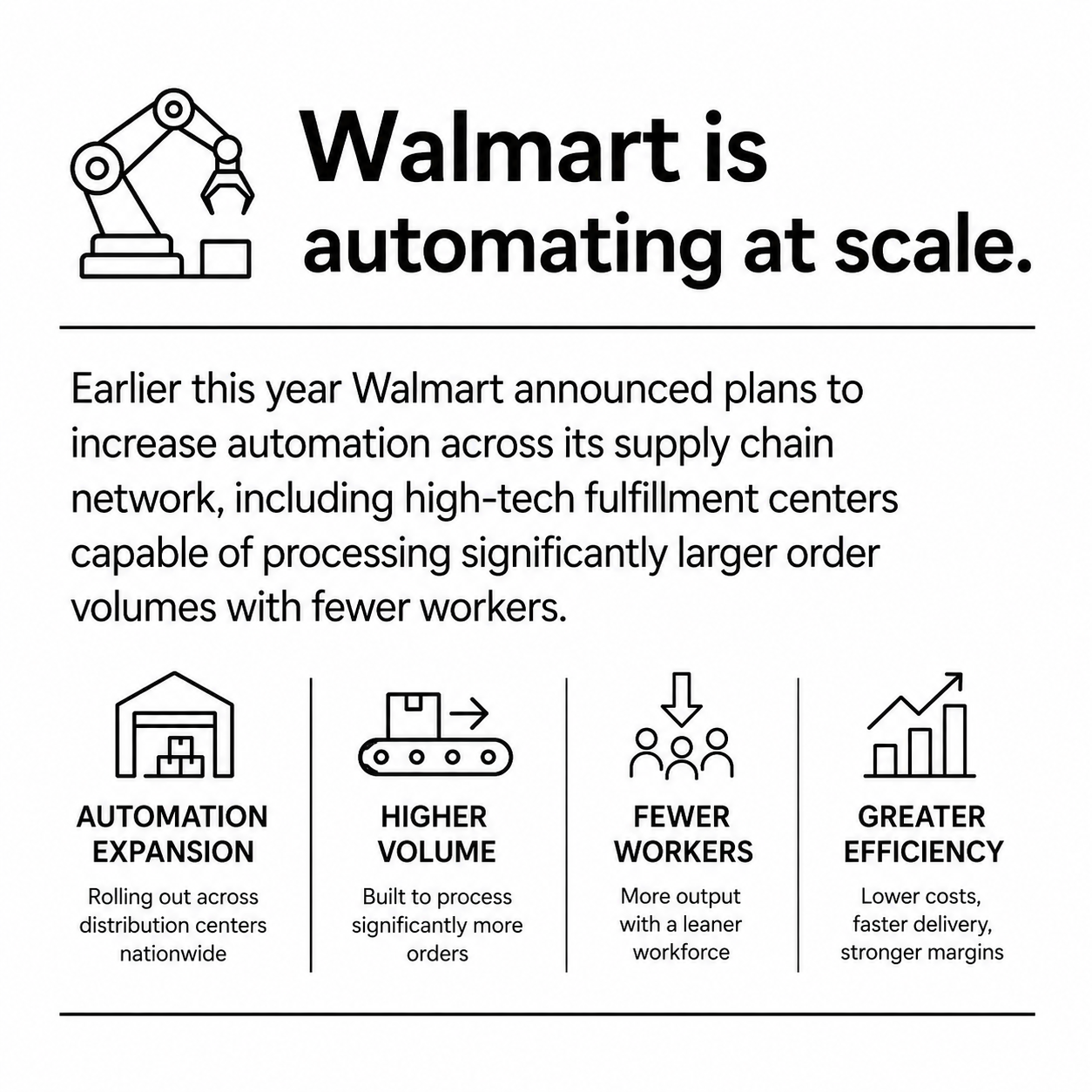
Earlier this year Walmart announced plans to increase automation across its supply chain network, including high-tech fulfillment centers capable of processing significantly larger order volumes with fewer workers. Its technology division has been repositioned not as a support function but as a core operational engine. The company is not building more people into that engine. It is building fewer — and expecting them to run more.
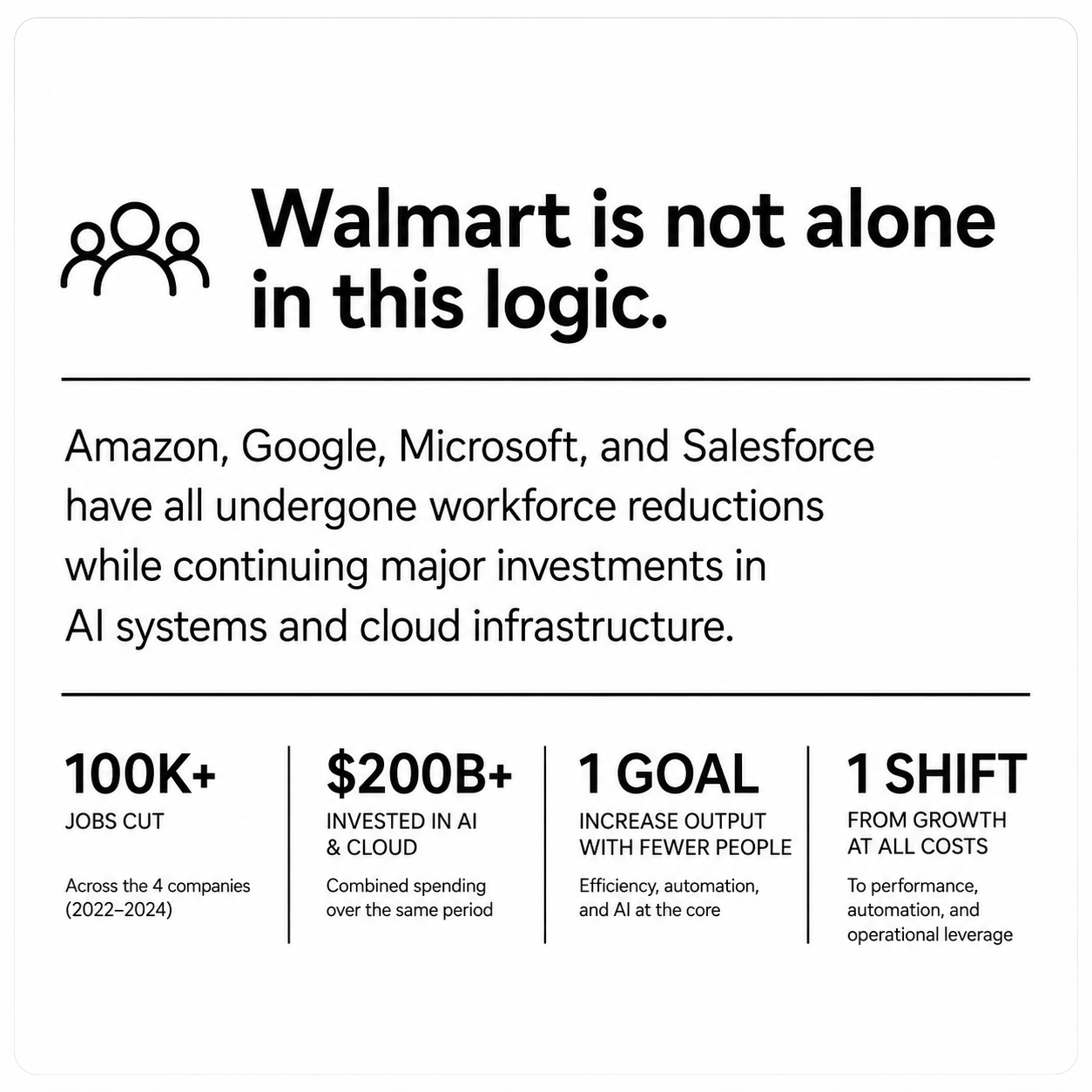
Walmart is not alone in this logic. Amazon, Google, Microsoft, and Salesforce have all undergone workforce reductions while continuing major investments in AI systems and cloud infrastructure. The workforce reductions are not occurring instead of technology spending. They are occurring alongside it. Across industries, companies are investing heavily in AI infrastructure while simultaneously narrowing the number of workers needed to execute routine operational tasks.
For decades, companies like Walmart symbolized institutional permanence — not just because of their market dominance, but because they offered scalable career ladders for both hourly and professional workers. That psychological contract is weakening in real time. A product manager in Hoboken, a software engineer in Dallas, and a logistics analyst in Atlanta can all produce measurable results and still find themselves structurally vulnerable if their role no longer aligns with where executives want power, data, and operational control concentrated.
What mainstream coverage consistently misses is that these restructurings are not isolated labor stories. They are infrastructure stories. Corporations are redesigning themselves around faster decision-making, tighter operational cores, and AI-enhanced productivity models that reward concentration over distribution.
Walmart’s reported changes are less about 1,000 jobs than about the emerging corporate assumption underneath them: the future workforce will be smaller, more centralized, more technologically leveraged, and expected to produce more output with less institutional permanence in return.
The streamlining is not the story. The model it reveals is.