In most countries, young people are more optimistic about the job market than older people. That is the global norm — youth carries confidence, older workers carry caution, and the data reflects that pattern consistently across advanced economies.
The United States has inverted it entirely.
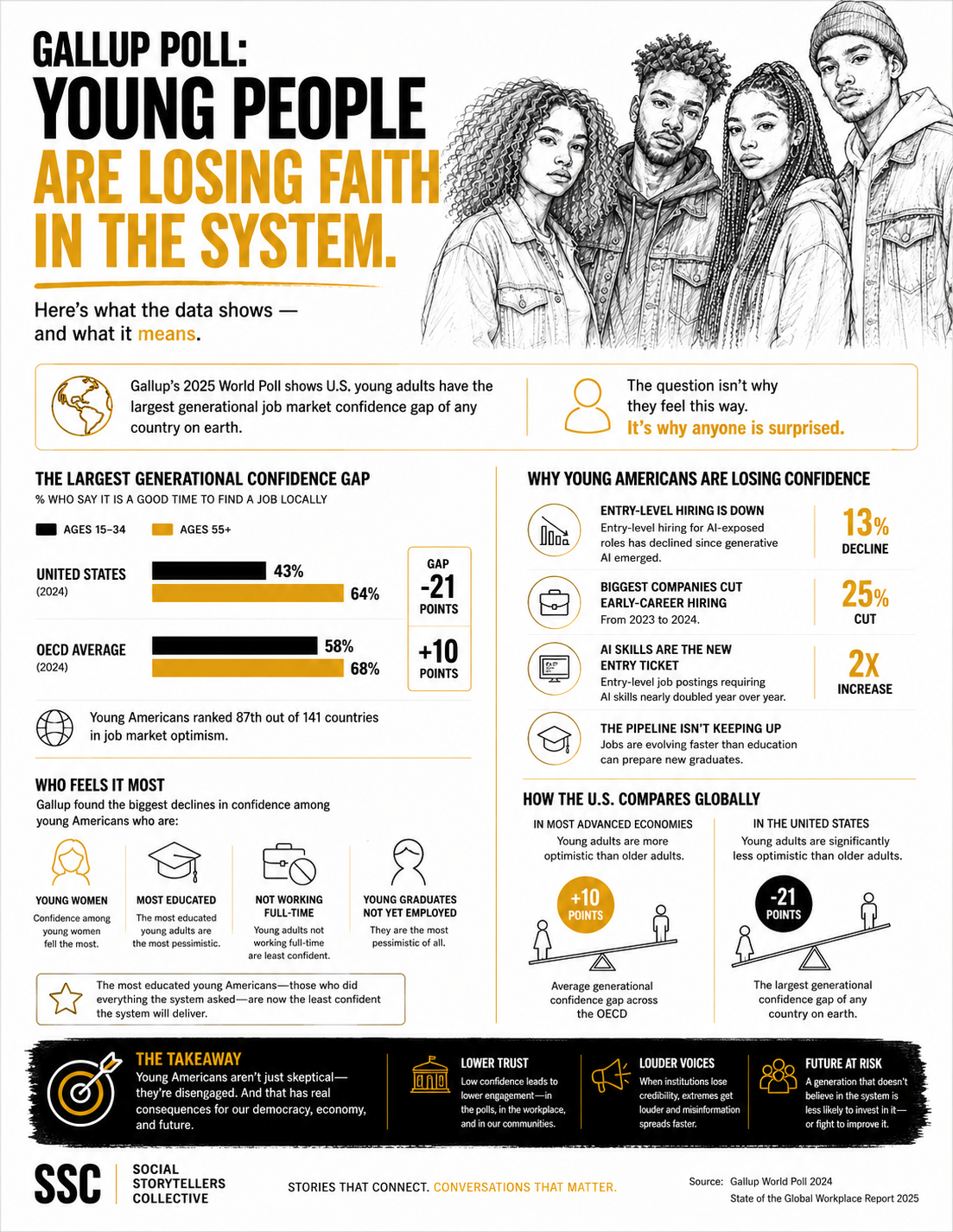
According to Gallup’s 2025 World Poll — released this week as part of the State of the Global Workplace Report — only 43% of Americans aged 15 to 34 said it was a good time to find a job locally last year. That is 21 percentage points lower than Americans aged 55 and older. It is the largest generational gap of any country on earth. It is the first time on record, outside of 2020, that US young adults have fallen below the median for other advanced economies in job market optimism. And it represents a 27-point decline since 2023 — a collapse in confidence that rivals the drop young Americans experienced during the 2008 global financial crisis.
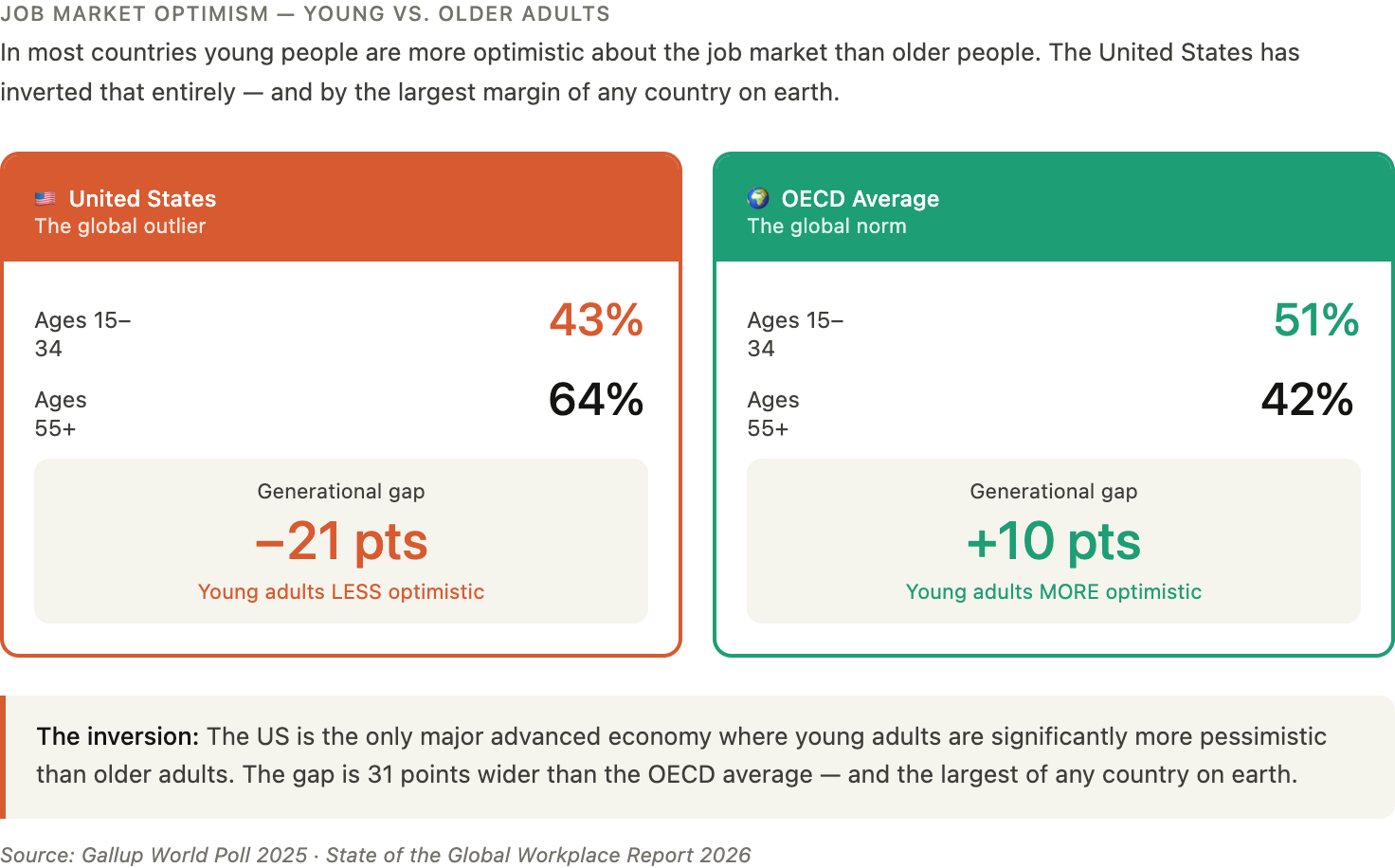
Young Americans ranked 87th out of 141 countries in job market optimism last year.
The instinct in most coverage will be to treat this as a sentiment story — young people feeling bad, generational anxiety, the psychology of uncertainty. That framing is not wrong. It is incomplete. What Gallup is measuring is not a mood. It is a perception of reality that the labor market data is increasingly validating.
What young Americans are actually seeing
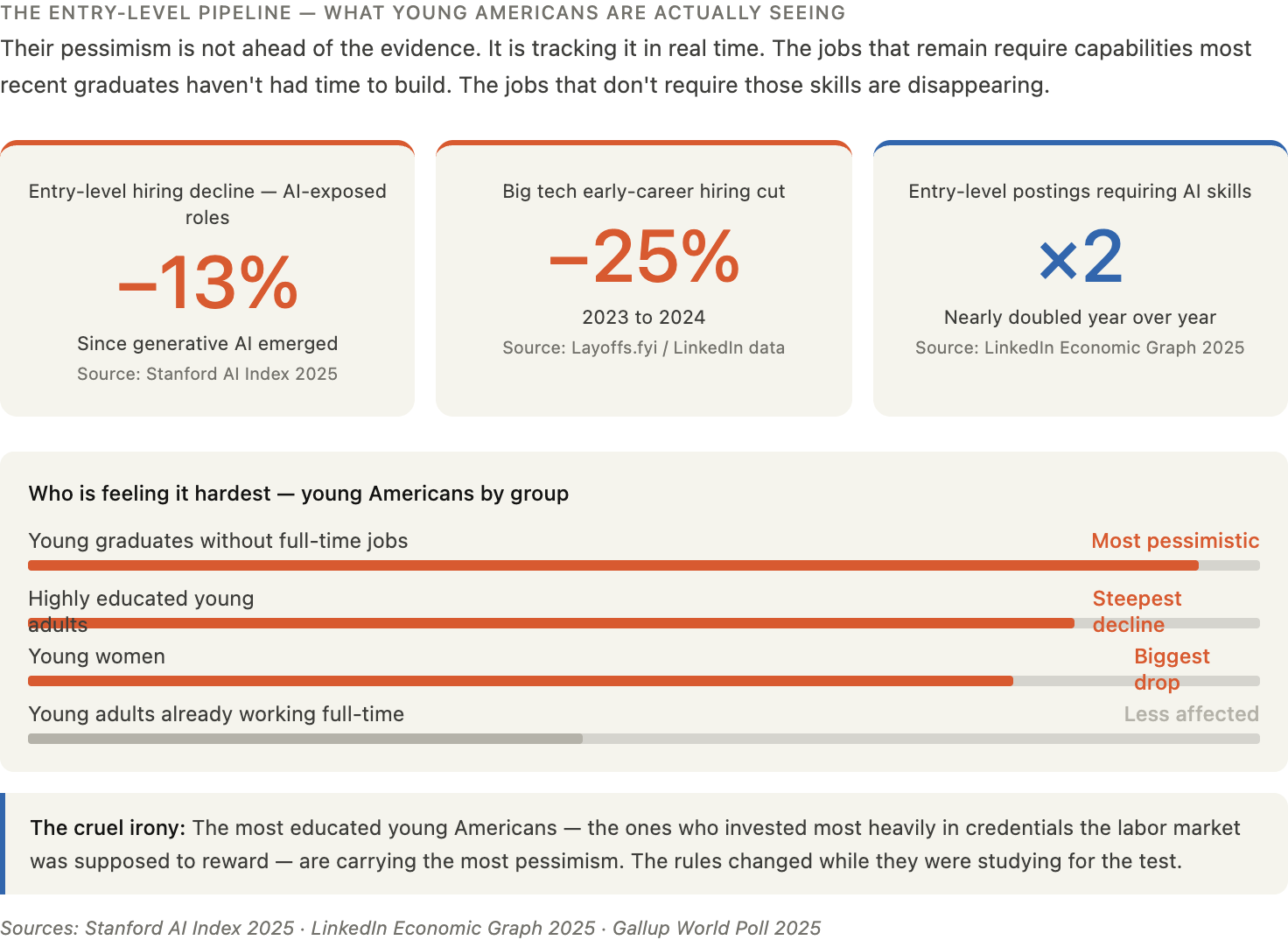
The steepest pessimism is concentrated among highly educated young Americans not yet working full-time — the group most actively trying to enter the labor market and most directly experiencing what the entry-level pipeline actually looks like right now.
That pipeline is contracting. Stanford research confirms a 13% decline in entry-level hiring for AI-exposed roles since generative AI emerged. The biggest tech firms cut early-career hiring by 25% from 2023 to 2024. Entry-level postings calling for AI skills nearly doubled year over year — meaning the jobs that remain require capabilities most recent graduates have not yet had the opportunity to build. The jobs that don’t require those skills are disappearing. The jobs that do require them are arriving faster than the educational infrastructure can produce qualified candidates.
Young Americans entering the workforce in 2025 and 2026 are doing so at the precise moment when the receiving categories — the entry-level roles that have historically absorbed new graduates — are being restructured around their elimination. Their pessimism is not ahead of the evidence. It is tracking it in real time.
Why the generational gap is the story
What makes the US data genuinely anomalous is not that young Americans are pessimistic. It is that older Americans are not — and the distance between those two perceptions is larger here than anywhere else on earth.
Americans aged 55 and older — many of them no longer actively in the workforce — remain relatively upbeat about local job conditions. They are measuring a labor market they largely experienced during a different era: one where entry-level roles were stable, where credentials reliably translated into employment, where the relationship between education and economic mobility was more predictable than it is today. Their optimism is not delusional. It is historical. It reflects a labor market that existed and that they navigated successfully.
Young Americans are measuring the labor market that actually exists right now. The gap between those two assessments — 21 percentage points — is the distance between the economy older Americans remember and the economy younger Americans are trying to enter.
In most other advanced economies that gap runs the other direction — young adults are 10 points more optimistic than older adults on average across the OECD. The US is not just an outlier. It is a reversal.
The specific groups feeling it hardest
Gallup’s data identifies which young Americans are carrying the most concentrated pessimism. The biggest declines have been among young women, the most educated, and those not already working full-time for an employer. Young graduates who haven’t yet found full-time jobs are the most pessimistic of all.
That profile is not random. It describes the people who did everything the system told them to do — pursued higher education, acquired credentials, prepared for professional careers — and are now finding that the labor market they were preparing for has restructured itself in the time it took them to get ready for it. The rules changed while they were studying for the test.
The irony is sharp and it is measurable. The most educated young Americans — the ones who invested most heavily in the credentials the labor market was supposed to reward — are the ones carrying the most pessimism about whether those credentials will deliver what was promised. That is not a psychological failure. It is a rational response to a broken promise.
What the rest of the world shows us
The international comparison is the most clarifying dimension of Gallup’s data because it removes the temptation to treat American youth pessimism as a cultural or generational character flaw.
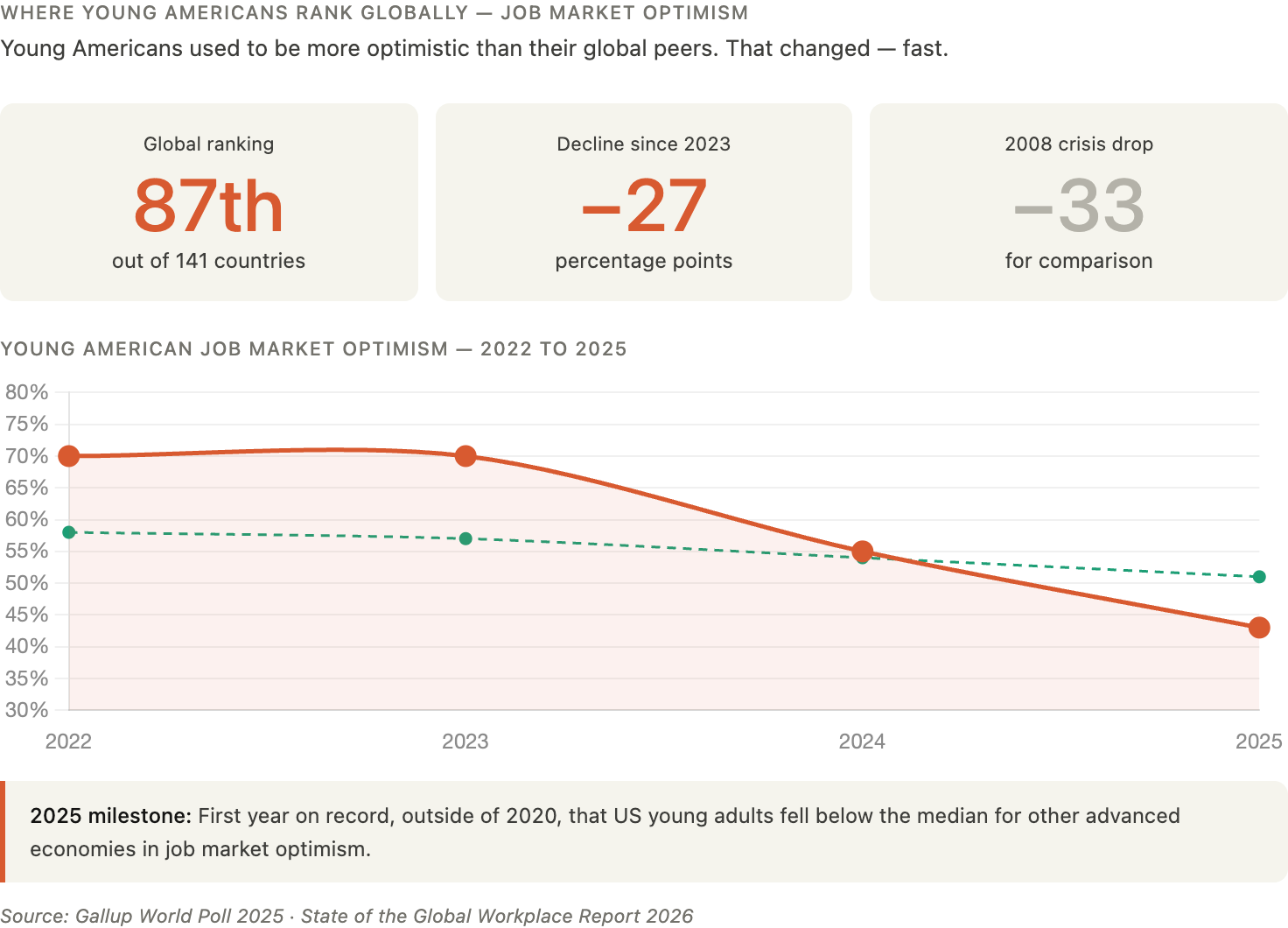
Other advanced economies have not seen the same inversion. Job market optimism has dipped since 2023 across the OECD for all age groups — the global economic environment has been difficult. But in those economies, young adults still lead older adults in job optimism. The pattern held. The generational confidence the labor market typically produces in young people — the sense that the future is more open than the past — has not collapsed in the way it has in the United States.
What is different here is not the global economic environment. It is the specific structural transformation happening inside the American labor market — the compression of the entry-level pipeline, the acceleration of AI-driven restructuring, the simultaneous contraction of the sectors that have historically absorbed new workers — that is producing a pessimism among young Americans that their peers in comparable economies are not yet experiencing at the same scale.
They are not wrong to feel it. They are simply the first generation in the most disrupted labor market in the world to feel it this clearly.
What this week’s SSC coverage has been building toward
This data does not arrive in isolation for SSC readers. It is the culmination of a week of reporting that has been mapping the same territory from multiple angles.
The April jobs report looked strong on paper — 115,000 jobs added, unemployment at 4.3%. The broader unemployment rate that captures discouraged workers and involuntary part-time workers sat at 8.2%. AI was the single most cited reason for job cuts in April for the second consecutive month — 21,490 layoffs, 26% of all cuts. The UNC system approved accelerated three-year degrees to prepare students for a workforce being restructured around their elimination. 95% of corporate AI investments have not delivered expected returns — meaning the cuts are real and the efficiency gains justifying them are still theoretical.
Young Americans are not pessimistic because they lack resilience or ambition. They are pessimistic because they are reading all of this at once, in real time, while trying to find a job. The Gallup data is not measuring a mood. It is measuring comprehension.
The question is not why young Americans feel this way. The question is what the institutions responsible for their economic future intend to do about the gap between what they promised and what they delivered.
That gap, measured in Gallup data points, is 21 percentage points wide. And it is the largest of any country on earth.