
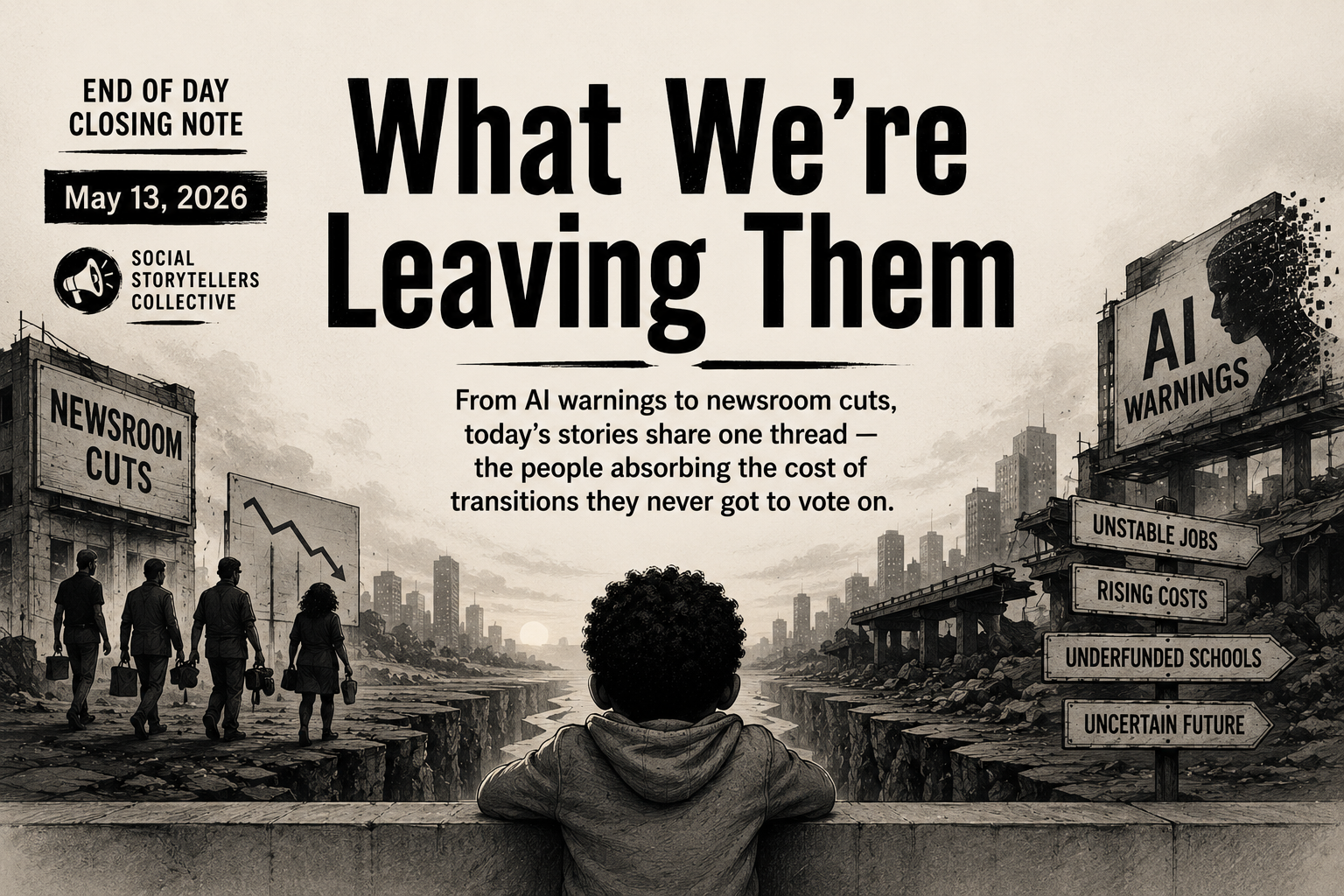
Somewhere today, a parent is holding a newborn and doing what every parent does in the quiet moments — imagining the future. What will they become. What kind of world will be waiting for them. Whether the things that worked for us will still be standing when they get there. That question used to feel rhetorical. Today’s stories make it feel urgent.
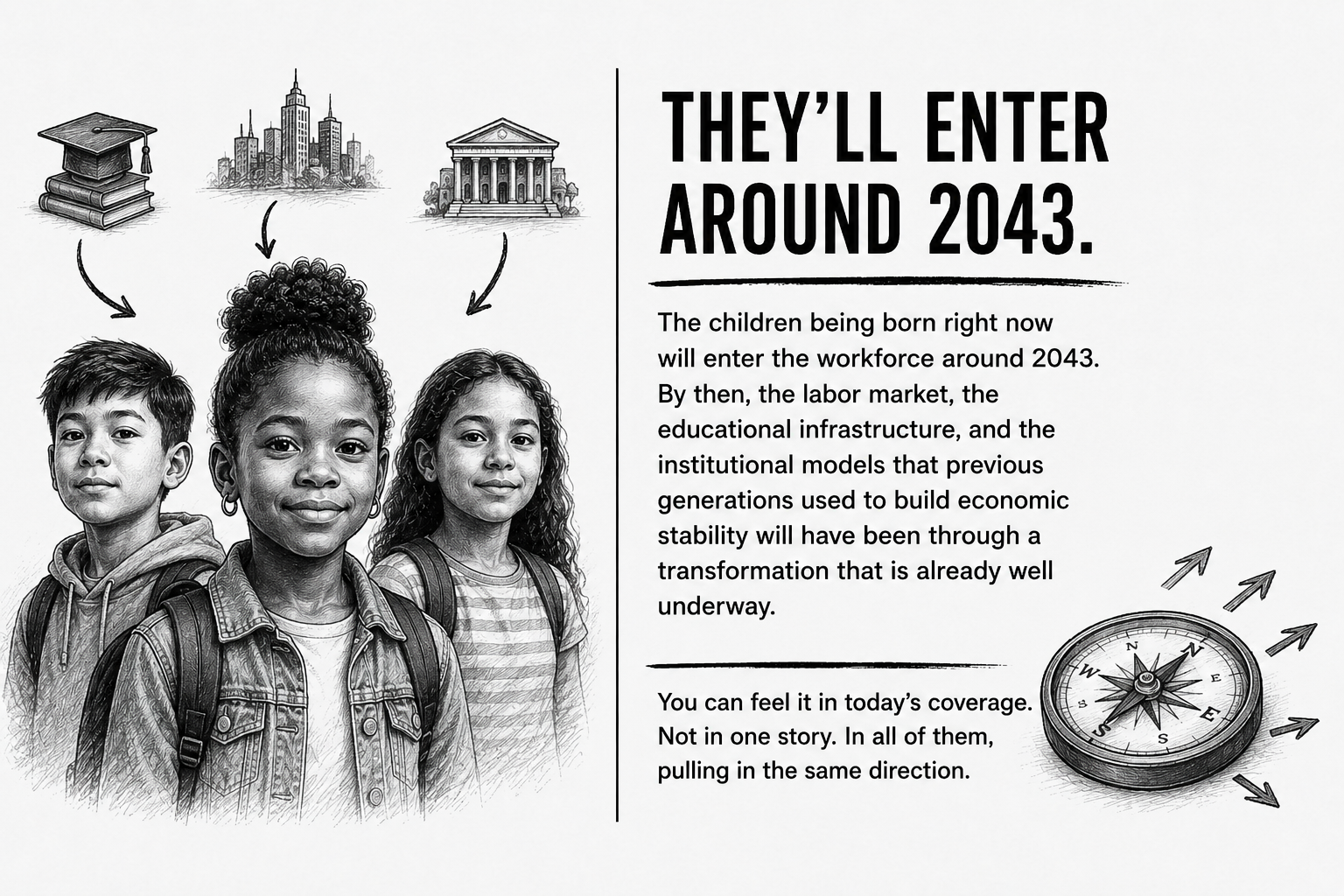
The children being born right now will enter the workforce around 2043. By then, the labor market, the educational infrastructure, and the institutional models that previous generations used to build economic stability will have been through a transformation that is already well underway. You can feel it in today’s coverage — not in one story, but in all of them, pulling in the same direction.
The CEO of Anthropic told Axios this week that artificial intelligence could eliminate roughly half of all entry-level white-collar jobs within the next one to five years. Marketing agencies are cutting the humans who built them. The Associated Press is offering buyouts to the journalists who built its reputation. Oracle cut between 20,000 and 30,000 workers and refused to negotiate with a single one of them individually. Google settled a racial discrimination lawsuit for $50 million at a company that generated more than $350 billion in revenue last year. And the White House wants a billion-dollar ballroom.
Today’s note is about what we are building — and what we are leaving behind for the people who will arrive in 2043 to find it.
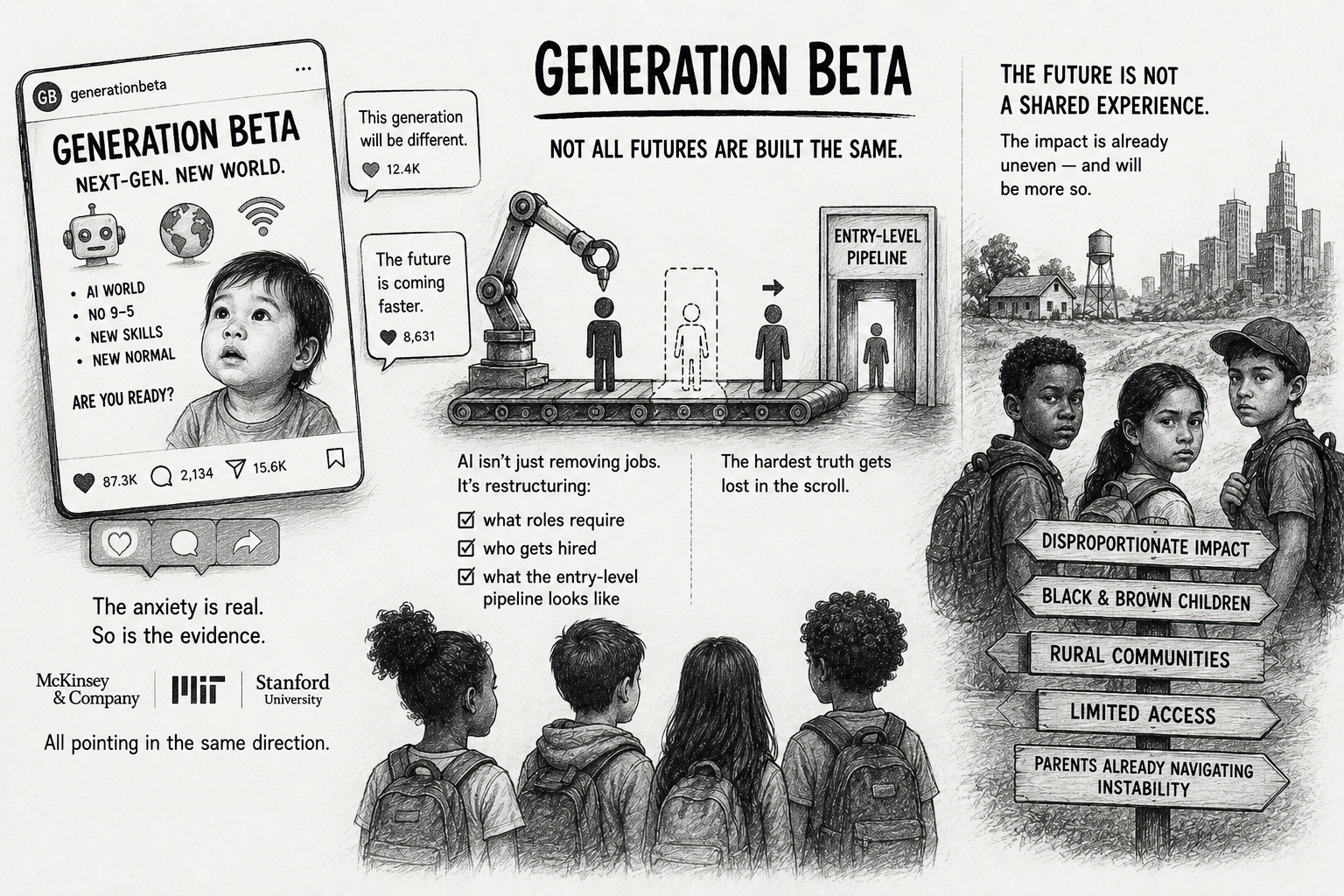
The viral posts about Generation Beta spreading across Instagram this week are capturing something real — not because the slides are precise, but because the anxiety driving their spread is grounded in evidence most people can feel even when they cannot fully name it. McKinsey, MIT, and Stanford researchers have all produced work pointing in the same direction. What gets lost in the scroll is the harder argument SSC examines in Viral “Generation Beta” Posts Are Reframing What Adulthood May Look Like — that AI is not simply removing roles from the economy. It is restructuring what roles require, who gets hired into them, and what the entry-level pipeline looks like for workers who have not yet built the credentials that make them harder to displace. The Generation Beta conversation online treats the future as a shared experience. It is not. The children who will absorb the most concentrated impact of this transition are already identifiable — disproportionately Black and Brown children, children in rural communities, children whose parents are already navigating the instability the posts are predicting as a future condition.
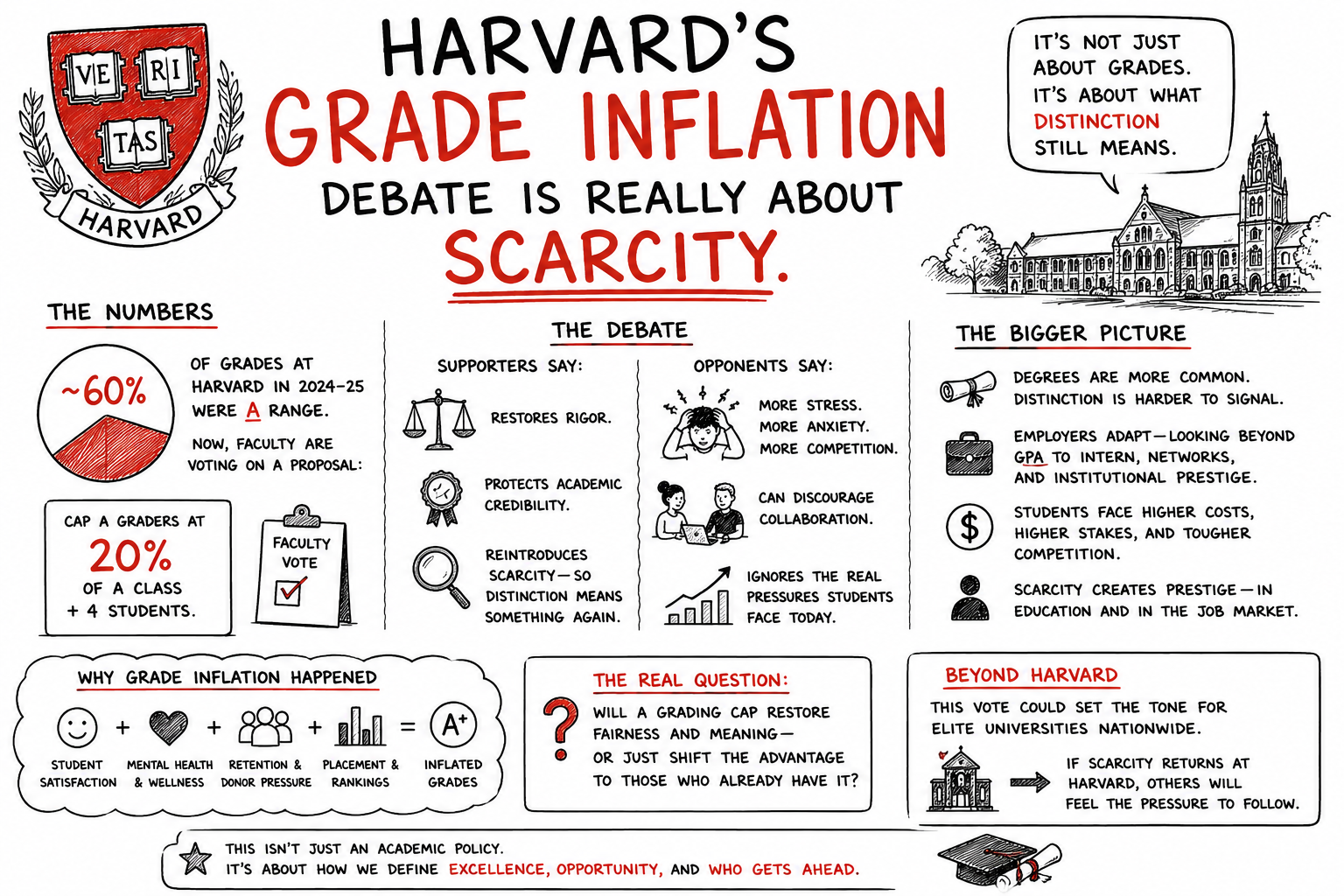
The elite education story today is not about grades. Harvard’s Grade Inflation Debate Is Really About Scarcity — Harvard faculty began voting on a proposal to cap A grades at 20% of each class, down from roughly 60% today. The debate is framed as a question of academic rigor. The structural argument underneath it is about prestige maintenance. When too many students receive top marks, distinction weakens as a signal for employers and graduate programs sorting candidates efficiently. Scarcity itself creates value in elite spaces — and Harvard is attempting to reintroduce it artificially into a credentialing system under pressure from every direction simultaneously. Students paying tuition exceeding $80,000 annually are behaving increasingly like high-stakes consumers. Universities are simultaneously marketing wellness and belonging while functioning as gateways into hypercompetitive professional pipelines. Grade inflation became one way to reduce friction inside that contradiction. The proposed cap is an attempt to restore the friction. Whether it resolves the contradiction is a different question entirely.
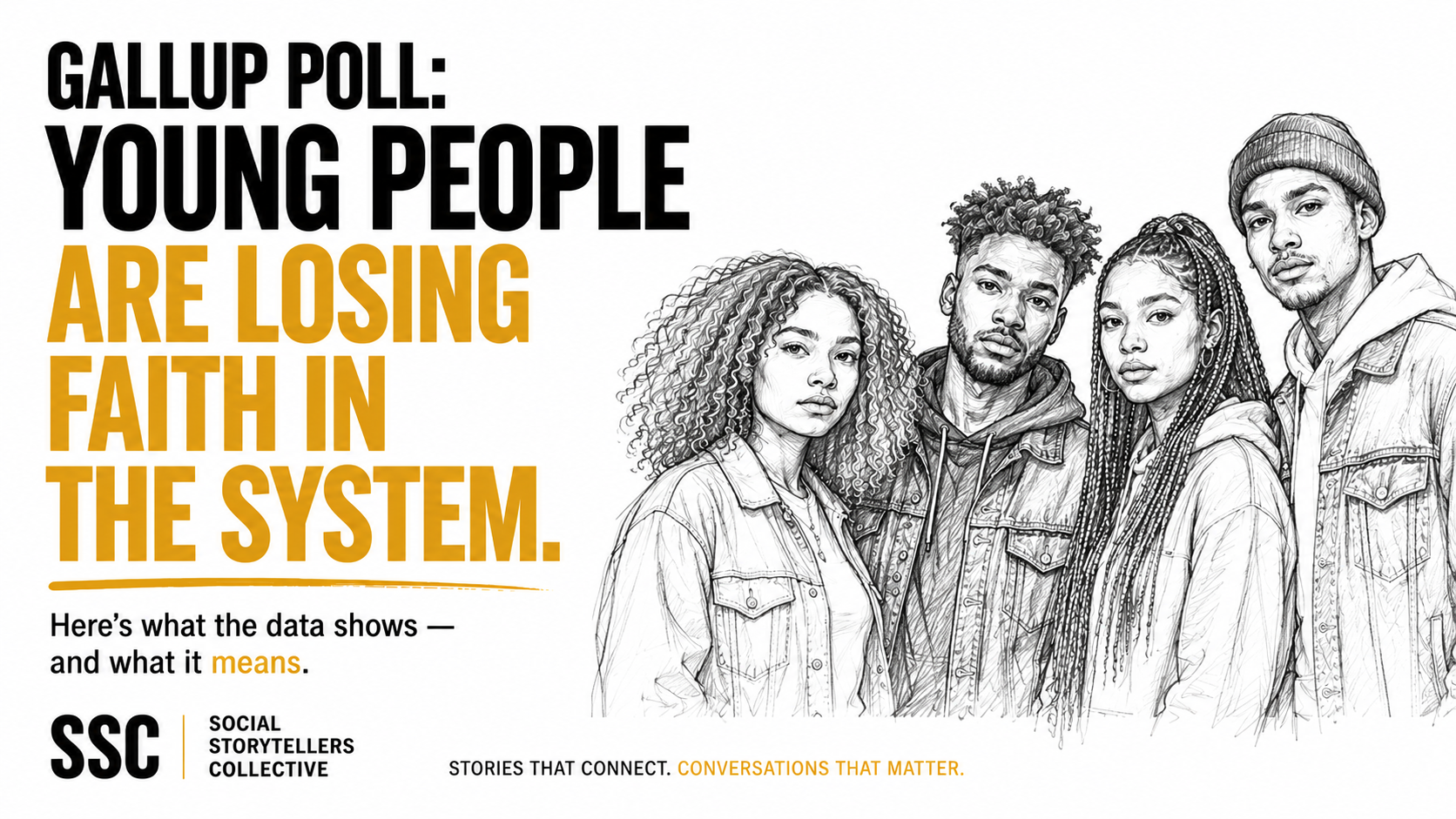
The data landed this week and it reframes the entire conversation about young Americans and work. American Young People Aren’t Pessimistic. They’re Paying Attention. According to Gallup’s 2025 World Poll, only 43% of Americans aged 15 to 34 said it was a good time to find a job locally last year — 21 percentage points lower than Americans aged 55 and older. That is the largest generational gap of any country on earth. Young Americans ranked 87th out of 141 countries in job market optimism. And since 2023 their confidence has collapsed by 27 points — a drop that rivals the decline during the 2008 global financial crisis. In most advanced economies young adults are 10 points more optimistic than older adults. The United States has inverted that entirely. The steepest pessimism is concentrated among the most educated young Americans who haven’t yet found full-time work — the people who did everything the system told them to do and are now finding that the labor market restructured itself while they were getting ready for it. Their pessimism is not ahead of the evidence. It is tracking it in real time.
Which makes what Dario Amodei said this week land differently than it might have a few years ago. The CEO of Anthropic — whose company SSC examined earlier this week as it races toward a valuation approaching $900 billion — told Axios that artificial intelligence could eliminate roughly half of all entry-level white-collar jobs within the next one to five years. Finance, consulting, law, technology. The sectors that college graduates have been pointed toward as the surest path to professional stability. What SSC unpacks in Even the Companies Building AI Are Starting to Publicly Warn About the Labor Impact is what makes this cycle different from every automation wave before it — not the scope of displacement, but the compression of the timeline in which displaced workers would normally find somewhere else to land. The receiving categories are contracting at the same time as the roles being eliminated. There is no obvious fallback. And the warning is coming from someone building the thing he is warning about.
The marketing and communications industry did not wait for the warning. It is already living inside the answer.
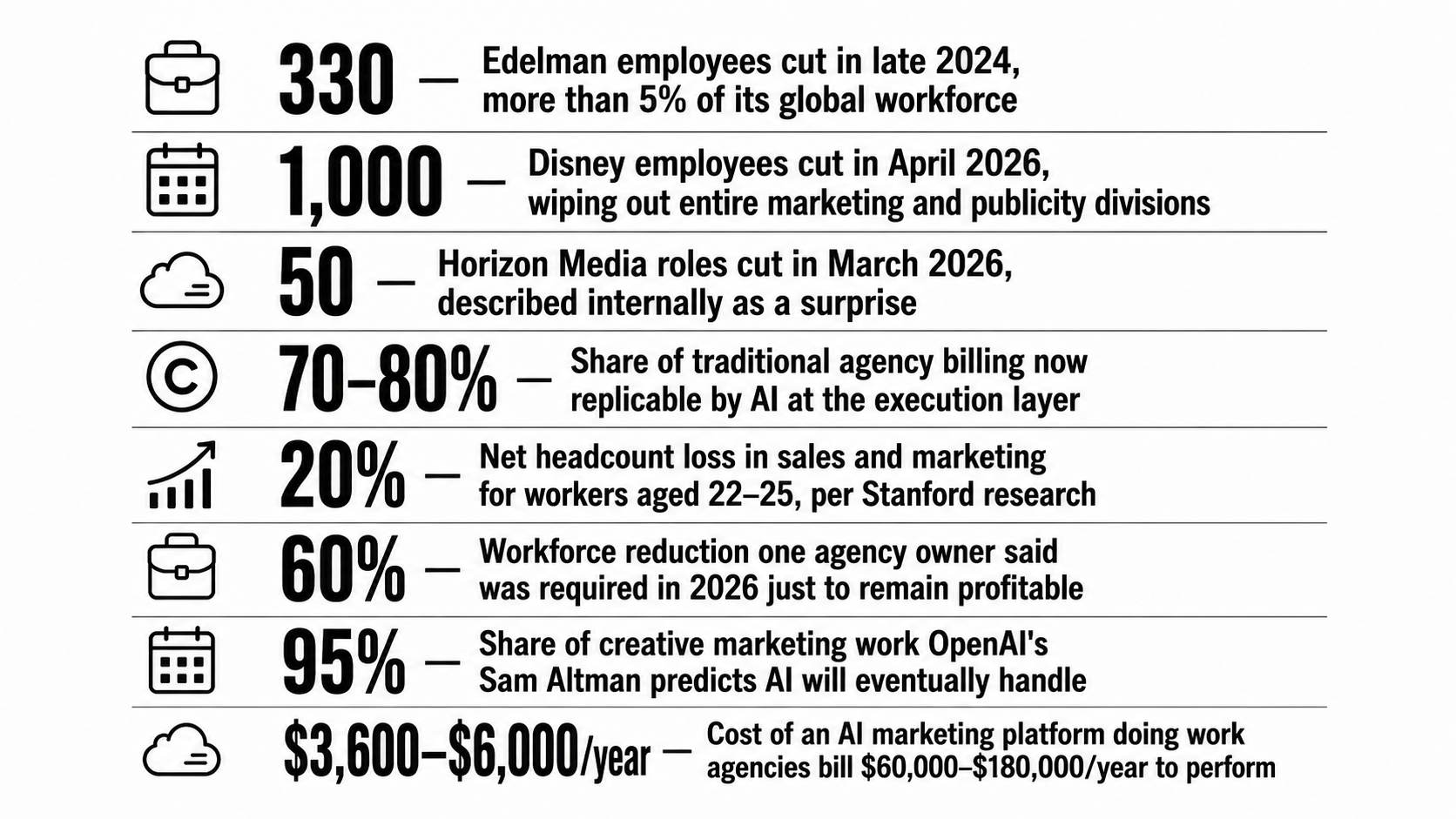
The cuts at Edelman, WPP, Publicis, and Disney’s marketing division did not arrive as a crisis. They arrived as a template. In The Agency Reckoning: When Efficiency Becomes the Product, SSC traces how one of the most consequential labor shifts in communications history is being narrated as modernization while the humans who built careers doing that work absorb the cost. The language across every announcement follows the same pattern — streamlining, realignment, agility, technological enablement. Strip the euphemism and the message is consistent. The work agencies have long billed for is now being done faster and cheaper by machines. One Stanford study found AI has caused a net loss of roughly 20 percent of headcount in sales and marketing roles for workers aged 22 to 25. This is not a technology story. It is a labor story wearing technology’s clothes.
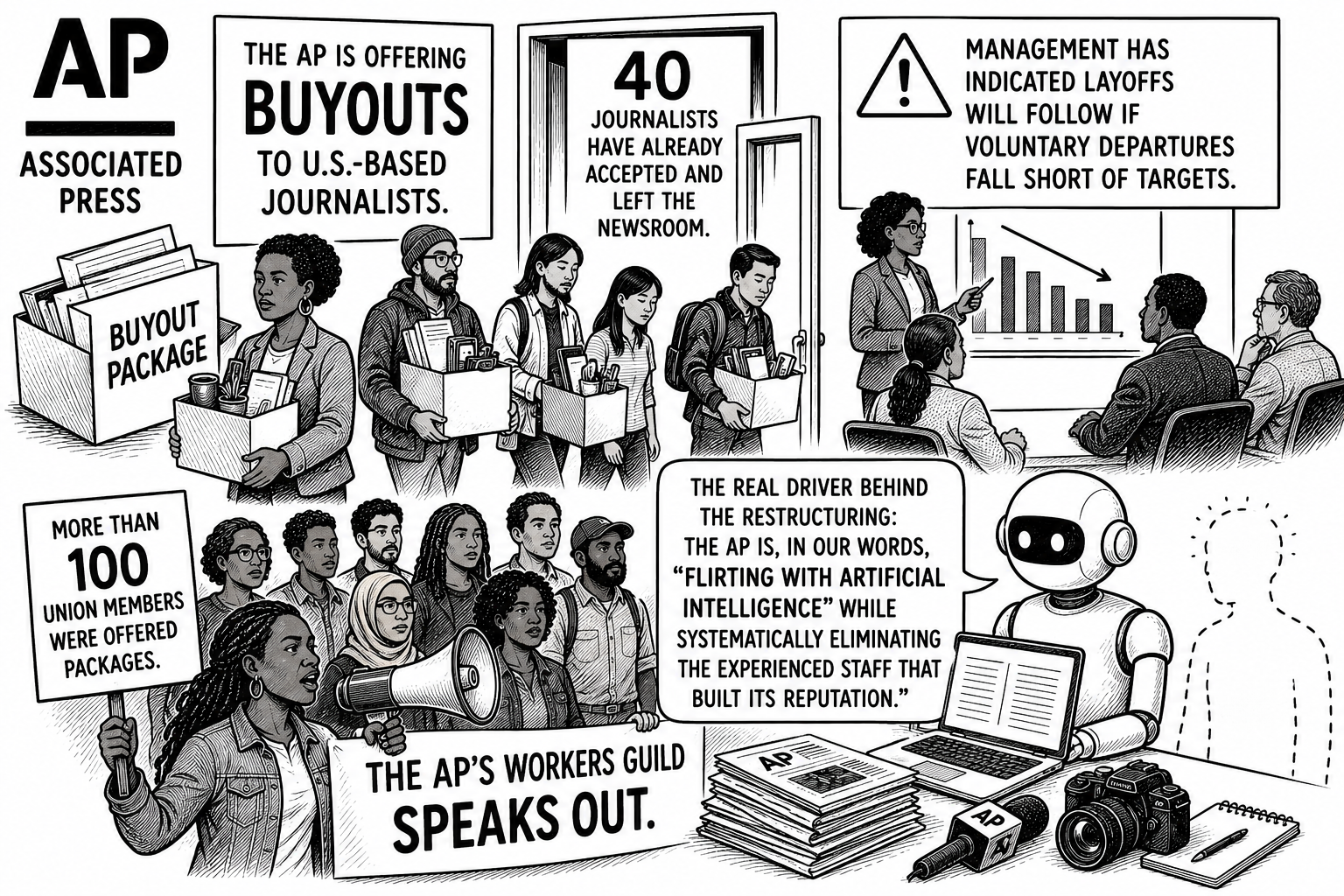
That compression is already visible inside journalism. The Associated Press — founded in 1846, operating across nearly 100 countries, the wire service that supplies reporting to thousands of newsrooms worldwide — is offering buyouts to U.S.-based journalists. Forty have already left. The AP workers guild described it as the organization flirting with artificial intelligence while getting rid of the experienced staff that built its reputation. Associated Press Offers Buyouts as Print Journalism Continues to Contract places AP inside a pattern the Washington Post confirmed just three months ago — when the Post cut more than 300 journalists in a single morning, then quietly called many of them back within weeks. The chaotic reversal said what the data was already showing: newsrooms do not know what they need until after they have eliminated the people providing it. Race and ethnicity reporter Emmanuel Felton, among those cut at the Post, put it plainly. This was not a financial decision. It was an ideological one.
The workers who saw it coming most clearly were the ones at Oracle. Between 20,000 and 30,000 people were cut globally. Several tried to negotiate — for stronger severance, for unvested stock, for WARN Act clarity. The company declined across the board. One former employee forfeited approximately $1 million in stock that was only months away from vesting. Oracle Workers Tried to Negotiate After Mass Layoffs. The Company Refused. reframes what happened not as a failure of effort but as a structural inevitability. Individual negotiation in a mass layoff is disadvantaged before it begins. The company has legal counsel, institutional experience, and standardized agreements. The worker has days to review documents and no coordinated counterpart. What Oracle’s former employees learned is what white-collar workers across industries are learning in real time — that leverage has to be built before it is needed, and exercised collectively rather than one person at a time.
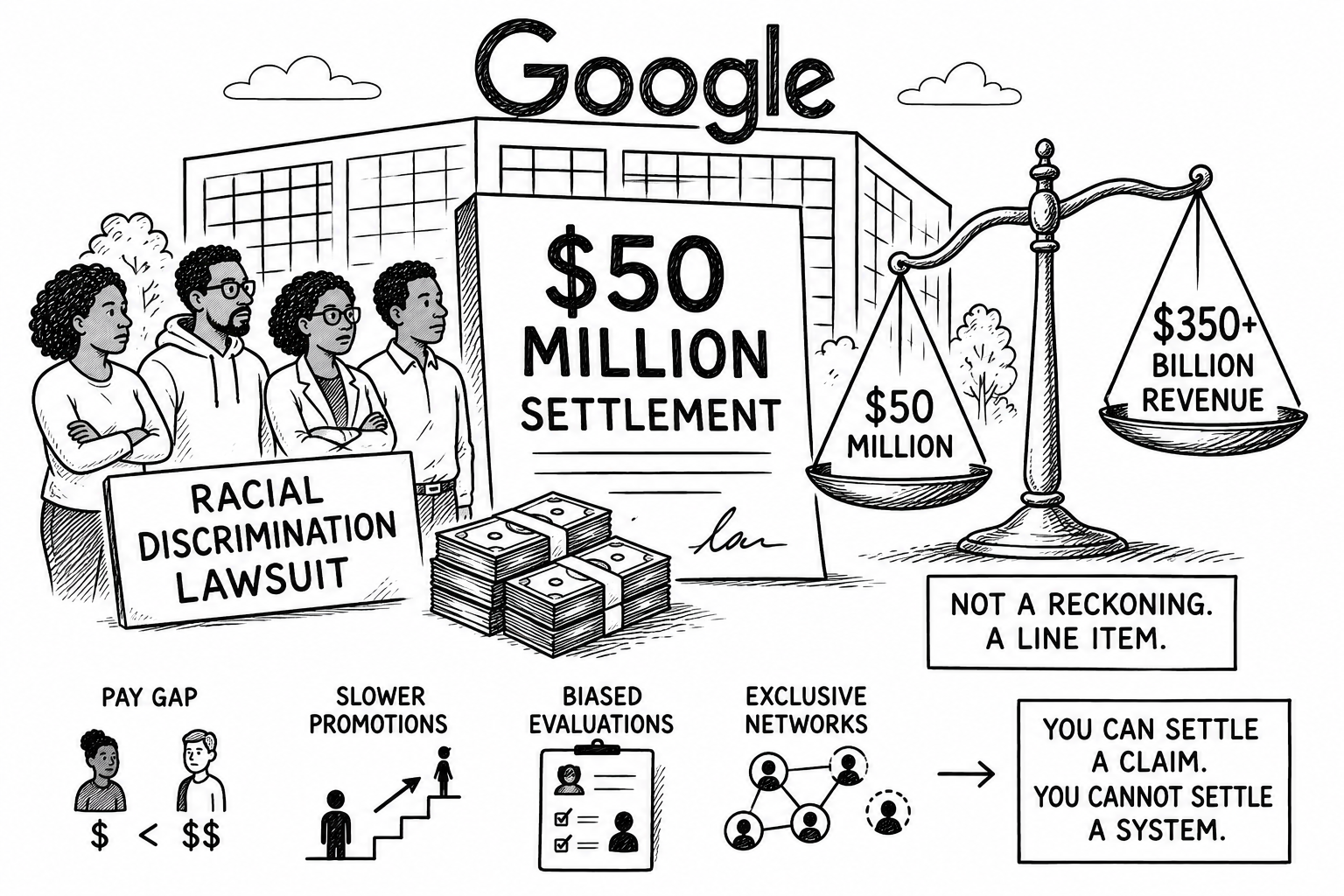
And then there is Google. In 2022, Black employees filed a lawsuit alleging systemic racial disparities in how the company hires, compensates, and promotes its workforce. This week, Google agreed to pay $50 million to settle it — at a company that generated more than $350 billion in revenue last year. Google Agrees to $50 Million Settlement in Racial Discrimination Lawsuit makes the case that the number is not the story. The lawsuit centered not on a single incident but on patterns — compensation structures, promotion pathways, evaluation systems, and recruiting networks that reproduced existing gaps rather than closing them. The settlement resolves the legal claim. It does not touch the system. And it arrives during a period when Google, like many of its peers, has been quietly retreating from the diversity commitments it spent years publicizing. You can settle a claim. You cannot settle a system.

The same structural tension appears in the beauty industry — another system built on Black visibility while remaining uneven in how it distributes access, investment, and long-term support. Are Black American Beauty Creators Being Left Out of the Global Beauty Boom? examines the growing tension between influence and ownership inside the creator economy, where Black American creators continue shaping trends, aesthetics, and engagement online while many brands increasingly redirect campaigns, partnerships, and cultural capital elsewhere. The story is not about whether Black creators are visible. They are often central to the culture itself. The question is who gets sustained institutional backing once that visibility becomes profitable at scale. Across tech, media, and beauty alike, the pattern keeps repeating: the system absorbs the contribution while distancing itself from the responsibility to invest equitably in the people driving it.

The cultural story today started on a livestream and ended up as a geopolitical debate. When the Stream Becomes the Story: IShowSpeed, the Dominican Republic, and What the Internet Did Next — IShowSpeed, the 20-year-old Ohio-born streamer with over 35 million YouTube subscribers, went to the Dominican Republic to make content. Within hours, clips from his visit spread across TikTok, Instagram, X, and YouTube — triggering a sprawling online debate about anti-Blackness, Dominican identity, anti-Haitian sentiment, and how race gets interpreted across the Caribbean diaspora in real time. The Dominican Republic occupies a particularly complicated position inside those discussions: the country simultaneously exports globally recognized Black cultural influence while facing sustained international scrutiny over racial politics internally. That contradiction is why a single livestream became a symbolic debate larger than the creator himself. The footage became a canvas onto which audiences projected unresolved arguments about race and belonging that predate the stream by decades. What makes the story important beyond influencer culture is what it reveals about how internet culture now compresses complicated historical conversations into real-time viral interpretation cycles — before anyone involved fully understands the scale of the conversation they have entered.
The Daily Visual Signal
A visual interpretation of the deeper systems, tensions, and structural shifts shaping the current moment — designed to translate complex societal changes into a single image.
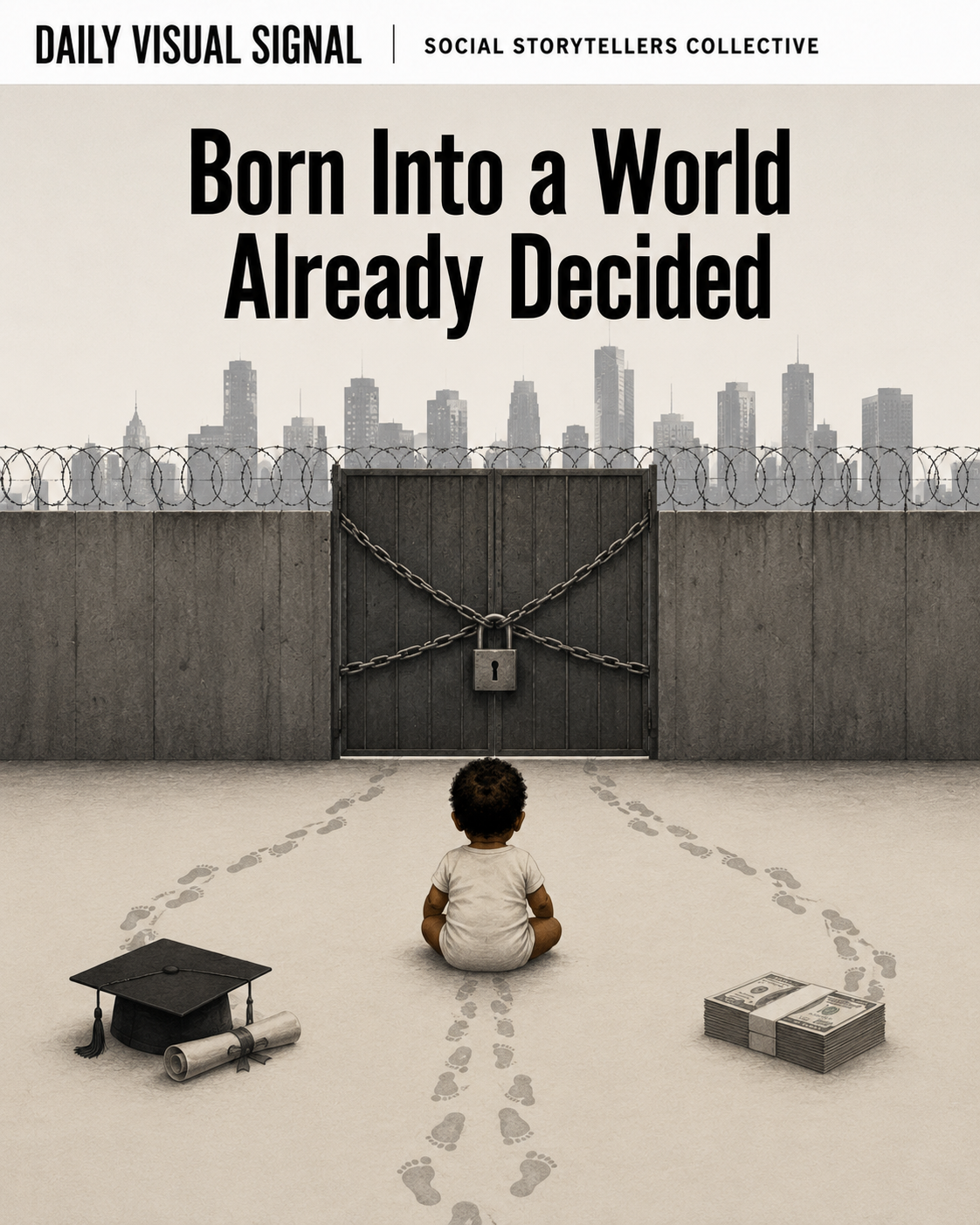
Born Into a World Already Decided. A child stands at a fork in the road. To the left, the institutions previous generations were handed — degrees, pensions, office careers — already showing cracks before this generation arrives. To the right, an AI economy with no map and no fallback. The child is small against the scale of both paths. Born in 2025. Arriving in the workforce in 2043. Both roads were built before they got here.
Featured Story: The White House Wants a Billion-Dollar Ballroom While the Economy Hollows Out
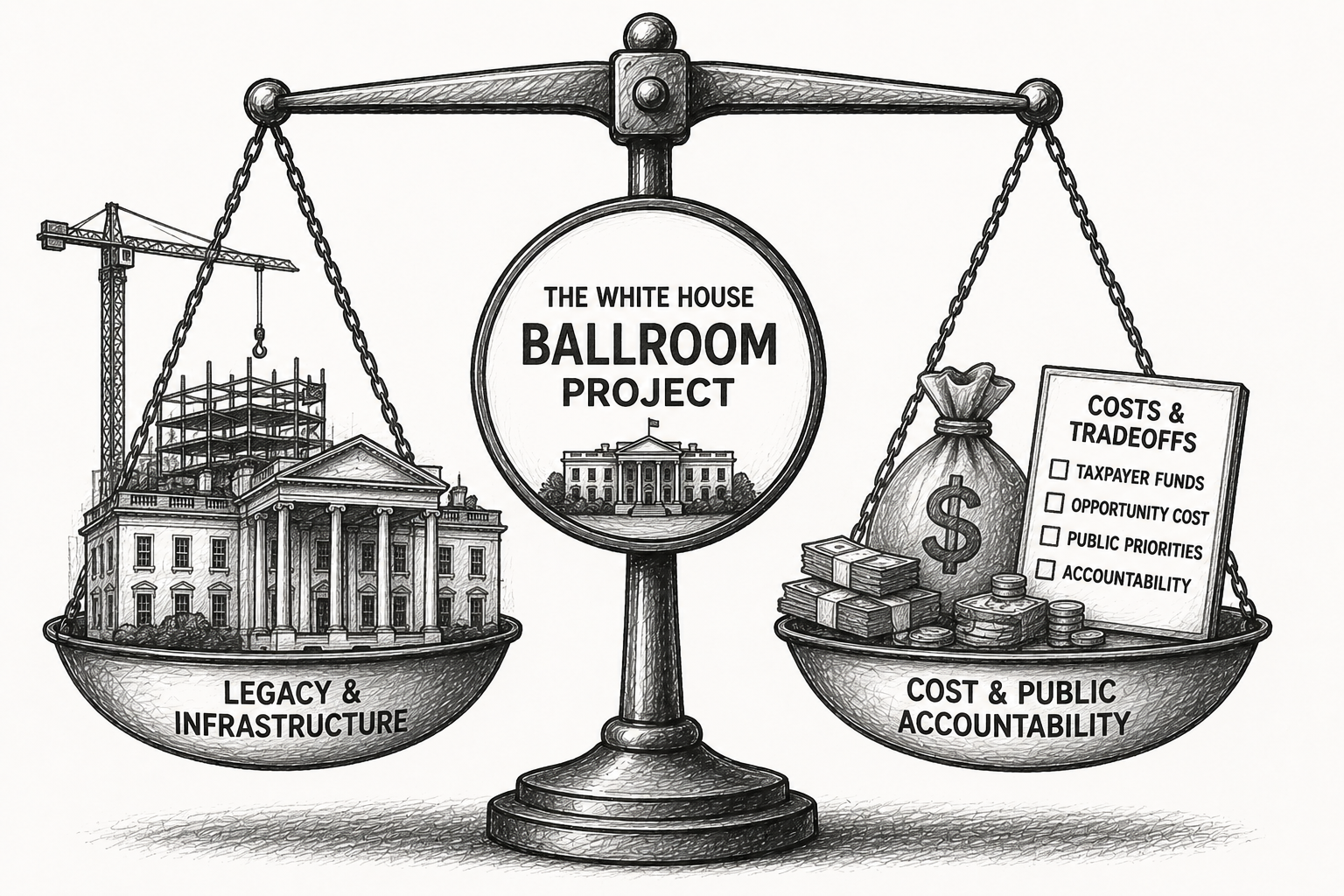
The proposal is being called a modernization effort. The White House Wants a Billion-Dollar Ballroom While the Economy Hollows Out — a $1 billion expansion of the White House complex is being framed as a practical upgrade to state function capacity. What it actually is, is a values statement rendered in concrete and square footage. Unemployment figures stay technically low while wages cannot absorb the actual cost of living in 2026. Housing affordability has reached crisis levels not just in coastal metros but across mid-sized cities that once functioned as affordable alternatives. Food insecurity and medical debt are spreading into working and middle-class communities that were once considered the assumed baseline of American economic stability. The people absorbing those conditions are the same people whose federal tax infrastructure would underwrite a ballroom designed for galas, donor gatherings, and state-function spectacle. Housing relief is infrastructure. Wage floors are infrastructure. Accessible healthcare is infrastructure. A ballroom is a room where people who already have power gather to confirm that they still have it.
Today’s stories are not happening in separate lanes. They are the same story arriving from different directions. A generation being born into a world where the institutions meant to catch them are already reorganizing around their own survival. A CEO warning that the technology his company is building will eliminate the entry points that generation would have used. Newsrooms cutting the journalists who would have covered all of it. Workers learning that individual leverage in a mass restructuring is almost no leverage at all. And a settlement that puts a number on a pattern that a check will not resolve.
The thread running through all of it is consistent. Systems reorganize around their own continuity. Workers and communities absorb the disruption that reorganization produces. And the distribution of consequences follows existing lines of access and power with a consistency that no technology transition has yet interrupted.
The children being born right now will inherit what we build — or fail to build — in the time between now and when they arrive. Today’s coverage is a record of where things stand. The question is not whether they will feel the consequences of these decisions. They will. The question is whether anyone making these decisions is thinking about them at all.
We will be back tomorrow with more.
— SSC
All of today’s coverage lives at socialstorytellers.substack.com. The full archive, beat navigation, and every linked piece are best experienced on a computer. If you have been reading and have not yet subscribed, we would be glad to have you with us.