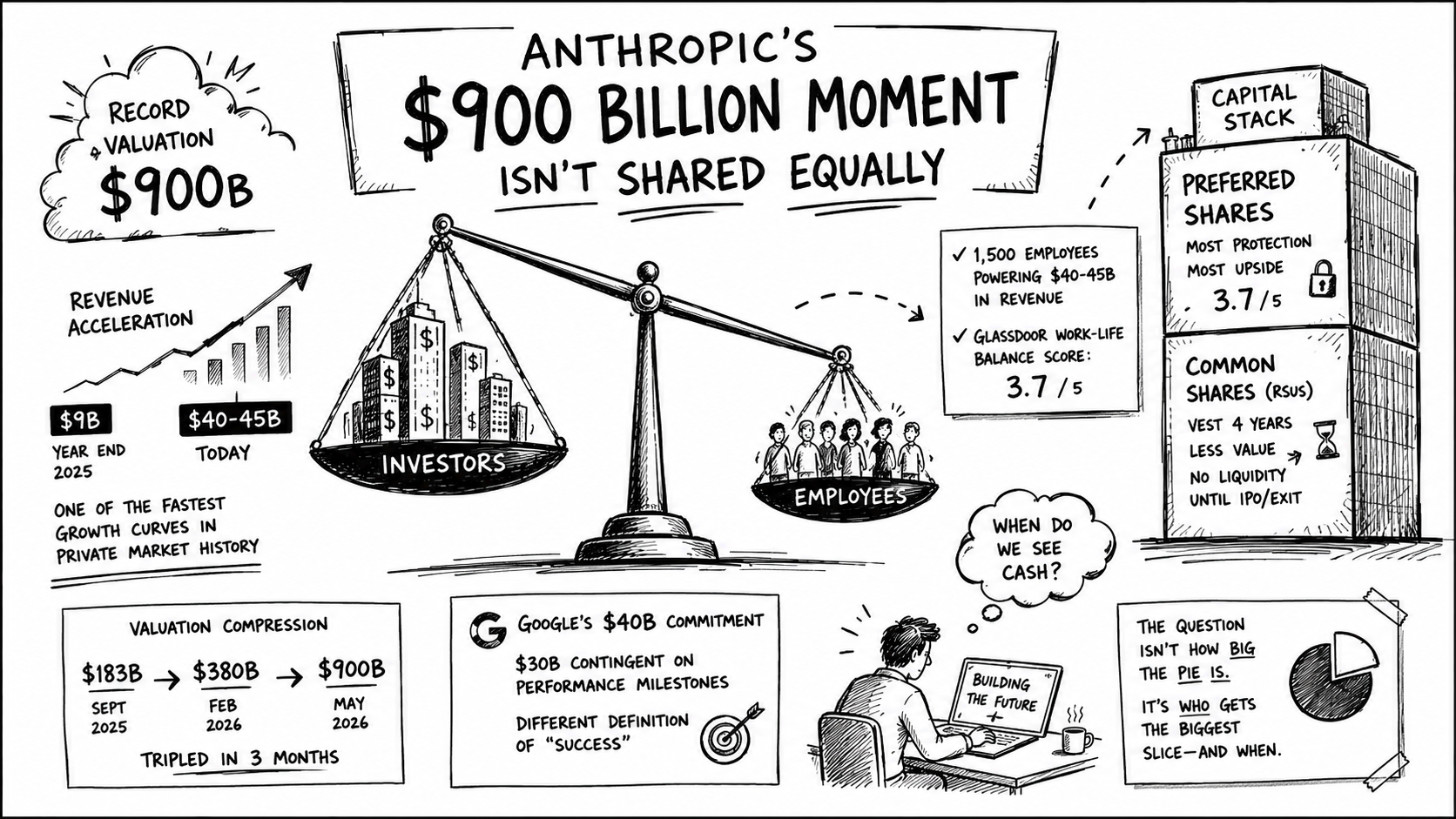
Anthropic is finalizing a funding round expected to raise $40 to $50 billion at a valuation approaching $900 billion, which would make it the most valuable AI startup in the world, surpassing OpenAI’s $852 billion mark from March. The company’s annualized revenue run rate has climbed from $9 billion at the end of 2025 to a reported $40 to $45 billion today — one of the fastest revenue acceleration curves in private market history. The board was expected to make a final decision on the round terms this month.
The capital is real. So is the question of who actually captures it.
Anthropic’s approximately 1,500 employees hold equity in a company that has tripled in valuation in three months. On paper, that’s generational wealth. In practice, the architecture is more complicated. Private RSU grants vest on four-year schedules, and common shares carry significantly less value than the preferred stock held by institutional investors — a structural gap that persists until an IPO or liquidity event. Google’s $40 billion commitment, with $30 billion contingent on performance milestones, introduces another layer: the terms that define “success” for investors are not the same terms that determine when workers see cash.
The workforce carrying the revenue load sits at 1,500 people — a headcount that rivals companies a fraction of Anthropic’s scale. Per-employee revenue efficiency at that output level is extraordinary, which means the margin being captured by institutional investors is being generated by a remarkably small number of people working under what the company’s own Glassdoor data describes as a 3.7 work-life balance score in a high-intensity environment.
Valuation compression this fast — $183 billion in September, $380 billion in February, $900 billion now — concentrates gains at the top of the capital stack. The employees who joined earliest hold the most upside. The investors who wrote the largest checks hold the most protected position. The workers who joined most recently are absorbing the most execution risk against the least certain liquidity timeline.
The number that matters most isn’t $900 billion. It’s how much of that reaches the people generating it — and when.