
The U.S. State Department says it will begin revoking passports for Americans with significant unpaid child support debt, starting with individuals owing more than $100,000 before eventually expanding enforcement to those owing more than $2,500. While passport restrictions tied to child support obligations have existed since the 1990s, the policy has historically focused on blocking renewals or applications. What is changing now is the scale and aggressiveness of enforcement. Under the expanded approach, passports can reportedly be revoked outright once overdue payments are reported by the Department of Health and Human Services to the State Department.
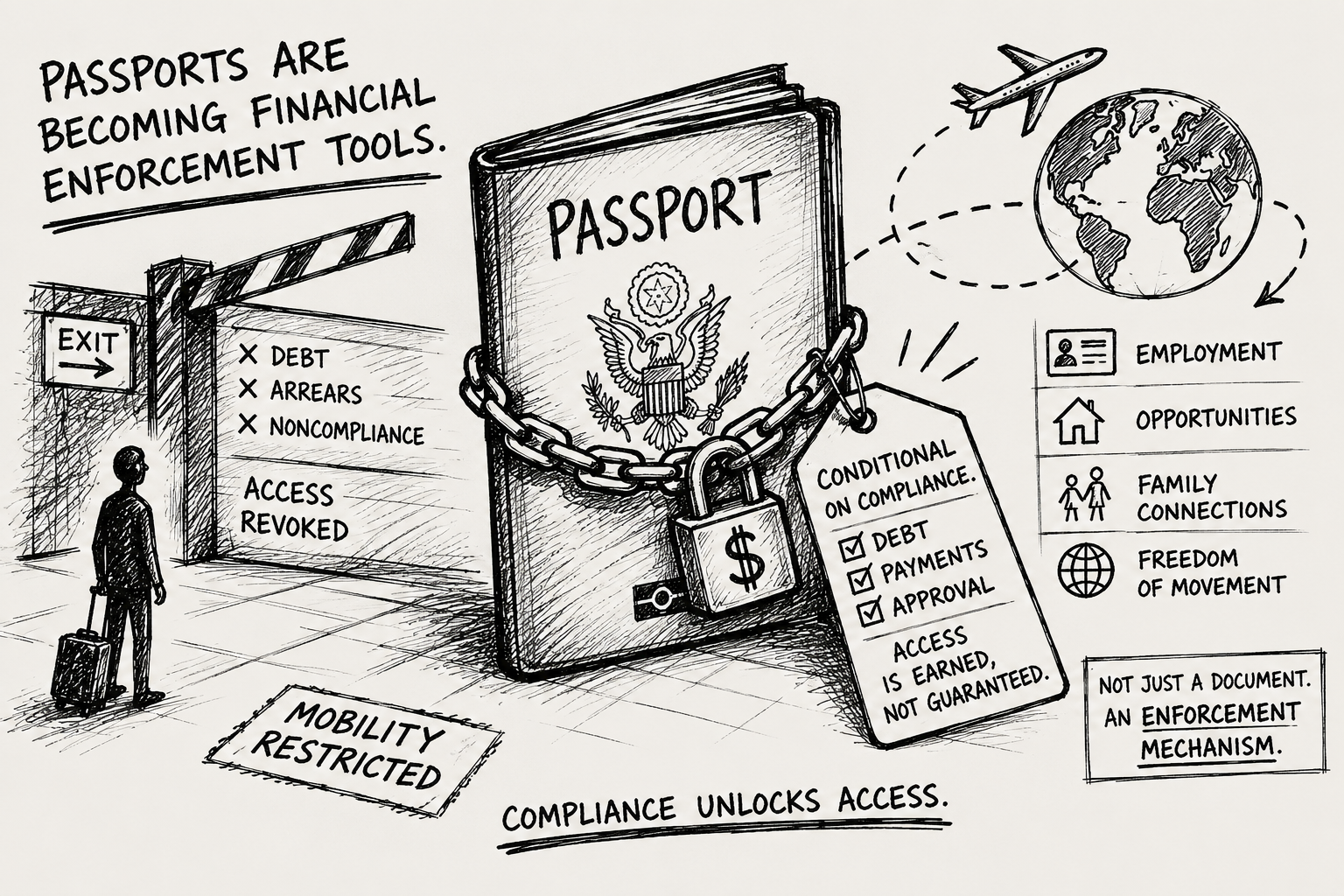
The shift matters because it reflects a broader trend in how institutions are increasingly using access restrictions to enforce compliance. Mobility itself is becoming leverage. A passport is not just a travel document — for many people it is tied to employment, international family connections, relocation flexibility, and economic opportunity. Revocation therefore extends the consequences of debt beyond financial penalties into participation and movement itself.
Supporters of the policy argue that stronger enforcement mechanisms are necessary because unpaid child support creates severe financial instability for custodial parents and children. Officials say the tougher approach is designed to pressure delinquent parents into resolving debts that can remain unpaid for years. Since the federal Passport Denial Program began in the late 1990s, officials say hundreds of millions of dollars in unpaid support have been collected through the threat or restriction of passport access.
But the expansion also raises questions about proportionality, especially as the threshold potentially drops from six-figure debt to just $2,500 — an amount many financially struggling Americans can accumulate relatively quickly during periods of unemployment, instability, or legal disputes. Until recently, enforcement was largely reactive, triggered when individuals attempted to renew or apply for passports. The newer approach is proactive, allowing the government to revoke existing passports based on state-reported arrears data.
What emerges is a larger structural story about how government systems increasingly connect financial compliance to access itself. Licenses, credit, housing eligibility, healthcare debt, and now international mobility are all becoming interconnected forms of behavioral enforcement. The policy may successfully increase collections, but it also reflects a society where the ability to move freely is becoming more conditional on economic standing and institutional compliance rather than existing as a neutral civic right.