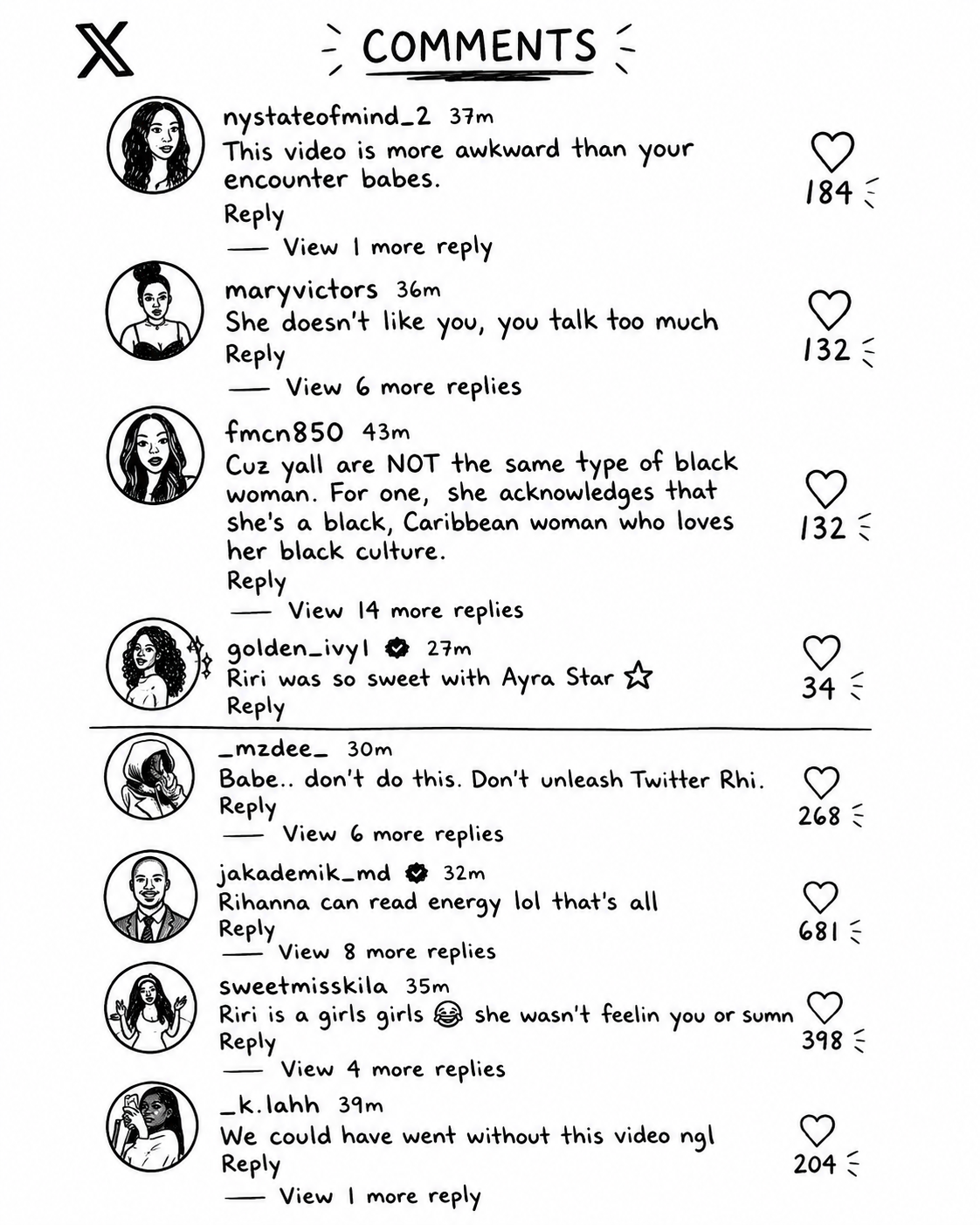
The internet has spent days dissecting multiple Met Gala moments involving Tyla and Rihanna. In one viral clip, Tyla recalled approaching Rihanna at a previous event only for Rihanna to quickly respond, “My baby’s dad is calling me,” before walking away. Another moment from the Met Gala itself showed Tyla standing nearby while Rihanna appeared occupied elsewhere, fueling online speculation that the interaction between the two felt distant or awkward. On their own, the clips were relatively ordinary celebrity moments. But online culture no longer processes celebrity interactions at face value. It processes them as evidence of hierarchy.
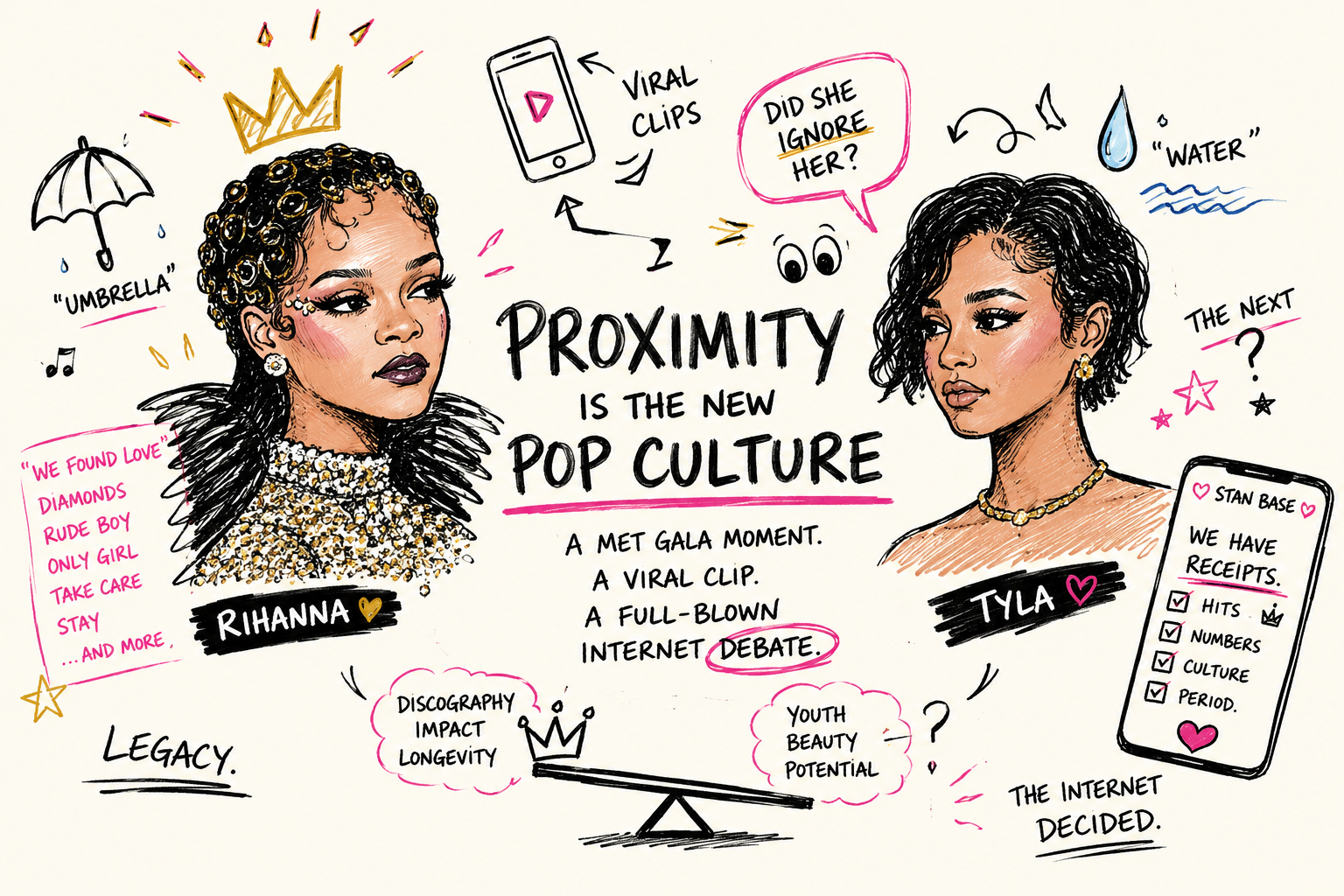
What followed was less about the actual exchange and more about projection. Some viewers framed Rihanna as dismissive or irritated. Others argued the internet was manufacturing drama out of exhausted facial expressions and fragmented clips taken during one of the most chaotic nights in celebrity culture. But once the videos entered algorithmic circulation, the discourse expanded into something much larger: a conversation about generational succession, beauty politics, desirability, relevance, and who the culture believes represents the future of global Black female pop stardom.
That escalation matters because it reveals how quickly modern celebrity culture converts proximity into rivalry. Tyla’s visible admiration for Rihanna became interpreted through a competitive lens almost instantly. Sections of social media began implying Rihanna felt threatened by Tyla’s youth, beauty, and rising visibility. Others framed Rihanna as “petty” after fans began circulating clips of her posting music by Ayra Starr amid the discourse. Comment sections quickly spiraled into comparisons over attractiveness, cultural authenticity, favoritism, and who Rihanna supposedly “preferred” among younger African female artists. The framing itself exposed a familiar dynamic within entertainment culture: the assumption that visibility is finite and that a younger woman ascending must automatically signal replacement anxiety for the established icon.
Rihanna’s fanbase responded in a way that was equally revealing. Rather than simply defending her socially, many defended her structurally through comparison graphics listing decades of hit records, chart dominance, collaborations, and cultural milestones. The viral side-by-side image contrasting Rihanna’s extensive catalog against Tyla’s current breakout success became less about music and more about institutional scale.
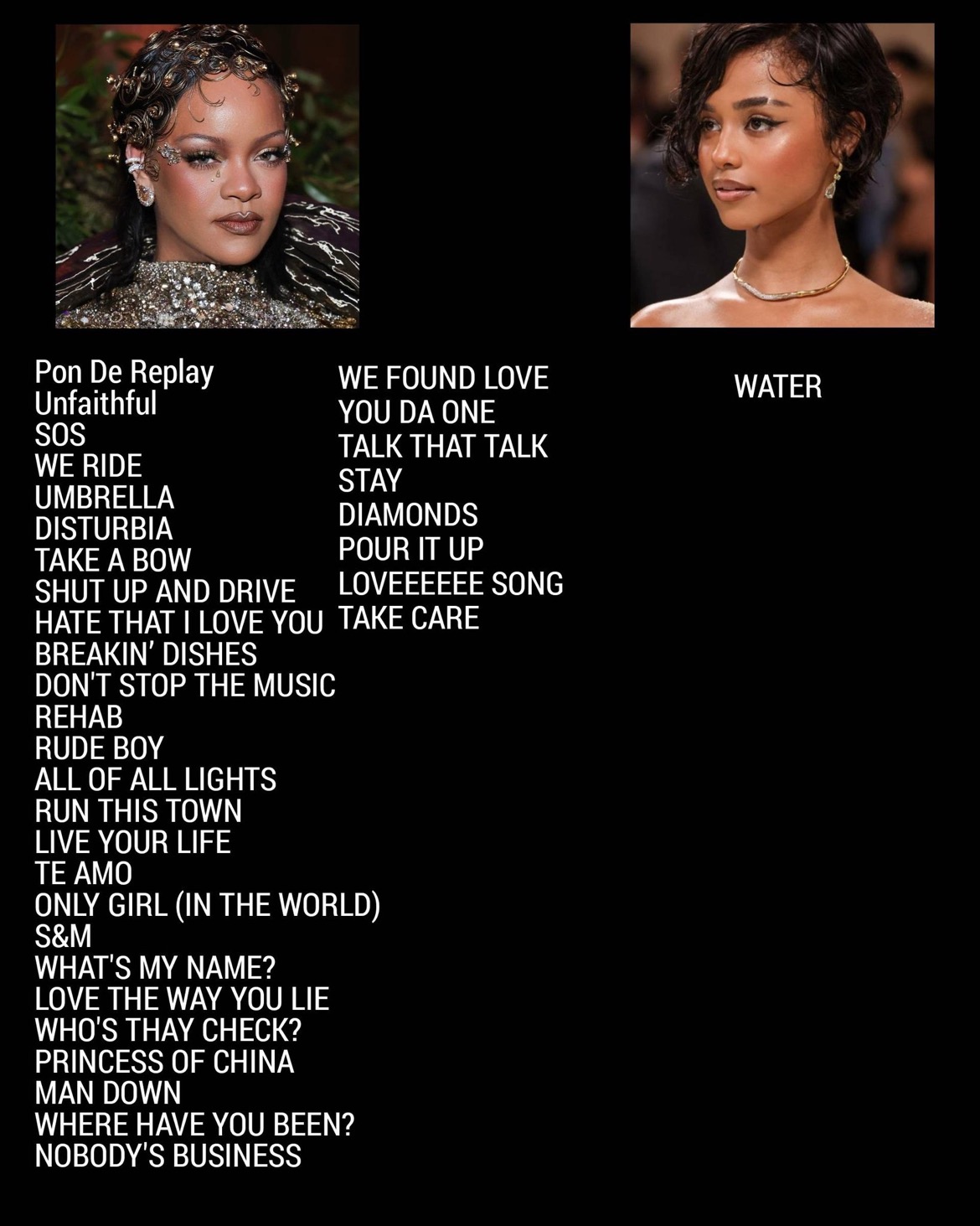
That context matters because younger artists are increasingly being evaluated against catalogs that were built during a completely different era of music consumption. Rihanna emerged at the tail end of monoculture, when major radio rotation, music video channels, award shows, blogs, and streaming were still concentrated enough to create universally shared songs. Today’s environment is far more fragmented. Artists can be massively successful within a niche ecosystem without necessarily producing the kind of all-encompassing ubiquity Rihanna achieved repeatedly for nearly a decade straight. That is part of why the comparison feels almost unfair online. Tyla is successful by modern standards. But Rihanna’s catalog reflects a period when hit-making itself operated differently.
The comparison also reveals how audiences now process legacy in real time. Rihanna has not released an album in years, yet her absence continues to shape the market because her catalog still functions as active cultural infrastructure. New artists are not simply competing against current peers. They are competing against permanently circulating catalogs that never left public consciousness. Streaming has flattened time in a way that keeps older megastars continuously present in the algorithmic environment. A Rihanna record from 2011 can still feel culturally active to listeners discovering it for the first time in 2026. That changes the developmental runway for emerging artists because the benchmark never really disappears.
For Tyla specifically, the conversation says less about failure and more about expectation inflation. “Water” becoming a global hit so quickly accelerated public perception of where her career should already be. Viral success now compresses timelines. Audiences often expect an artist to jump immediately from breakout act to generational institution without acknowledging how long the construction of those catalogs actually took. Rihanna’s list was built through years of relentless releases, collaborations, reinventions, controversies, fashion pivots, and radio dominance across multiple album cycles. Looking at the songs stacked together in one image obscures the time and industrial machinery behind them.
What makes the discourse resonate is that it unintentionally documents the transition between two eras of celebrity itself. Rihanna represents the final phase of the global pop superstar as singular cultural center. Tyla represents a newer era shaped by algorithmic discovery, fragmented fandoms, and accelerated visibility. Both models can create stars. But only one was designed to create omnipresence.
And that may be the clearest signal hidden underneath the drama. The internet thought it was debating whether Rihanna was rude to Tyla. What it was actually debating was whether modern celebrity culture still allows the creation of another Rihanna at all.