
When Isaiah Rashad said, “They don’t make a manual for being a bisexual Black dude,” he was not offering a confession. He was naming a structural absence that hip-hop has spent decades refusing to acknowledge.
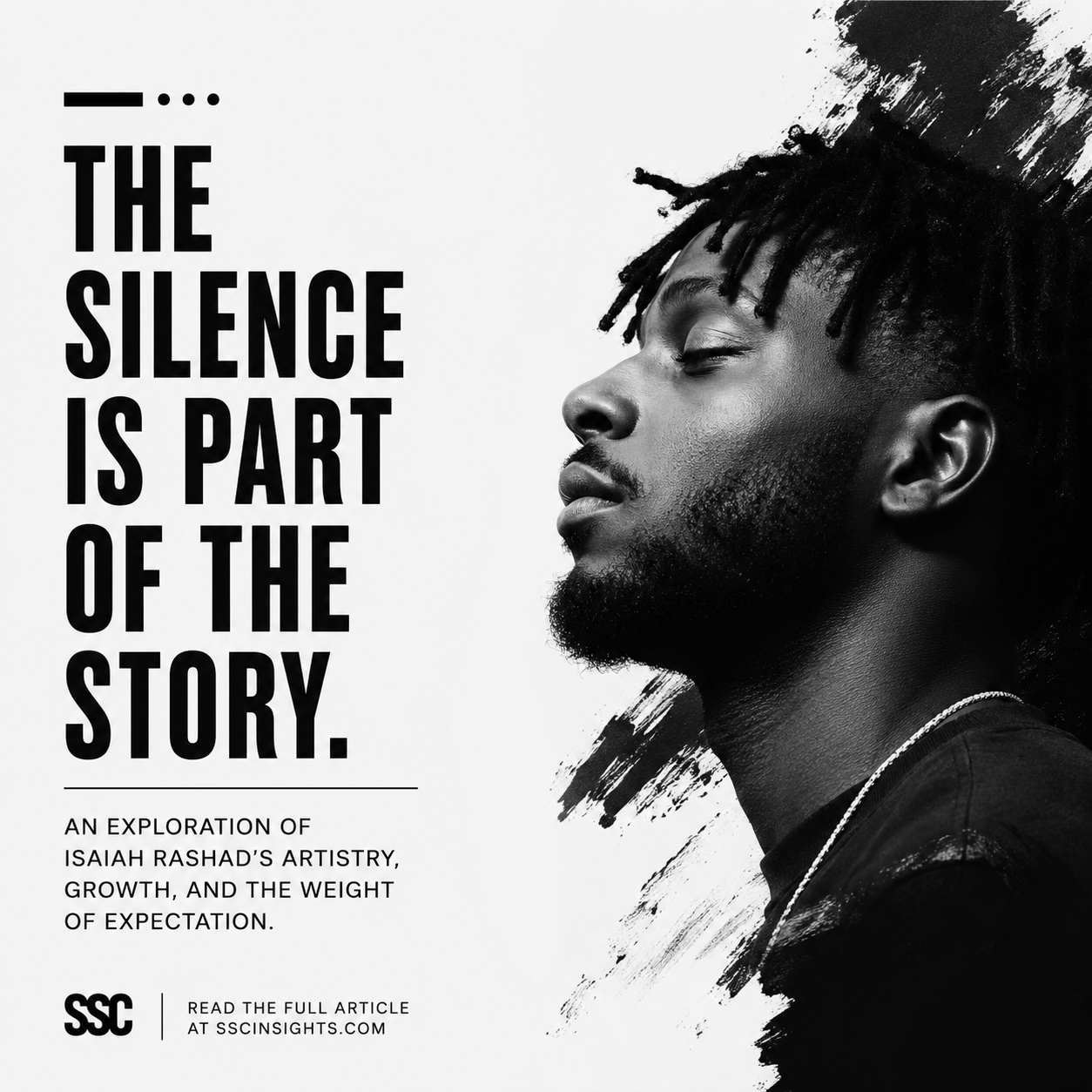
The comment arrived years after one of the more painful public moments in recent rap culture. In 2022, explicit videos of Rashad with men leaked and spread rapidly across social media, turning an intensely private situation into a collective online event that he had no control over and no framework to navigate publicly. The clips triggered immediate speculation about his sexuality, generated waves of mockery alongside waves of support, and left Rashad largely retreating from public view while an entire cultural conversation about him unfolded without him. What he experienced was not simply exposure. It was the forced collapse of the boundary between private identity and public persona at a scale and speed that previous generations of artists never had to absorb.
Hip-hop has never been a generous space for that kind of vulnerability. The genre built its mainstream architecture around a specific and narrow performance of Black masculinity — one rooted in dominance, emotional restraint, heterosexual confidence, and the appearance of control under pressure. Artists who existed outside those expectations faced ridicule, career instability, or quiet industry distancing. Sexuality outside heteronormative presentation was something to be hidden, denied, or treated as fundamentally incompatible with rap credibility. That environment did not emerge by accident. It was shaped by the same interlocking pressures that govern Black male public life more broadly — religious expectation, regional identity, family loyalty, and the constant negotiation of respectability in a culture that has historically offered Black men very little room to be complicated without consequence. As SSC has reported, the red pill ecosystem has actively worked to codify and reinforce those exact expectations, giving digital infrastructure to a set of masculinity norms that were already doing significant damage long before they found an online audience.
What made the public response to Rashad’s situation notable was where portions of the audience had already moved. Alongside the predictable mockery, there was a substantial wave of fans who identified the leak itself as the violation rather than Rashad’s sexuality. Many listeners focused less on categorizing him and more on the emotional reality of having deeply personal moments taken and distributed without consent. That distinction is not small. It reflects a meaningful shift in how younger audiences are evaluating authenticity — one where emotional honesty and personal complexity are becoming more legible and more valued than rigid adherence to older identity performance. The audience, in other words, had started rewriting the manual before the artists were given permission to.
The “manual” Rashad references is the thing that does not exist. There are no widely visible frameworks inside hip-hop for Black men navigating sexuality publicly and surviving it with their careers and dignity intact. There are no roadmaps for processing identity in real time while the internet turns your private life into content. Black male artists in particular move through overlapping systems of pressure simultaneously — industry branding, internet culture, religious expectation, regional loyalty, family — and when visibility arrives through exposure rather than personal choice, the emotional weight of that moment compounds in ways that are difficult to overstate. Rashad was not simply outed. He was outed into one of the least forgiving cultural environments available for that kind of disclosure. The institutional expectations that Morehouse and the broader discourse around Black male identity have spent years debating are not abstract — they are the exact pressures that determine whether a moment like Rashad’s becomes a career ending event or something a person can eventually speak about on their own terms.
The internet removed whatever structural protection once existed between private identity and public image. In previous eras, artists retained meaningful control over personal disclosure — what they shared, when, and in what framing. That control is largely gone. Viral circulation can collapse years of careful image construction within hours, and once something spreads, the artist loses authorship of their own story almost immediately. The conversation becomes memes, reaction videos, commentary channels, and social media speculation — a collective narrative that moves faster than any individual can respond to and that rarely waits for the person at the center of it to find their footing.
That Rashad’s career and public presence survived at all is the part of this story that deserves more attention than it typically receives. Survival is not a small thing in a cultural environment that has historically treated this kind of exposure as career-ending. His continued presence — and his willingness now to speak about that period with clarity and without apparent shame — signals something real about where hip-hop is moving, even if the movement remains uneven and incomplete. The genre is being slowly forced to expand its definitions of Black masculinity because the artists themselves are more emotionally visible, more publicly layered, and more resistant to old binaries than the institutions surrounding them have been willing to accommodate.
Rashad’s story is ultimately not about one leaked video or one difficult public moment. It is about what happens when a culture built around a specific performance of manhood begins to run out of room to contain the actual complexity of the people making the music. The manual he said does not exist is being written in real time — not by institutions, not by the industry, but by artists who are surviving situations the culture was never designed to support and choosing to talk about it anyway.
That is where the shift is happening. Quietly, imperfectly, and without a roadmap.