The gap between what systems promise and what they deliver is widening — and it’s not widening evenly.

Some days the news arrives in fragments. Today it arrived in a pattern. Across economy, labor, culture, and politics, the stories that surfaced share a single underlying structure: institutions and systems presenting themselves as functional while quietly redefining who that function still works for. The gap between stated purpose and actual outcome is not new. What’s new is how consistently it’s showing up at the same time, across the same communities, through the same mechanisms.
Economy
Wages are projected to grow 3.4 percent in 2026, outpacing home price increases by 1.2 percentage points — and that gap is being marketed as recovery. It is not. Incomes would need to rise 20 percent to restore pre-pandemic purchasing power. The home price-to-income ratio sits at 4.9, down from a 2022 peak but still historically elevated and well above the range where first-time buyers can reasonably enter the market. A smaller deficit is not the same thing as progress. It is a smaller deficit being framed as one.
And while that housing narrative hardens domestically, China has announced a zero-tariff policy covering 53 African nations — a trade story on the surface, a power story underneath. When the United States contracts its engagement with the African continent, someone else sets the terms. Today that someone is China, and the terms are being written in trade policy. Every time a preferential trade relationship with the U.S. becomes uncertain, the relative value of China’s offer increases. Africa’s average public debt-to-GDP ratio is approaching 63 percent, with interest payments absorbing nearly 15 percent of public revenue across the continent — in that fiscal environment, zero-tariff access to the world’s largest manufacturing economy isn’t a geopolitical abstraction. It’s a concrete economic input that affects government budget math and trade flow projections.
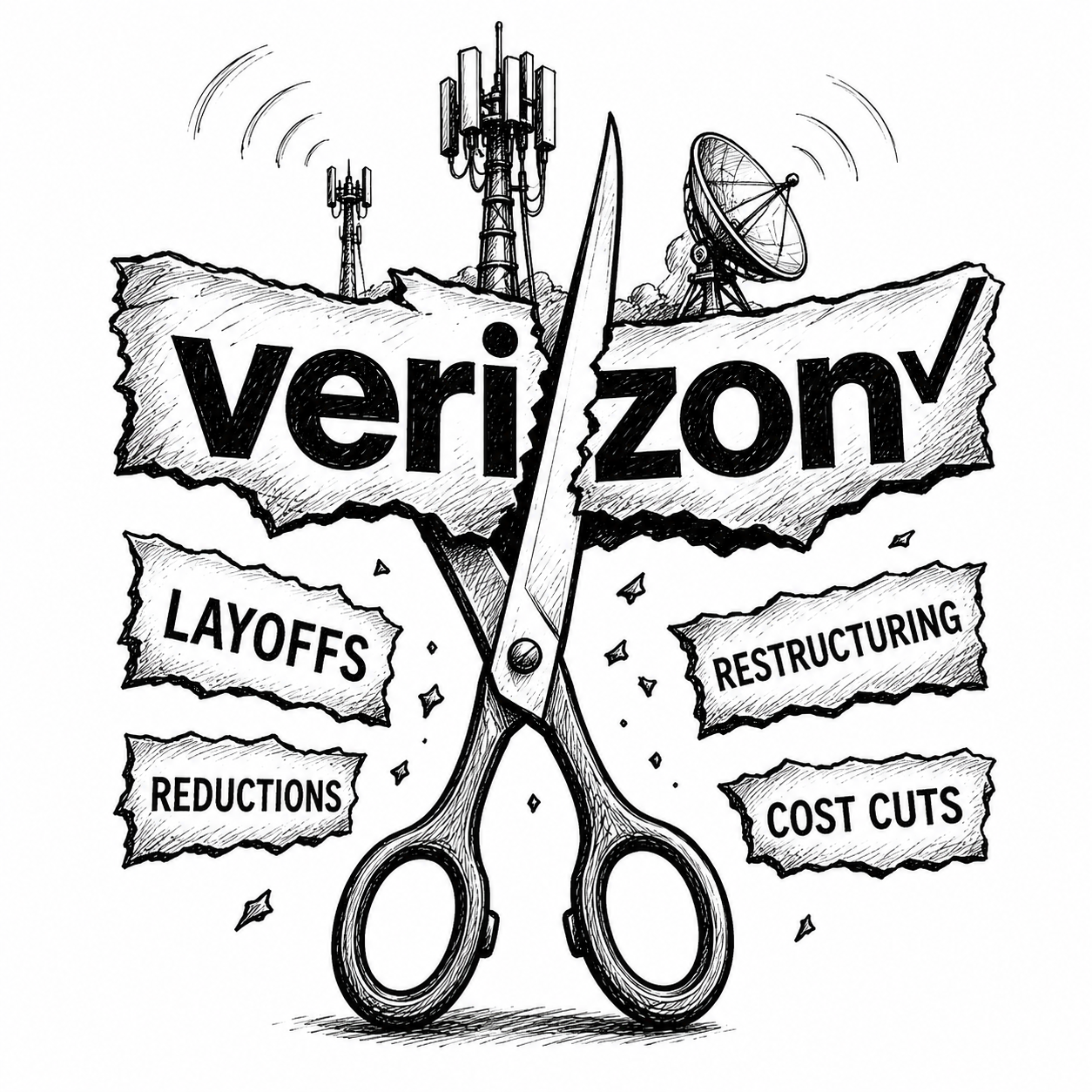
That same dynamic is playing out in corporate labor. Verizon is cutting several hundred jobs while simultaneously raising its annual profit forecast — adding 55,000 monthly bill-paying wireless subscribers in Q1 2026, its first March-quarter subscriber growth in more than a decade, on $34.4 billion in quarterly revenue. The company is not in crisis. It is restructuring toward efficiency, automation, and a leaner operating model — and workers are absorbing the consequence of that pivot. This comes less than six months after Verizon eliminated more than 13,000 positions in the largest workforce reduction in its history. AT&T and T-Mobile are following parallel paths. What’s being dismantled is not just headcount. It’s the implicit contract that stable companies sustain stable workforces.
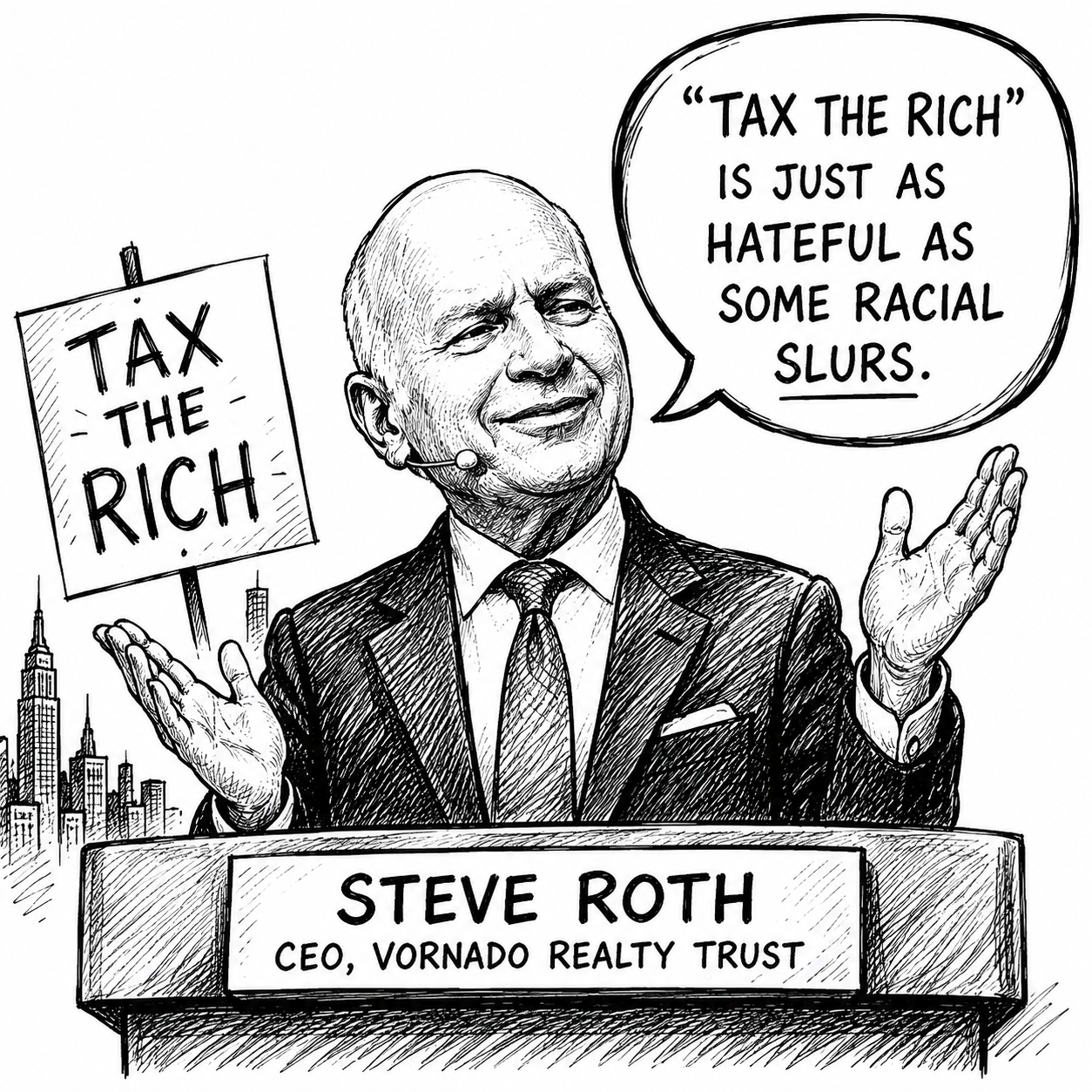
Meanwhile, the Vornado Realty Trust CEO compared “tax the rich” to a racial slur during an earnings call while arguing wealthy individuals should be “praised and thanked” rather than politically targeted. The comment arrived against a backdrop of rising rents, shrinking pathways to homeownership, and deepening post-pandemic inequality. What makes it worth examining is not the remark itself but what it reveals: segments of the ultra-wealthy are increasingly framing their position not as beneficiaries of systems that require maintenance, but as persecuted contributors deserving protection. That rhetorical move shapes the political environment in which decisions about taxation, housing, and public investment get made.
Labor
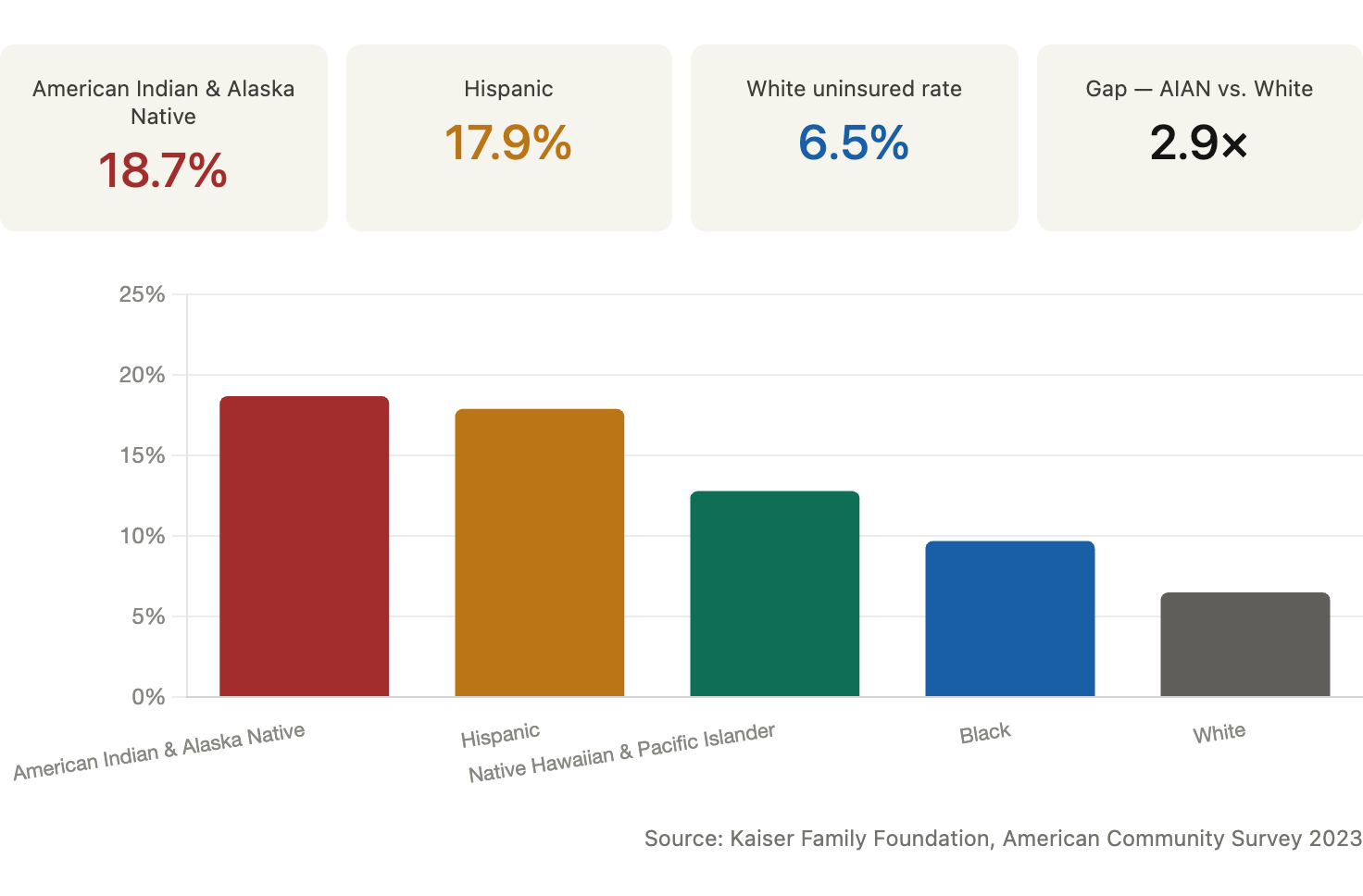
A new Kaiser Family Foundation analysis confirms that the Affordable Care Act never closed the structural gaps determining who has access to care. Drawing on American Community Survey data from 2010 through 2024, the report shows that while uninsured rates dropped across all racial and ethnic groups, American Indian and Alaska Native and Hispanic populations still face uninsured rates approaching 19% — more than double the rate for white individuals. The gains were policy-dependent, not structural. As emergency protections expired, the system reverted — adding more than 1.3 million people without coverage in 2024 alone, the first increase since 2019. KFF projects that current Medicaid and ACA marketplace cuts could push that number higher by 14 million more by 2034, with communities of color positioned to absorb the largest share of those losses.
The data on Black unemployment makes the structural dimension impossible to ignore. While white unemployment has moved just 0.2 percentage points, Black unemployment has climbed to 7.6% — up 1.2 points since the start of the current administration. This is not being driven by a weakening economy. It is being driven by specific policy decisions: federal hiring freezes, DEI rollbacks, and certification changes that removed the exact pathways Black professionals had used most reliably to build economic stability. Black men’s employment-population ratio dropped 1.7 percentage points since Q1 2025, with noncollege graduates absorbing the bulk of that decline. The Economic Policy Institute is clear that these are not coincidental outcomes — they compound over time on household savings, retirement contributions, and generational wealth accumulation in ways that reach well beyond the present moment.
And the closing of Spirit Airlines made that same dynamic visible from a different angle — the workers inside the system experienced its collapse before the passengers did, with pilots moving through narrow windows in shared access systems measured in hours, negotiating their way home in real time while the structure that made their movement routine disappeared underneath them.
Culture

The Oscars drew a line around who gets credit for human performance in the age of AI — and the people most at risk of being displaced are not the ones standing behind it. The Academy’s answer to AI-generated vocal replication is narrower than it appears, and the artists whose work is most vulnerable to that technology are the least represented in the room where the policy was written.
The Reebok x ICECREAM Board Flip re-release landed in Pink Lemonade and Watermelon colorways — and it didn’t ask for permission. In a market that has spent years rewarding neutral palettes and quiet luxury adjacency, that refusal to negotiate is the point.
The internet’s reaction to The Game borrowing Drake’s private jet reflects this same dynamic from a different angle. Online audiences immediately reframed the moment not as status but as dependence — drawing comparisons to getting flewed out, borrowing someone’s car, seeking validation from a figure with more institutional leverage. The ridicule was not really about the jet. It was about what the relationship surrounding the jet appeared to communicate. Online audiences have become increasingly attuned to the difference between access and autonomy — and when those two things appear to be in tension, autonomy wins the interpretation every time.
NPR’s $113 million philanthropic rescue is the infrastructure story that connects everything else. Congress eliminated all federal funding for public broadcasting. Two major charitable gifts arrived to help stabilize the institution — and even with that, NPR leadership has not ruled out future layoffs. That detail is the whole story. Philanthropy can fund innovation. It cannot replace the predictability of public investment. What is being quietly decided right now is whether trusted journalism infrastructure is something the public funds as a collective good — or something that survives only when wealthy donors decide it is worth preserving. That is not a media question. It is a democracy question.
Travel
Air India is scaling back select long-haul routes between May and July — affecting flights to Europe, North America, Australia, and Singapore. The framing is operational adjustment. The mechanism is structural. Jet fuel costs are up as much as 14 percent year-over-year, and Iran-related airspace restrictions are forcing reroutes that add flight time and fuel burn to routes already operating on compressed margins. When those two pressures converge on a single long-haul route, a profitable connection becomes marginal. A marginal one gets cut. Global travel is not shutting down. It is becoming more expensive to sustain — and the routes that go first are rarely the ones serving the travelers with the most options.
Politics
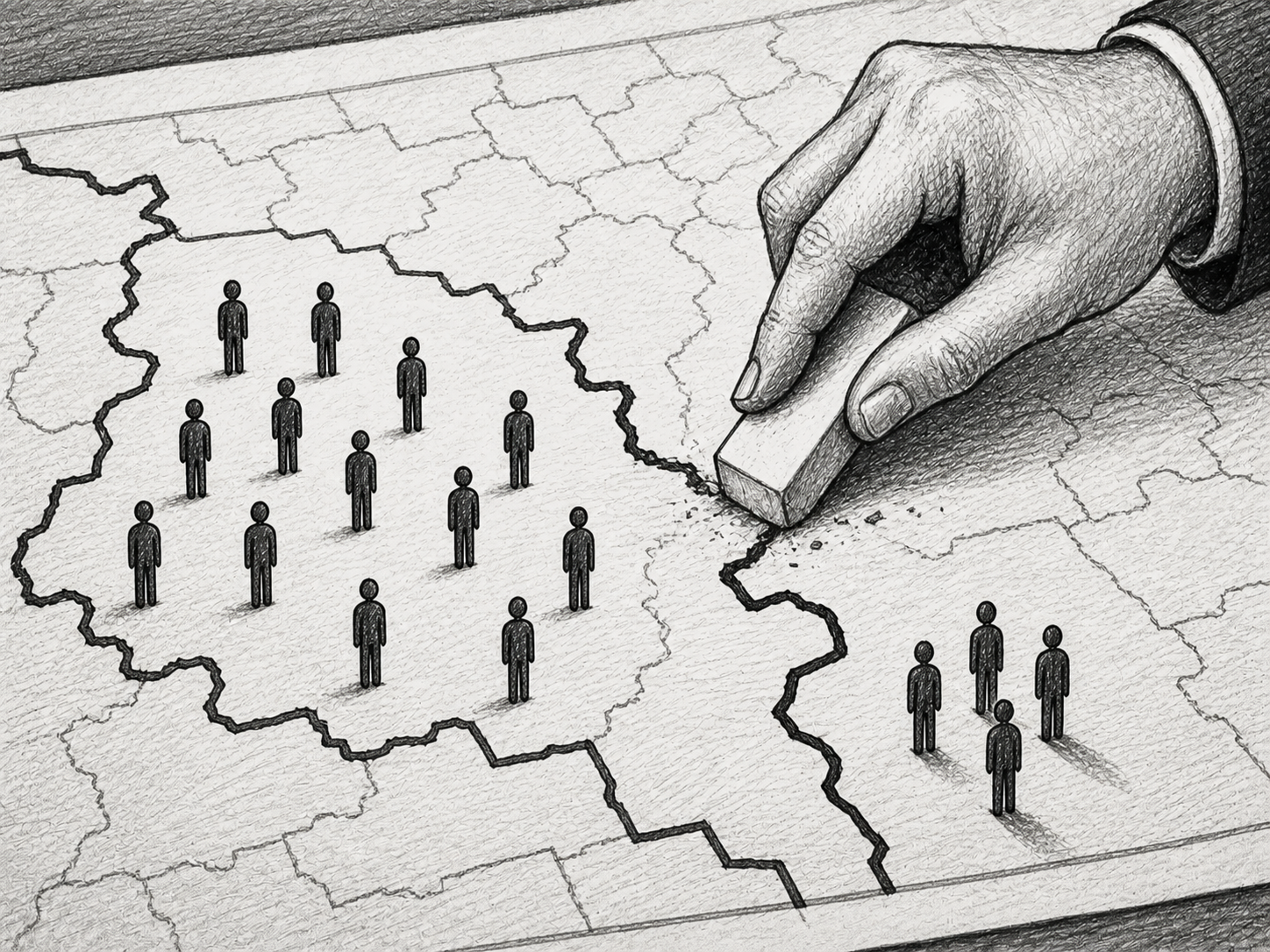
For the first time in decades, the Republican Party will have no Black representation in its congressional ranks — and the path that produced that absence is more instructive than the absence itself. The last Black Republican in the House didn’t lose an election. He left to run for Senate. So did another. A third is navigating a redrawn district that made his seat structurally unwinnable. A fourth is simply done. The outcomes are different. The result is the same. Representation doesn’t disappear all at once. It phases out through structure — through redistricting, through the incentive systems that shape who runs and who stays, through the accumulated weight of decisions that each look procedural in isolation.
What today’s stories share is not a single crisis or a single sector. It is a single pattern: the distance between what systems claim to produce and what they actually deliver — and who absorbs the weight of that distance when it goes unexamined.
We will be watching.
The Daily Visual Signal
A visual interpretation of the deeper systems, tensions, and structural shifts shaping the current moment — designed to translate complex societal changes into a single image.
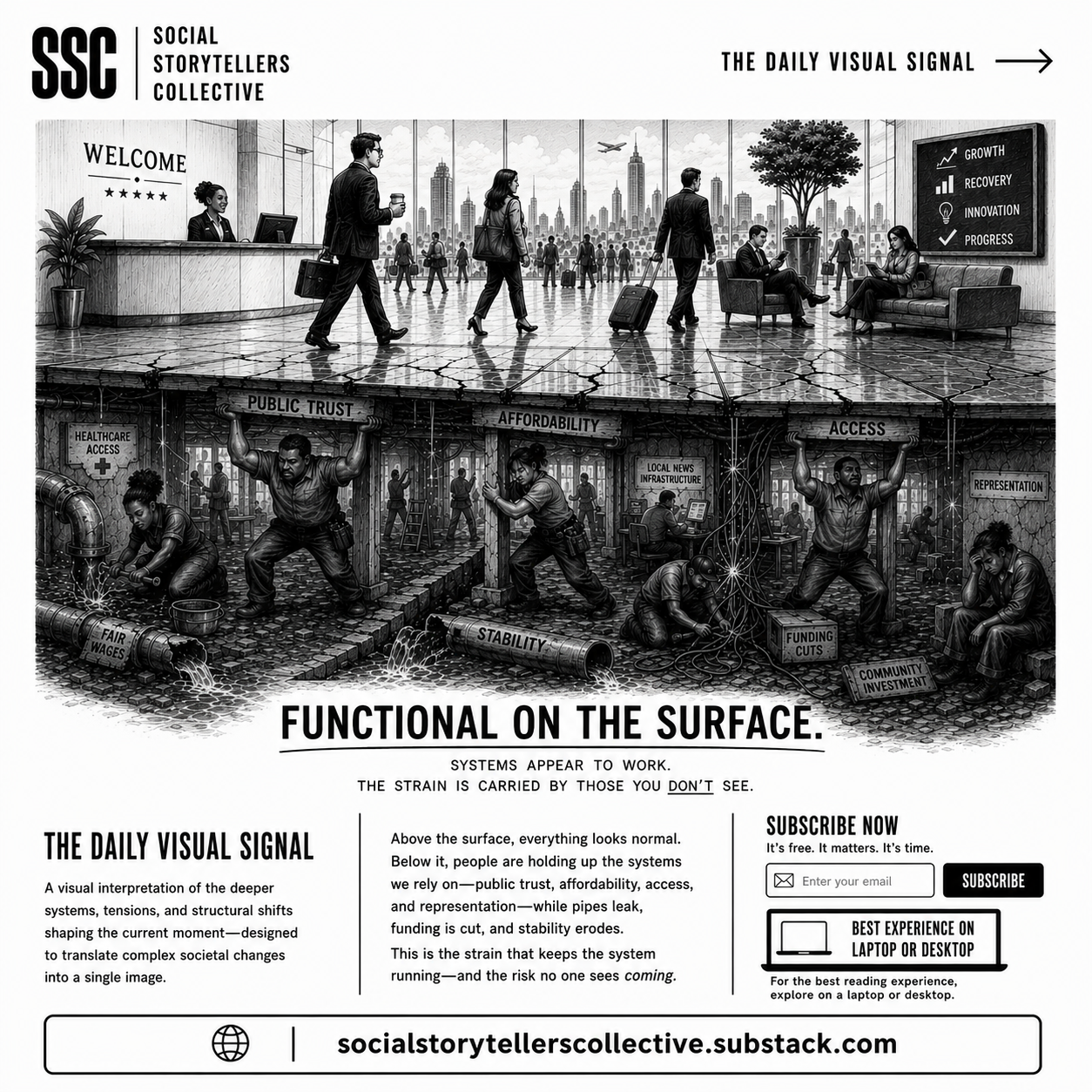
Functional on the Surface. Many of today’s systems still appear operational from the outside. Flights still depart. Markets still grow. Newsrooms still publish. Healthcare systems still function. But underneath the surface, the pressure required to maintain that appearance is becoming increasingly unevenly distributed. The instability is not always visible in the presentation. It is visible in who is being asked to absorb the strain required to keep everything appearing normal.
Featured Story
AI Adoption Is Becoming a Workplace Compliance Metric
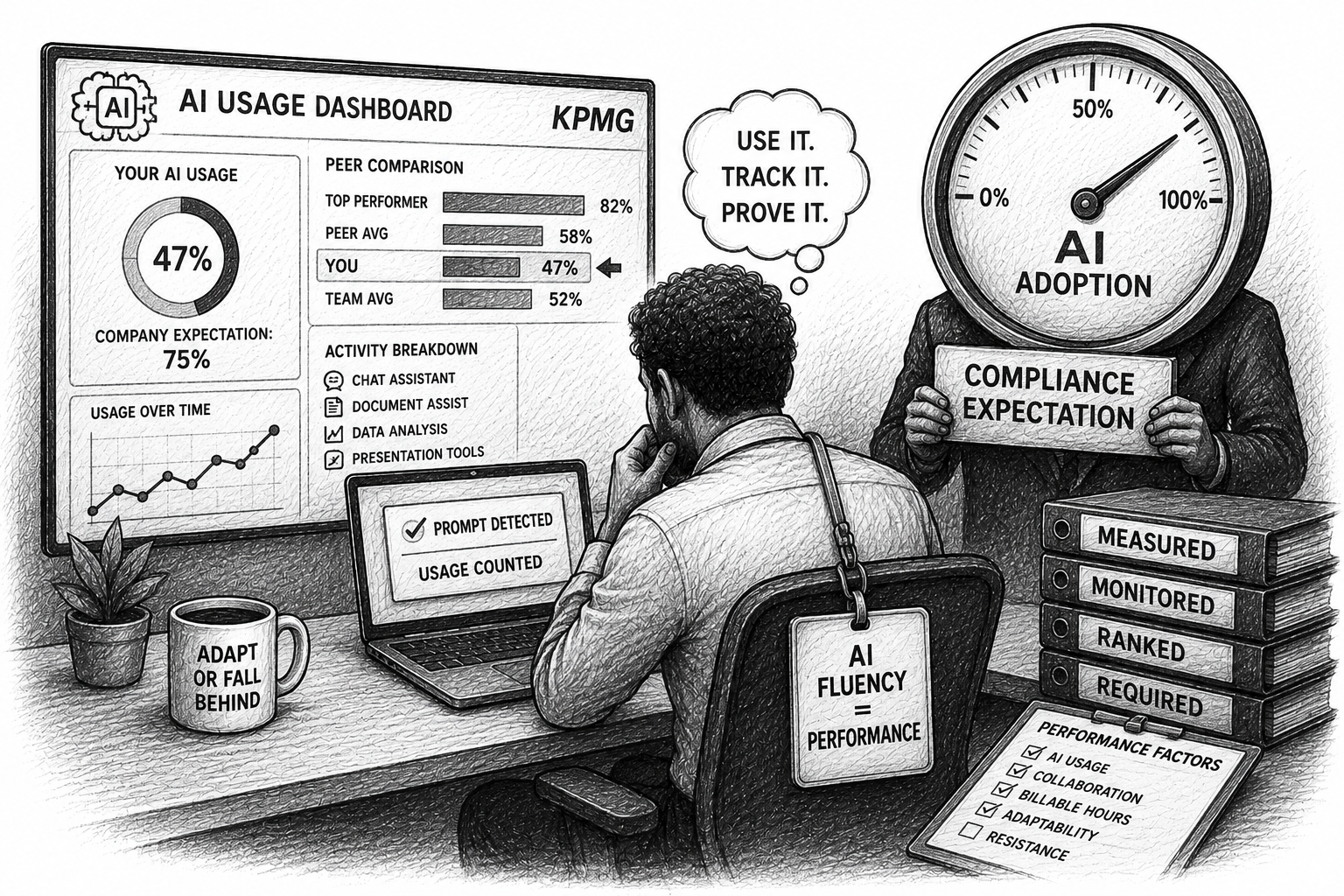
KPMG is now tracking how frequently employees use AI tools, comparing workers against peers, and measuring progress toward internal usage targets — with some employees expected to hit 75% AI usage rates. What looks like a modernization initiative is something more structural: AI is no longer being introduced as a tool workers can leverage if useful. It is becoming something workers are expected to visibly perform. And as Meta’s recently reported Model Capability Initiative revealed, one company is measuring whether workers use AI enough while another is using workers’ behavior to build the AI itself. The direction of both moves is the same — labor is becoming legible to institutions in ways it never previously was.
Read the full piece on Social Storytellers Collective.