
Over one million Black households now hold $1 million or more in net worth. That number is real, it is historically significant, and it deserves to be named without qualification. A decade of gains in entrepreneurship, equity market participation, and professional income growth has produced a measurable expansion of Black wealth at the top of the distribution. The visibility of that growth — across industries, cities, and cultural influence — reflects something genuine about what economic access, when it arrives, can produce.
The number that sits next to it is the one the headline tends to leave out.
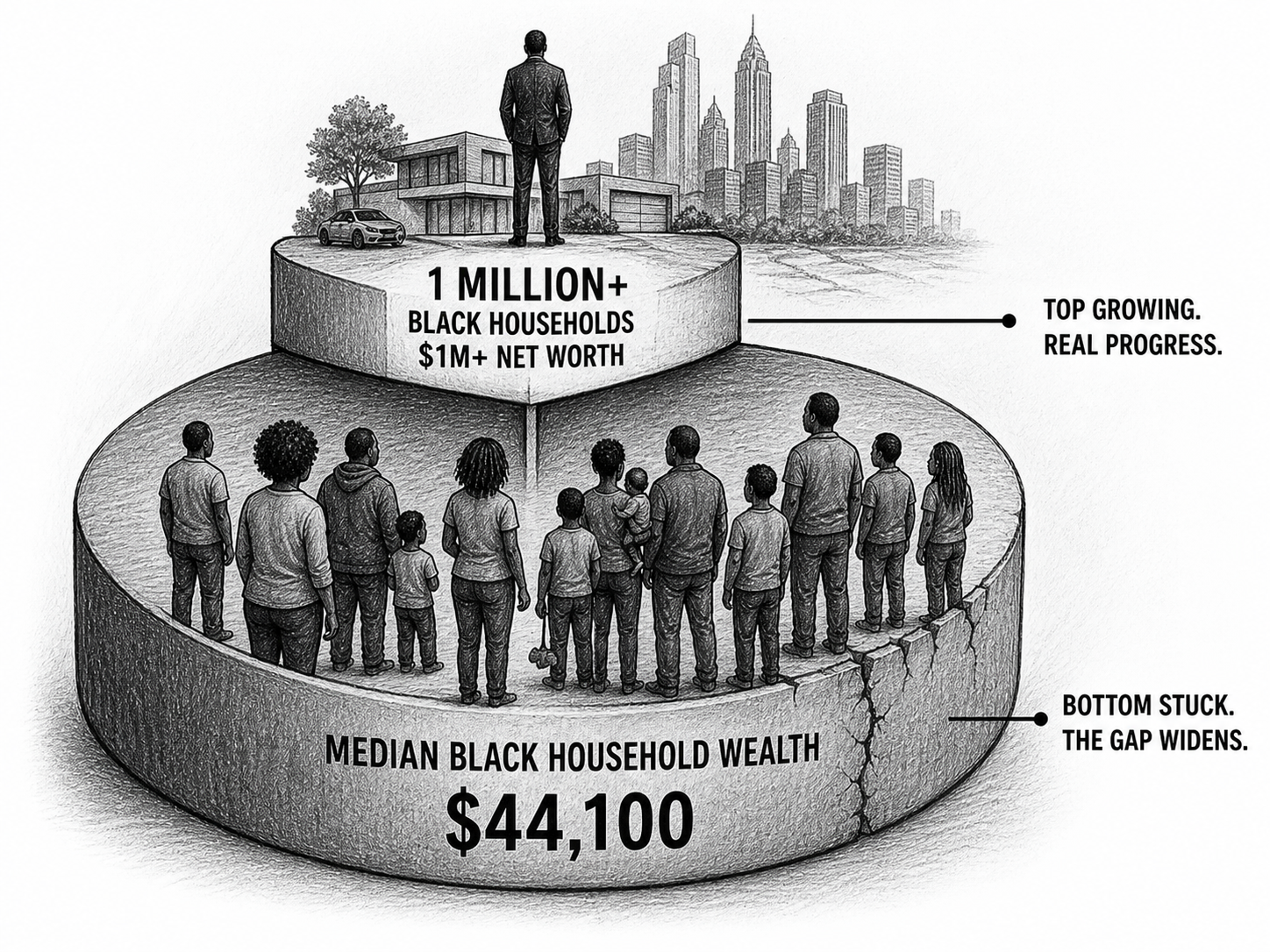
Black median household wealth stands at $44,100. White median household wealth stands at $284,310. That gap — $240,210 in absolute terms — is not closing. Between 2019 and 2022, Black families’ median net worth rose 57.8 percent. The dollar movement underneath that percentage tells the actual story: from $27,940 to $44,100, while white families moved from $219,210 to $284,310. The rate of growth looks like progress. The absolute gap widened. Both things are true simultaneously, and understanding which one is doing the most structural work is the analysis that matters.
As SSC has documented, the homeownership gap — the primary mechanism through which American families build the wealth that funds education, absorbs emergencies, and transfers across generations — is now wider than it was the day the Fair Housing Act was signed — 28.4 percentage points in 2026 compared to 27 in 1968. The millionaire class growing at the top of the Black wealth distribution is not insulated from that structural reality. It exists alongside it. A community can produce more millionaires and still have a median wealth figure that leaves the majority of its households one emergency away from financial instability. Those two facts describe the same distribution from different ends.
The system shaping that distribution has a specific architecture. Black households that do reach homeownership revert to renting at nearly four times the rate of white households in the same age cohort — 34 percent versus 9 percent for first-time buyers over 44. That reversion rate is the mechanism through which the wealth-building cycle breaks down in practice. It’s not just that fewer Black households enter homeownership. It’s that fewer of the ones who do manage to stay in it long enough for it to accumulate into something transferable. As SSC has reported, the labor market conditions producing the Black Recession are compressing the income base from which wealth accumulation begins — Black unemployment at 7.5 percent, nearly double the national average, arriving precisely when the DEI infrastructure that had slowed the last-hired-first-fired dynamic was being dismantled.
The growth in Black millionaires is not a sign that the system is working. It is a sign that some people are succeeding despite it — which is a different claim entirely. Progress at the top of a distribution that remains structurally compressed at the middle and bottom is not the same as progress in the distribution. The story is not just how many have crossed the threshold. It is how the system continues to shape who can follow, and at what pace.