A schedule change is rarely just a schedule change. Air India’s decision to scale back select long-haul routes between May and July — affecting flights to Europe, North America, Australia, and Singapore — is being reported as an operational adjustment. The mechanism driving it is more structural than that.
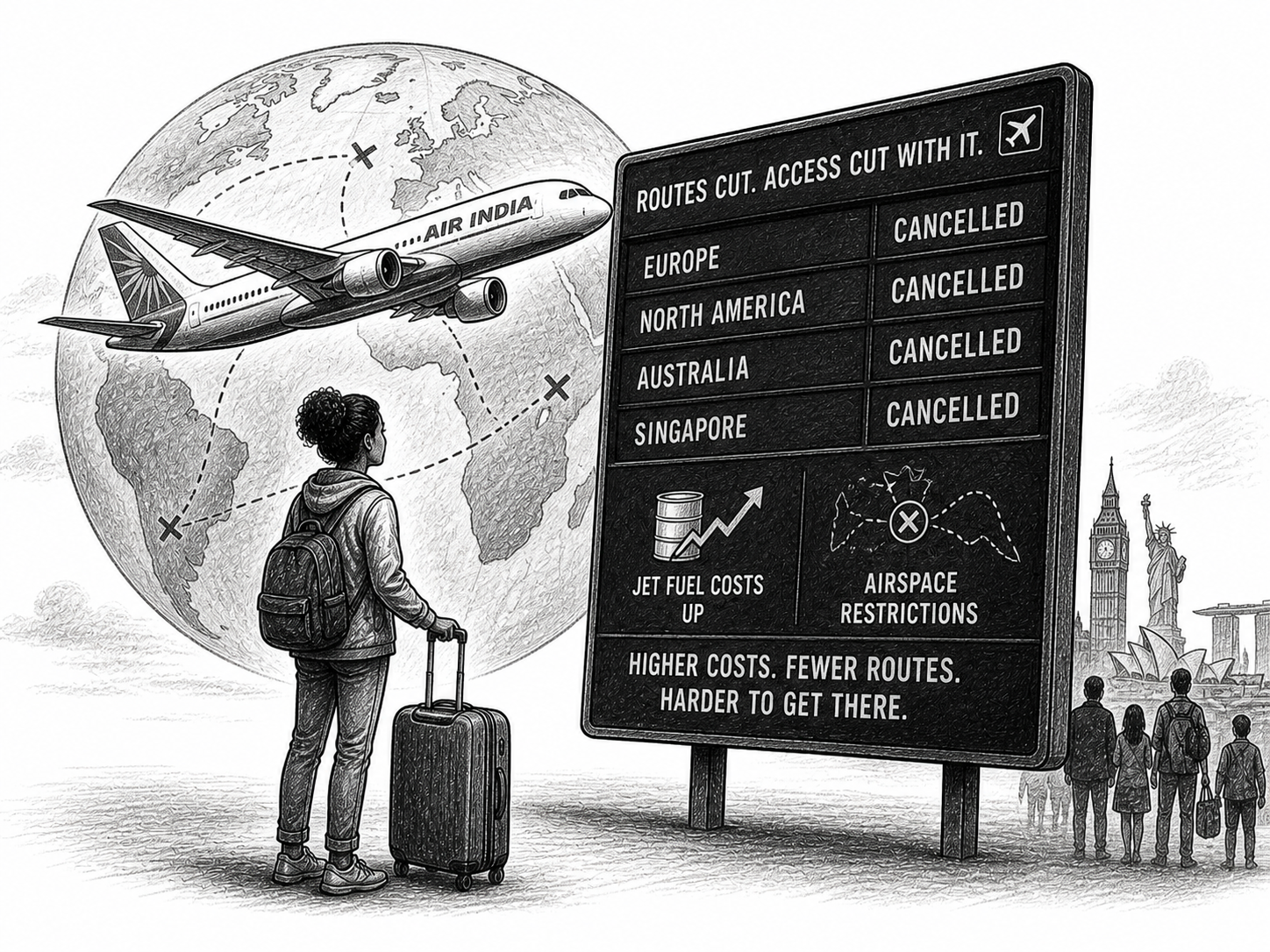
Two forces are converging simultaneously. Jet fuel costs remain volatile, with fuel expenses rising as much as 14 percent year-over-year for major carriers in early 2026. At the same time, Iran-related airspace restrictions are forcing airlines to reroute flights around closed corridors, adding flight time and fuel burn to routes that were already operating on compressed margins. When those two pressures meet on a single long-haul route, the economics shift quickly. A profitable connection becomes a marginal one. A marginal one gets cut.
SSC has documented how fuel volatility moves through aviation systems — not as a single visible collapse but as a series of quiet adjustments that accumulate into a different cost reality for travelers. Baggage fees rise. Routes are trimmed. Frequencies are reduced. Each decision is defensible in isolation. Together they add up to a system that is functioning but contracting — and contracting in ways that are not evenly distributed across the people who depend on it.
That distribution is the part worth watching. When airlines optimize under pressure, they don’t cut equally across their network. They cut where margins are thinnest and where demand is least concentrated among high-yield travelers. The routes most likely to face reduction are the ones serving price-sensitive passengers — diaspora travelers, students, families making once-a-year international trips on budgets that don’t absorb fare increases the way business class does. The travelers least equipped to absorb rising costs are the ones who depend most on route stability — and the removal of a route doesn’t just inconvenience them. It removes the condition of participation entirely.
Air India’s adjustment is a single data point in a pattern that is building across global aviation. Geopolitical instability is closing airspace. Energy volatility is compressing margins. And the system’s response — reduce, optimize, redistribute capacity toward higher-yield routes — is structurally identical regardless of which carrier is making the decision. Global travel isn’t shutting down. It is becoming more expensive to sustain at the access level where it matters most.
The schedule change is the visible part. The quiet narrowing of who can afford to move through the global system is the story underneath it.