
In 2023, a viral track called “Heart on My Sleeve” circulated across streaming platforms featuring AI-generated vocals designed to sound exactly like Drake and The Weeknd. Universal Music Group had it pulled. But before it disappeared, it had already demonstrated something the industry couldn’t un-see: the tools to replicate a recognizable human performance had arrived, they were accessible, and the system had no clear answer for what to do with them. The Academy of Motion Picture Arts and Sciences has now offered its answer — and it is narrower than it appears.
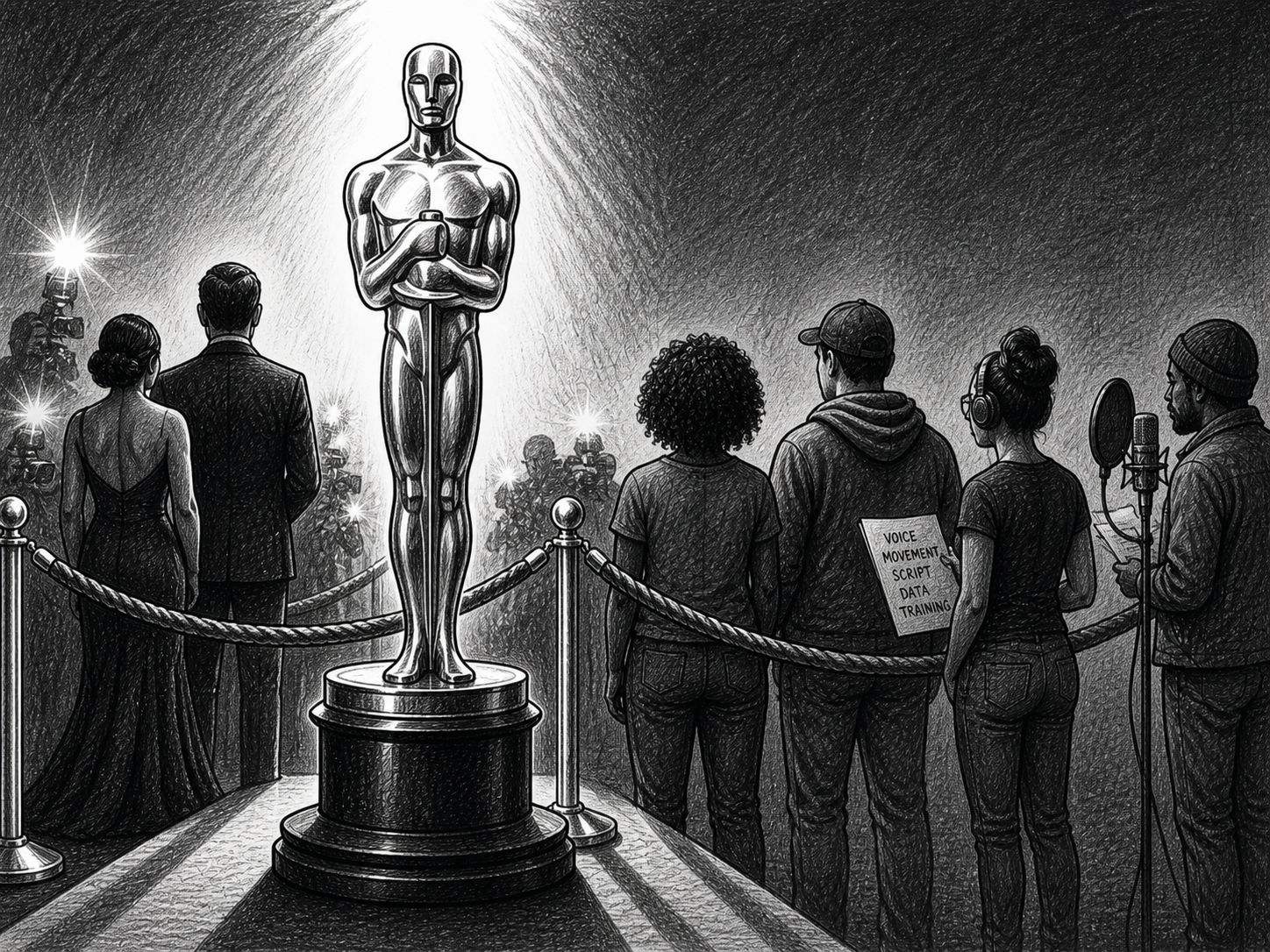
The new eligibility rules are precise in their intent: performances must be demonstrably human, and screenwriting must be credited to human creators in order to qualify for Oscar recognition. Studios can still use AI across a wide range of production processes — editing, visual effects, pre-visualization, early-stage writing support. What the Academy is drawing a boundary around is attribution. Awards are not just about output. They are about who is recognized as the origin of that work. In that sense, the rule is less about technology and more about ownership — and ownership, in the creative industries, has always been unevenly distributed before the question of AI ever entered the room.
As SSC has documented in its examination of how hitmaker relationships shape creative credit, the sound audiences associate with an artist is rarely the product of a single author. It is the accumulated output of producers, session musicians, co-writers, vocal arrangers, and background performers — many of whom receive limited credit and more limited compensation. The Academy’s rule protects the top layer of that system: the named performer, the credited screenwriter, the above-the-line creative whose work is legible enough to the institution to be nominated. It does not protect the layer underneath.
That layer is where the AI displacement risk is most acute and least discussed. The workers most vulnerable to AI voice and likeness replication are not the A-list performers whose names appear above the title. They are the working-class creatives — the voice actors who narrate audiobooks and animated series, the background performers whose facial expressions and movement patterns are being trained on without consent or compensation, the mid-tier screenwriters whose sample scripts have been absorbed into large language models without attribution. Many of them are writers and performers of color whose cultural production has historically generated commercial value that didn’t return to them. AI replication doesn’t just threaten their future work. It is being built on their past work — and the Academy’s eligibility rule does nothing to address that extraction.
The parallel to what Spotify is navigating with its human verification badge is precise — both institutions are drawing lines around authenticity in response to AI scale, and both are doing so in ways that protect the most visible and already-resourced creators while leaving the structural vulnerability of smaller, less institutionally connected artists largely intact. Spotify’s verification criteria ties authenticity to engagement metrics, touring history, and social presence — thresholds that emerging and independent artists, particularly those without label infrastructure, may not meet. The Academy’s eligibility rules tie recognition to above-the-line credit structures that were already designed to concentrate attribution at the top. In both cases, the line being drawn is real. It is just not drawn around the people who need the protection most.
What the Academy has done is an early governance decision, not a final one. The pressure on these definitions will only increase as AI tools grow more capable of mimicking human voice, movement, and narrative structure across longer and more complex outputs. By acting now, the Academy is attempting to stabilize the value of its categories before those lines blur beyond recognition — a legitimate institutional instinct. But the categories being stabilized were already built on credit structures that systematically undervalued certain kinds of creative labor. Protecting those categories without examining those structures doesn’t resolve the problem. It preserves it with a new rationale.
The Oscar rule signals that the industry understands what is at stake. What it hasn’t yet demonstrated is whether it understands for whom.