
Costa Rica will let you live there for up to two years without paying local income tax — if your money comes from somewhere else. That framing, widely circulated through social media, reads like a lifestyle upgrade. Sun, ocean, remote work, lower tax burden. But the policy itself tells a more structural story. This is not a tourism incentive and it’s not a traditional immigration pathway. It’s a targeted strategy to pull foreign-earned income into the local economy without taking on the long-term obligations that usually come with population growth.
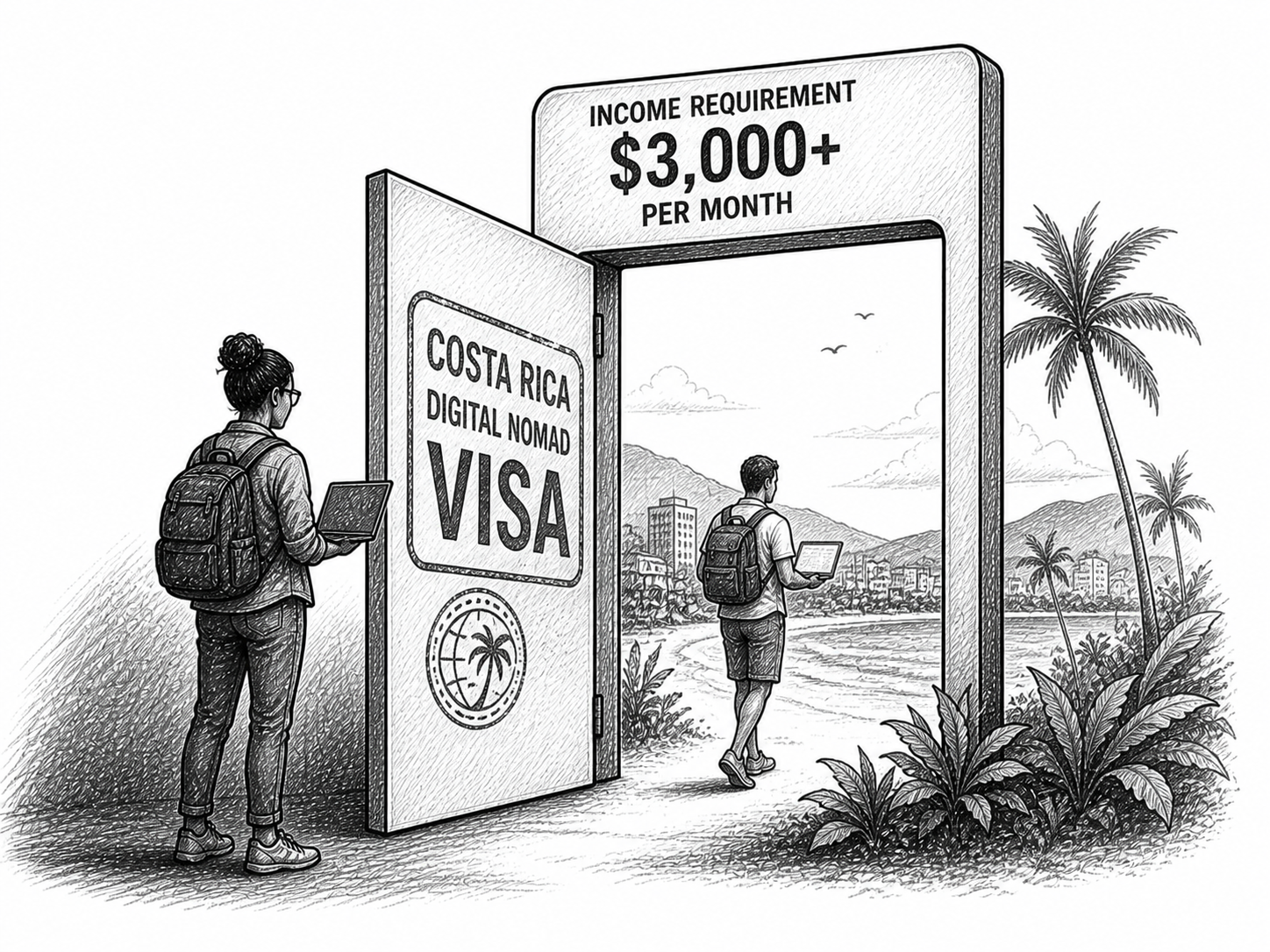
The mechanics of the program make that intent explicit. Applicants must prove a steady monthly income of at least $3,000 — $4,000 if they’re bringing family members — and that income must originate outside Costa Rica. Visa holders are not allowed to work for local employers, which removes them from the domestic labor market entirely. In exchange, they receive temporary residency status and exemption from Costa Rican income taxes on that foreign income. The country is not trying to create jobs for these residents. It is trying to redirect how and where their existing income is spent.
That distinction marks a shift in how national economies are thinking about growth. For decades, the dominant model was to attract companies — build infrastructure, offer incentives, create jobs, and hope those jobs anchor long-term population and tax revenue. The digital nomad visa flips that model. Instead of importing employers, countries import earners. Instead of building jobs, they capture consumption. Rent, groceries, transportation, dining, healthcare, and services become the primary economic inputs, funded by income generated elsewhere. It is a different kind of development strategy — lighter on infrastructure commitments, faster to implement, and more flexible in how it scales.
There is a reason the requirements are calibrated the way they are. A $3,000 monthly income threshold filters for a specific class of remote worker — one with enough disposable income to meaningfully participate in the local economy but not necessarily enough to drive up the highest tiers of the housing market alone. The tax exemption sweetens the offer, effectively increasing purchasing power while making Costa Rica more competitive against other countries running similar programs. What the country captures is steady, predictable spending without needing to subsidize job creation or absorb the volatility of local employment cycles.
The limitations of the visa are just as revealing as the benefits. It does not provide a direct path to permanent residency or citizenship — a signal that this is not designed as a long-term population strategy. It is a controlled inflow: time-bound, conditional, and reversible. That allows Costa Rica to benefit from the economic activity without fully integrating these residents into public systems like long-term healthcare, pensions, or political representation. It is participation without permanence — a model that maximizes short-term economic gain while limiting long-term obligations.
What is happening in Costa Rica is not isolated. Countries across Latin America, Europe, and Southeast Asia are rolling out variations of the same policy, competing for a growing class of location-independent workers. The underlying trend is that income is becoming increasingly detached from geography. A software developer paid by a U.S. company can live in San José. A content strategist working for a New York firm can base themselves in Lisbon. As that decoupling accelerates, countries are adjusting their policies to capture the downstream effects — housing demand, consumer spending, and local economic activity.
But the image of who this lifestyle is designed for has never fully matched who it could transform. As SSC has documented, the return-to-office movement isn’t primarily about productivity — it’s about the reassertion of physical presence as a proxy for professional legitimacy, a shift that lands hardest on Black knowledge workers for whom remote work offered something the office historically hadn’t: the ability to be evaluated on output rather than navigated through the informal politics of environments that weren’t built for them. Location independence, for those workers, wasn’t a lifestyle preference. It was a structural advantage that changed the terms of their careers. And as SSC has covered in its quiet cutting analysis, the workers most likely to be quietly sidelined — through reduced responsibilities, budget freezes, and informal exclusion — are the same workers for whom remote work had provided the most protection. The digital nomad pathway extended that logic globally: if the workplace is the problem, remove the workplace from the equation entirely.
Which makes the income filter the most consequential and least discussed dimension of these programs. A $3,000 monthly income floor doesn’t just screen for financial stability — it screens for the industries, employment structures, and career trajectories that produce that kind of income reliably on a remote basis. That’s a narrower lane than the lifestyle content suggests. It favors workers in digital, knowledge-based, or client-service roles that can operate across borders. It favors those with stable income streams and the flexibility to relocate. The Black professionals, Latino freelancers, and workers of color who pursued location independence precisely as a route around workplace discrimination — who needed the exit most — are the ones most likely to fall just below the threshold that makes the exit available.
What looks like a broad lifestyle trend is, in practice, a selection mechanism. Costa Rica’s digital nomad visa invites a specific type of resident — one who brings income but does not compete for local jobs, one who spends but does not fully integrate, one who stays long enough to matter economically but not long enough to reshape the system. That balance is the point. The policy is less about welcoming people and more about positioning the country within a global shift where work moves freely, but systems still decide how that movement is monetized — and who gets to move with it.