
China’s announcement of a zero-tariff policy covering 53 African nations is being reported as a trade story. It is more precisely a power story — one about who sets the terms of economic relationship with the African continent when the United States is actively contracting its own engagement.
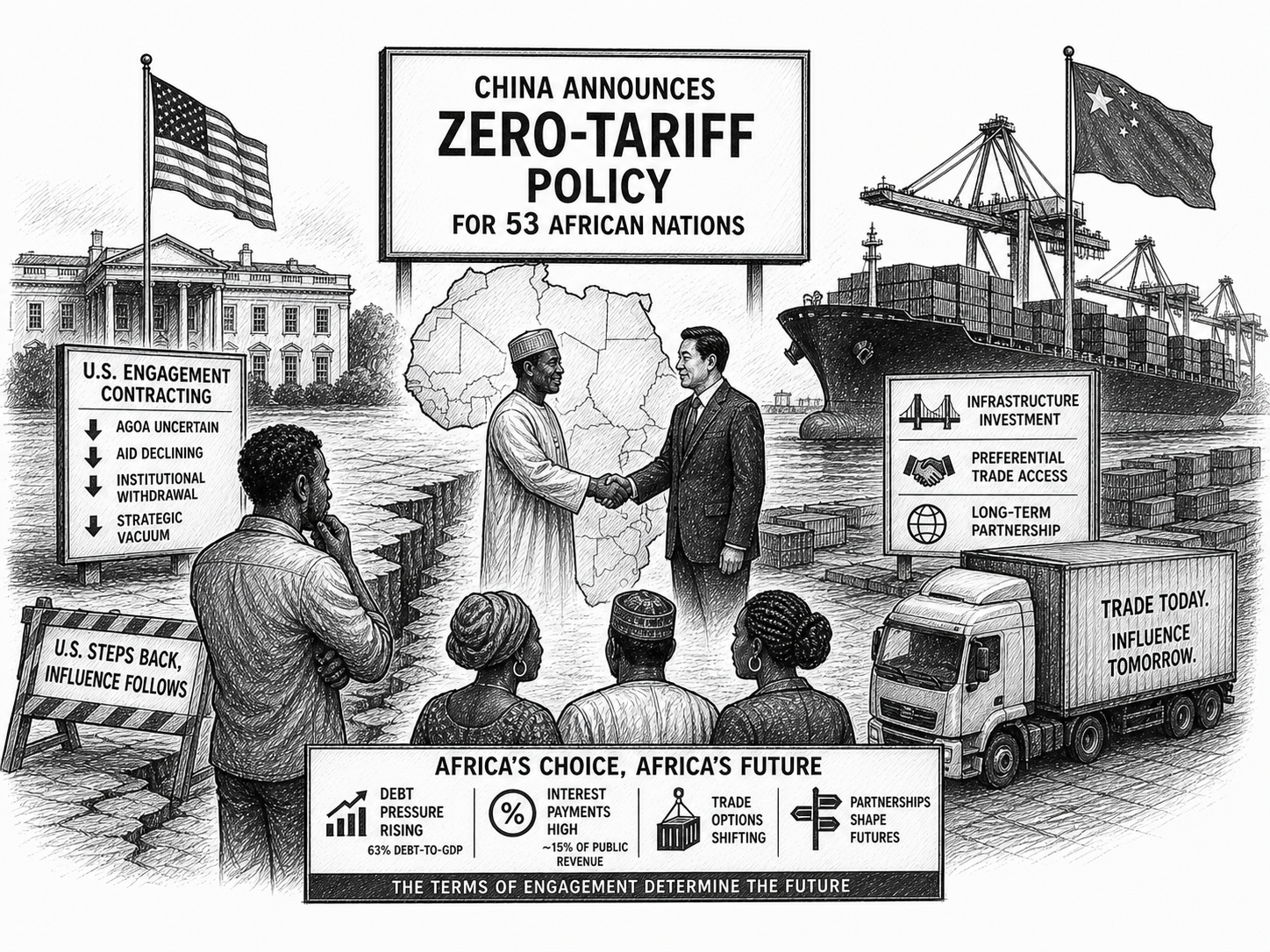
The context matters. The African Growth and Opportunity Act faces ongoing uncertainty. U.S. development assistance to the continent is declining. The current administration’s Africa policy is defined less by strategy than by withdrawal — from multilateral commitments, from preferential trade frameworks, and from the kind of sustained institutional engagement that builds durable economic relationships. Against that backdrop, China’s zero-tariff announcement isn’t just a trade preference. It’s an offer to fill a vacuum, and it arrives at a moment when the vacuum is visible and measurable. SSC has documented how that withdrawal dynamic operates in practice — when U.S. funding recedes, community labor and alternative partnerships fill the gap, and the system appears stable until the accumulated pressure makes it visible. The trade vacuum China is filling operates on the same logic, at a larger scale.
The structural logic of China’s positioning has been consistent across two decades: build infrastructure relationships, extend preferential trade access, create economic dependencies, and accumulate the geopolitical influence that follows. This isn’t a secret strategy — it’s been documented extensively. What’s less examined is how the U.S. withdrawal accelerates the timeline. Every time a preferential trade relationship with the U.S. becomes uncertain, the relative value of China’s offer increases. Every time development assistance contracts, infrastructure financing from Chinese institutions becomes more attractive to governments that have capital needs and limited alternatives. That dynamic has a specific shape in resource-rich African nations — where health aid, mineral access, and trade relationships operate in overlapping lanes, and the structural pressure of that overlap doesn’t require a written ultimatum to function as leverage.
For African nations navigating this dynamic, the calculus is pragmatic rather than ideological. Africa’s average public debt-to-GDP ratio is approaching 63 percent, with interest payments absorbing nearly 15 percent of public revenue across the continent. In that fiscal environment, zero-tariff access to the world’s largest manufacturing economy isn’t a geopolitical abstraction — it’s a concrete economic input that affects government budget math and trade flow projections. South Africa and Kenya’s welcoming response reflects that math, not naivety about China’s strategic intentions.
What’s at stake in the longer term is the architecture of Africa’s economic integration into the global system. Trade relationships create infrastructure dependencies. Infrastructure dependencies shape regulatory alignment. Regulatory alignment influences political orientation. The countries that build the most significant trade and infrastructure relationships with African nations in the next decade will have disproportionate influence over how African economies are structured — what they produce, how they move goods, who they partner with, and whose standards they adopt.
The U.S. has historically used that influence position to advance democratic governance, civil society, and rule-of-law frameworks alongside economic engagement — imperfectly and inconsistently, but as an explicit part of the relationship. China’s framework is different: non-interference in domestic governance in exchange for economic access. As U.S. engagement contracts, so does the leverage that came with it. What fills that space won’t look like what was there before.