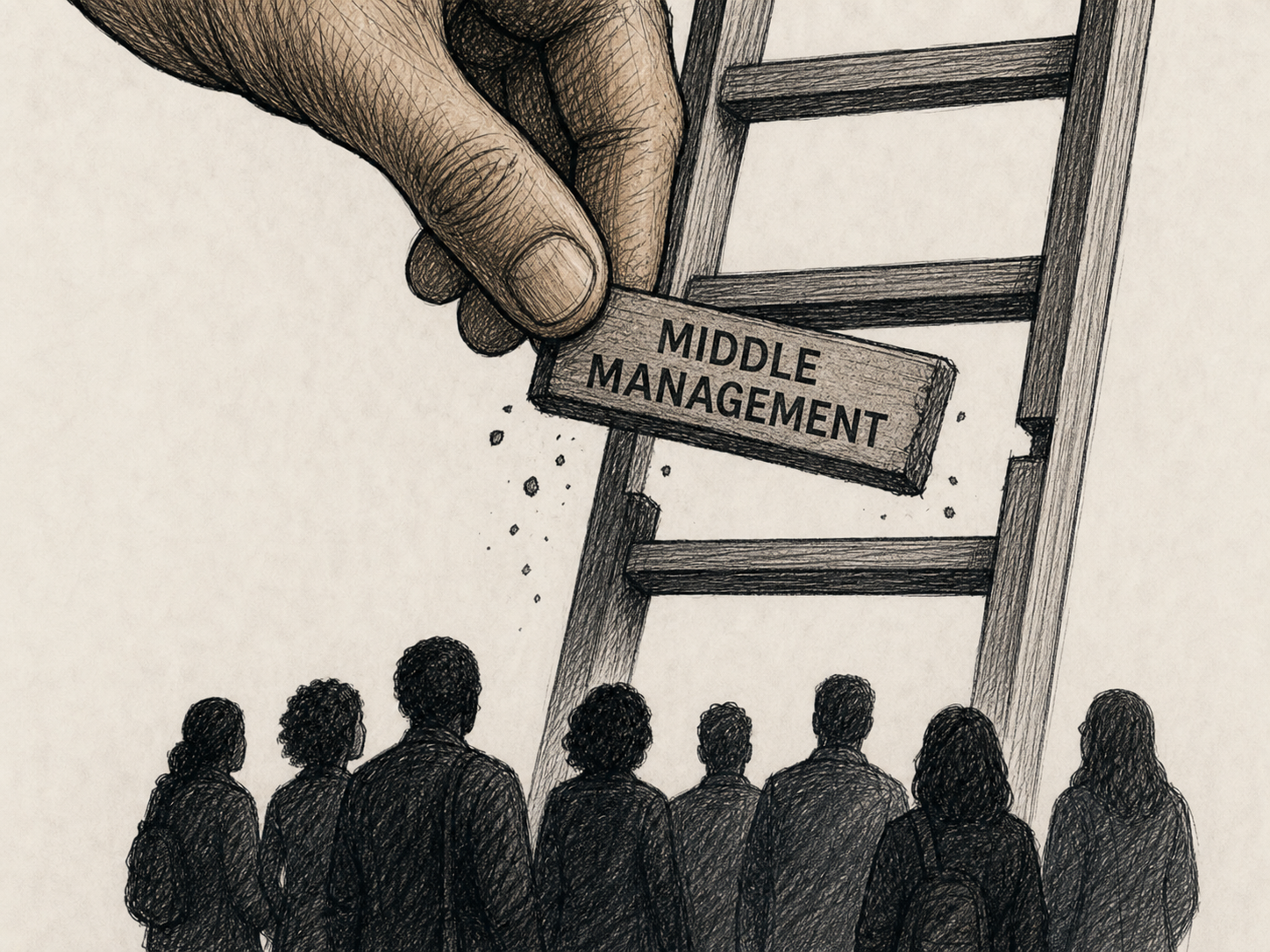
The conversation around AI and jobs has concentrated on two endpoints: the displaced factory worker and the displaced knowledge worker. What’s getting less attention is the middle — specifically, middle management — and why its elimination carries structural consequences that extend well beyond corporate efficiency.
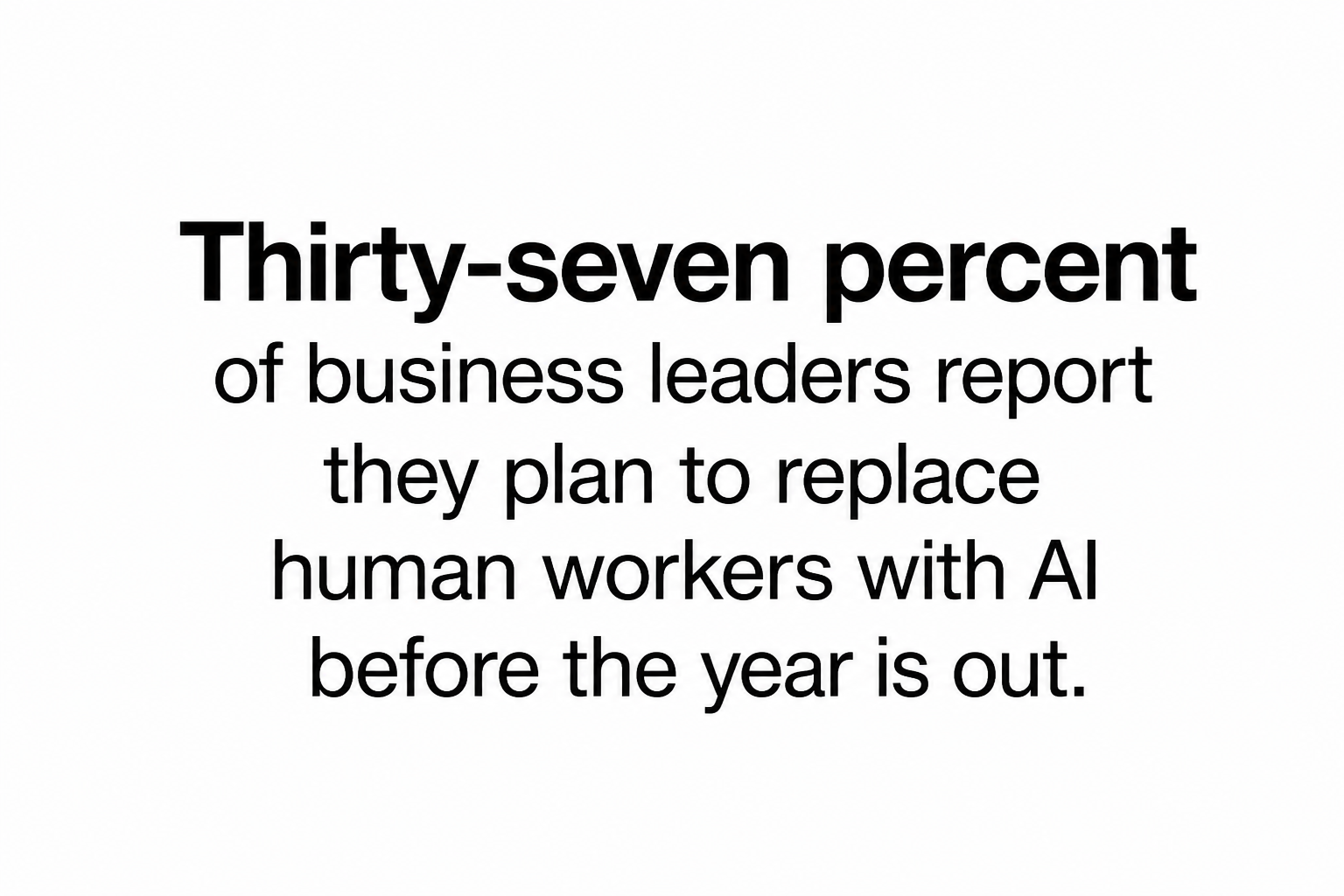
By the end of 2026, 20 percent of organizations are expected to use AI to flatten their hierarchies, eliminating over half of current middle management positions in the process. Thirty-seven percent of business leaders report they plan to replace human workers with AI before the year is out. The jobs in the crosshairs — accounting, compliance monitoring, junior software development, financial modeling, contract review, paralegal summarization — are precisely the roles that have functioned as the primary on-ramp to organizational seniority for workers who entered industries after the barriers to entry began to lower.
That timing matters. Middle management didn’t become accessible to Black and Latino professionals through some natural evolution of the labor market. It became accessible through decades of civil rights legislation, affirmative action infrastructure, corporate diversity commitments, and the gradual accumulation of tenure by workers who entered industries that had previously excluded them. That infrastructure is already under assault from a different direction— DEI rollbacks, federal equity program eliminations, and the dismantling of the institutional frameworks that created the on-ramp in the first place. AI hierarchy flattening isn’t arriving into a stable environment. It’s arriving into one where the protective infrastructure is already being removed. The result was a professional tier that — while still inequitably distributed at the top — had begun to reflect something closer to workforce demographics at the middle. AI-driven hierarchy flattening doesn’t eliminate middle management neutrally. It eliminates it at the exact moment when the workers who most recently gained access to it have the least tenure to protect them from displacement.
The efficiency logic is clean from a corporate perspective. Fewer management layers mean faster decisions, lower overhead, and leaner organizational structures that can respond to AI-driven workflow changes. Goldman Sachs projects that entry-level workers in their 20s and 30s entering knowledge sectors will be most affected — not the senior leaders making the automation decisions, and not the technical workers building the tools. The impact concentrates in the middle, among workers who are early enough in their careers to lack organizational protection and recent enough in their industry access to lack the accumulated capital that makes displacement survivable. That dynamic is already visible in the labor market data — Black unemployment at 7.5 percent, nearly double the national average, produced by the same last-hired-first-fired logic that AI displacement is now extending into white-collar sectors.
What makes this structurally significant rather than just economically disruptive is the compounding effect. Workers displaced from middle management in 2026 don’t just lose a job — they lose the tenure accumulation, the professional network density, and the organizational credibility that middle management positions are specifically designed to build. Those are the inputs to senior leadership. Remove the rung and you don’t just slow the climb — you eliminate the pathway.
The AI displacement conversation needs to stop treating this as a neutral technological transition and start asking who specifically is losing what, and why the distribution of that loss tracks so precisely onto the same communities that have spent the last fifty years building the access the transition is now erasing.