
Mayor Zohran Mamdani’s Preliminary Citywide Racial Equity Plan is being covered as a political document — and it is one. But underneath the political valence is a structural question that matters beyond New York: can municipal government hold equity frameworks in place when federal ones are being actively removed?
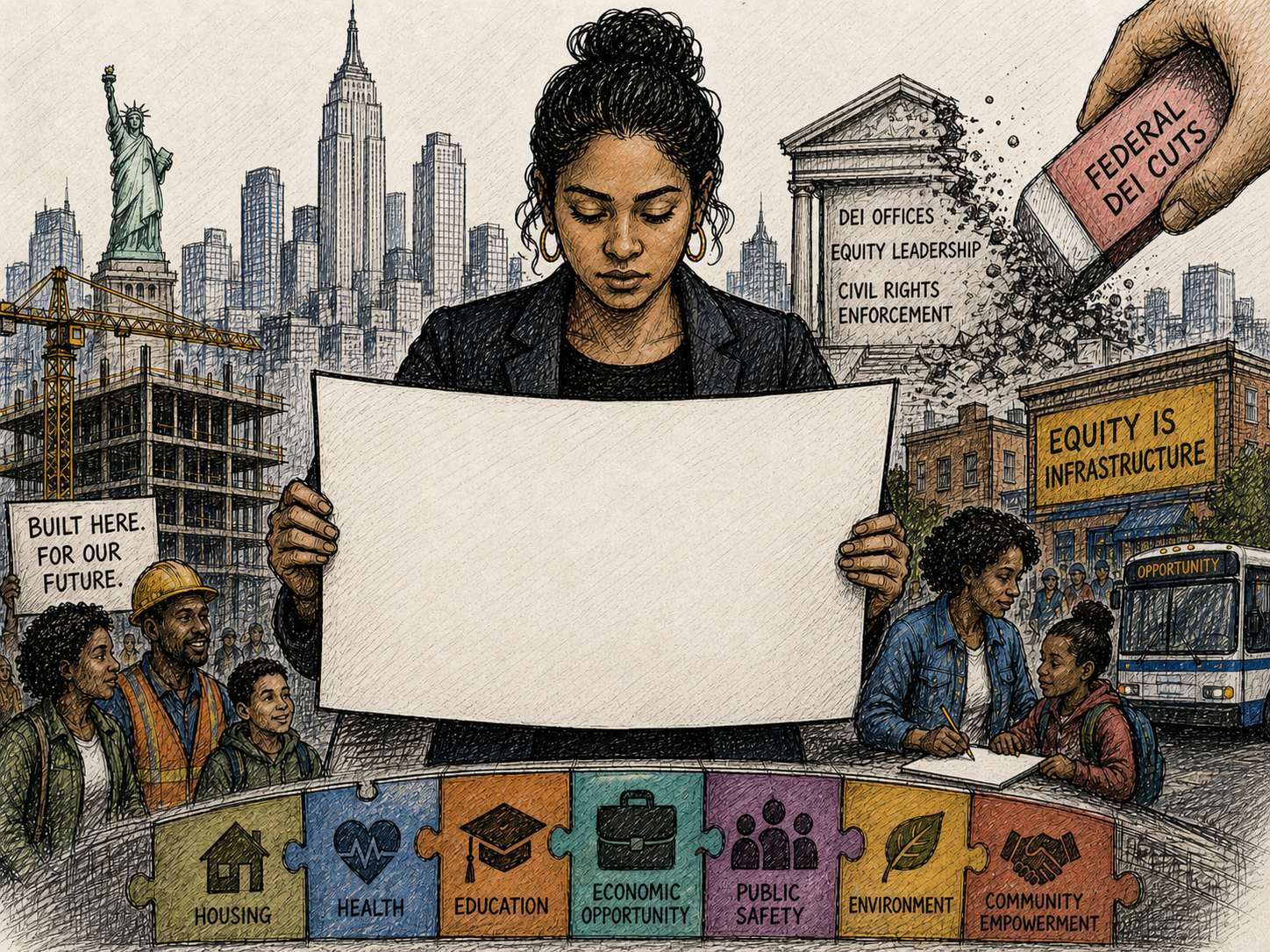
The plan is ambitious in scope. It directs 45 city agencies to apply a racial equity lens across budget lines, hiring decisions, and service delivery — producing over 800 strategies and 600 indicators across seven domains including housing, health, education, and economic opportunity. Released alongside a True Cost of Living measure that found 62 percent of New York City residents earn below what it actually costs to live there, the plan frames affordability and racial equity not as parallel concerns but as the same problem viewed from different angles.
That framing is analytically correct. The True Cost of Living data makes the connection explicit: 66 percent of Black New Yorkers fall below the economic security threshold, compared to 44 percent of white New Yorkers and 78 percent of Hispanic New Yorkers. These aren’t disparities produced by individual choices. They’re the accumulated output of a housing market, a labor market, and a public investment history that has operated with consistent racial logic for decades. The plan names that logic directly, which is precisely why it has drawn federal scrutiny and conservative legal challenge.
What’s underreported in the pushback coverage is the timing. The plan’s release comes as the federal government is dismantling the administrative infrastructure that had, however imperfectly, provided a parallel equity framework — DEI offices, equity-focused agency leadership, civil rights enforcement capacity. New York is not filling a vacuum created by normal policy transition. It’s building a counter-architecture in direct response to a federal direction that is moving the opposite way. That’s a different kind of political act than municipal governments typically perform, and it raises a question the plan itself can’t answer: what happens to a city equity framework when the federal government actively works to undermine it legally, financially, and through oversight pressure?
The legal exposure is real. The Trump Justice Department has already signaled concern, and the constitutional questions around race-conscious government action post-Students for Fair Admissions are genuinely unsettled. But the legal vulnerability doesn’t diminish the structural logic. It just means the plan will be tested in courts as well as communities — and the outcome of that testing will matter for every other city watching to see whether this model is replicable or merely symbolic.
New York is making a bet. The bet is that naming the system clearly enough, measuring it precisely enough, and directing enough institutional capacity toward it will produce outcomes that survive political opposition. Whether that bet pays off will say something important about whether structural equity work is possible at the municipal level when the federal scaffolding is gone.