The communities that built the most recent access to these systems are the ones being asked to carry the weight of their restructuring.
Wednesday closes with a set of stories that are less about individual events and more about a pattern becoming harder to explain away. The systems designed to distribute opportunity are being quietly restructured to concentrate it — and the communities that built the most recent access to those systems are absorbing the cost in real time.
Labor
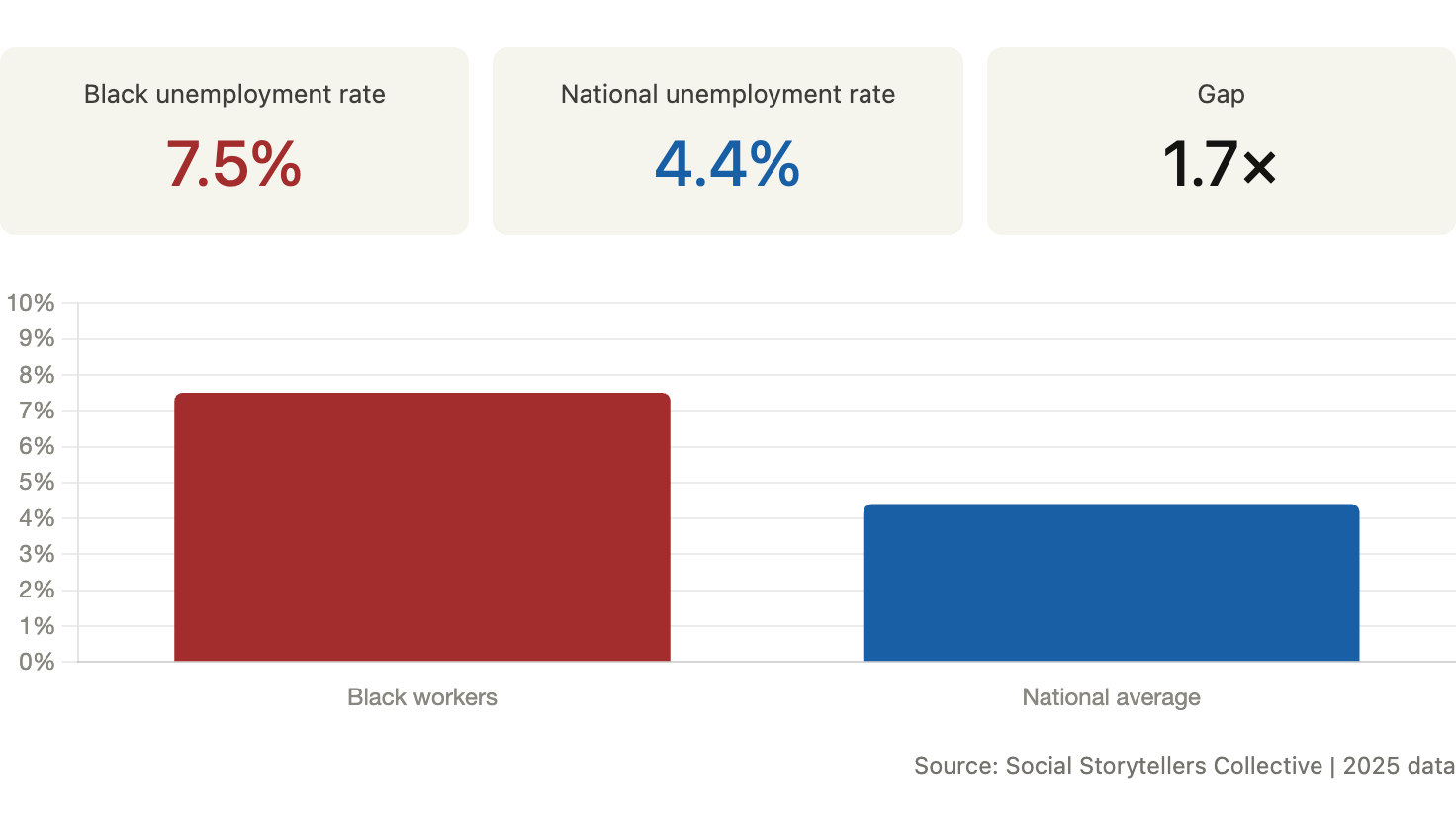
Black unemployment has reached 7.5 percent — nearly double the national average of 4.4 percent. Researchers are calling it a Black Recession, and the name is precise: it is a recession concentrated in one community while the broader economy registers as stable. What produced it was not a single shock. The federal workforce shed 277,000 jobs concentrated in agencies where Black workers — and Black women in particular — were overrepresented.
Tariff-driven manufacturing contraction eliminated 70,000 more in a sector Black households have historically depended on for stable employment. And the DEI rollback removed the institutional buffers that had slowed the last-hired-first-fired dynamic for generations. Each force had its own justification. Together they produced an outcome the data is making difficult to attribute to anything other than structural design. And while that pressure concentrates at the labor market level, the visibility of Black achievement is pushing back from a different direction — a wave of Black men posting advanced degrees online is turning a Census statistic into a public archive of proof, collapsing the perception gap that data alone has never closed.
Economy
The tariff story extends into small business. Black-owned firms are disproportionately concentrated in the size category — fewer than 20 employees — that has no mechanism for absorbing the cost of unpredictable trade policy. Large corporations retain legal teams to apply for exemptions and financial reserves to wait out instability. Small businesses absorb the full cost in real time. The 62,000 jobs shed by small businesses since January 2025 are not evenly distributed across the economy. They are concentrated where capital buffers were thinnest — and where workers have the fewest options for lateral movement when their employer contracts.
Politics
New York City is attempting to build an institutional counter-argument to that pattern. Mayor Mamdani’s Preliminary Citywide Racial Equity Plan found that 62 percent of New York City residents earn below what it actually costs to live there — and directs 45 city agencies to apply a racial equity lens across budget, hiring, and service delivery. The data is plain: 66 percent of Black New Yorkers fall below the economic security threshold, compared to 44 percent of white New Yorkers. What the plan cannot yet answer is whether a municipal equity framework can hold its ground when the federal government is actively dismantling the scaffolding that makes such frameworks viable. The Justice Department has already signaled concern. The courts will likely be the next venue. New York is making a bet that naming the system clearly enough and measuring it precisely enough will produce outcomes that survive political opposition. Whether that bet pays is a question the rest of the country’s cities are watching closely.
Technology
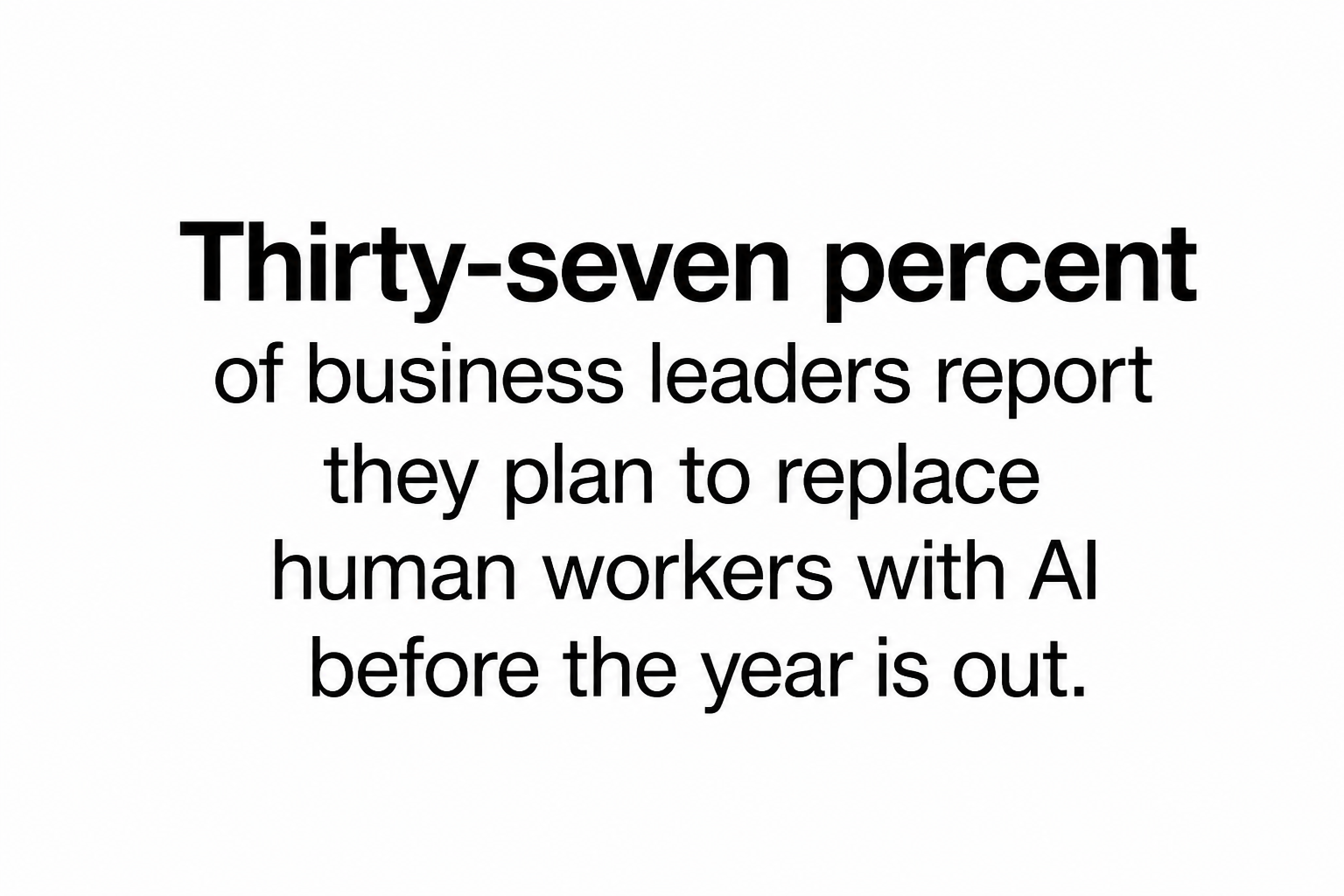
37 percent of business leaders report they plan to use AI to replace human workers before the end of the year. The efficiency case is clean. What it obscures is who absorbs the displacement. The roles being eliminated are not the roles of the leaders making the automation decisions. They are the roles of workers early enough in their careers to lack organizational protection and recent enough in their industry access to lack the capital that makes displacement survivable. Middle management didn’t become accessible to Black and Latino professionals through natural market evolution. It became accessible through decades of civil rights legislation, corporate diversity commitments, and the slow accumulation of tenure. Flattening the hierarchy at this moment doesn’t just cut costs. It removes a rung at the exact point where many of those workers are standing.
Housing
Wages are projected to grow 3.4 percent in 2026, outpacing home price increases by 1.2 percentage points — the most favorable gap in years — and that gap is being marketed as recovery. It is not. Incomes would need to rise 20 percent to restore pre-pandemic purchasing power. A 1.2 percentage point advantage against a 20 percent hole is not recovery. It is a smaller deficit being framed as progress to a population still locked out of the primary vehicle for wealth accumulation in this country.
Culture
Essence Festival of Culture is being asked a political question it hasn’t had to answer before. After the Supreme Court allowed Louisiana to move forward with redistricting maps critics say weaken Black voting power, public figures including Baltimore Mayor Brandon Scott began questioning whether one of the country’s largest Black cultural gatherings should continue generating $300 million in annual economic impact for a state government accused of undermining Black political representation. New Orleans is a majority-Black city. The local workers, vendors, and small businesses that depend on Essence Fest are not the state government. That is what makes the question hard — and what makes it worth asking.
Global
China is quietly building the architecture of a different kind of access on the African continent — a zero-tariff policy covering 53 African nations being welcomed by business and government leaders across South Africa and Kenya not out of ideological alignment, but out of fiscal pragmatism. Africa’s average public debt-to-GDP ratio is approaching 63 percent, with interest payments absorbing nearly 15 percent of public revenue. In that environment, preferential trade access from the world’s largest manufacturing economy is a concrete budget input, not an abstraction. The United States is not offering a competing framework. It is contracting its existing one — through AGOA uncertainty, declining development assistance, and an administration whose Africa posture is defined more by withdrawal than engagement. The trade relationships being built now will shape infrastructure dependencies, regulatory alignment, and geopolitical orientation for the next decade. That story is being written this week, with limited American participation in the authorship.
What connects these stories is not a single cause but a single direction of pressure. Institutional retreat at the federal level. Efficiency logic that distributes its gains upward and its costs downward. Recovery narratives that are technically accurate and practically misleading. And on the other side of each of those forces, communities that built recent, hard-won access to systems that are now being restructured around different priorities.
The systems are still functioning. The function has shifted. And the distance between what these systems claim to do and what they are currently doing is the story Wednesday is leaving us with.
We will be watching.
Featured Story
The Show Is the Strategy. The Product Is the Outcome.

The signal is showing up in plain sight. PayPal is reportedly willing to pay up to $236,000 for a Head of CEO Content. The most advanced AI companies in the world are investing heavily in content strategists. That is not a hiring trend. It is a structural shift in how companies understand where value is actually created. The brands shaping markets right now are no longer treating content as marketing. They are treating it as infrastructure. The job is not to promote the product after it is built. The job is to build a system of attention that makes the product inevitable.
Read the full piece on Social Storytellers Collective.
We will be watching.