
Airlines are capping and reducing fares to absorb Spirit passengers, but the ultra-low-cost model that made those trips possible isn’t being replaced—and both travelers and employees are now navigating a different set of constraints.
When Spirit Airlines shut down, the rest of the industry moved quickly to contain the immediate disruption. Carriers including United, Delta, American, JetBlue, Southwest, Frontier, and Allegiant introduced capped fares, discounted “rescue” tickets, and added capacity on overlapping routes to absorb displaced demand. American and Delta are offering reduced fares on high-volume Spirit routes for customers concerned with pricing, while Allegiant has introduced similar reductions on routes it previously shared with Spirit. Frontier has gone further, offering reduced rates on overlapping routes through May 10. Behind the scenes, airlines are also working to move displaced Spirit employees—many of whom were stranded in the cities where they were working—through travel pass agreements that allow them to return on other carriers, including standby and jump seat access. The response is designed to keep the system moving—preventing immediate disruption while Spirit moves through liquidation.
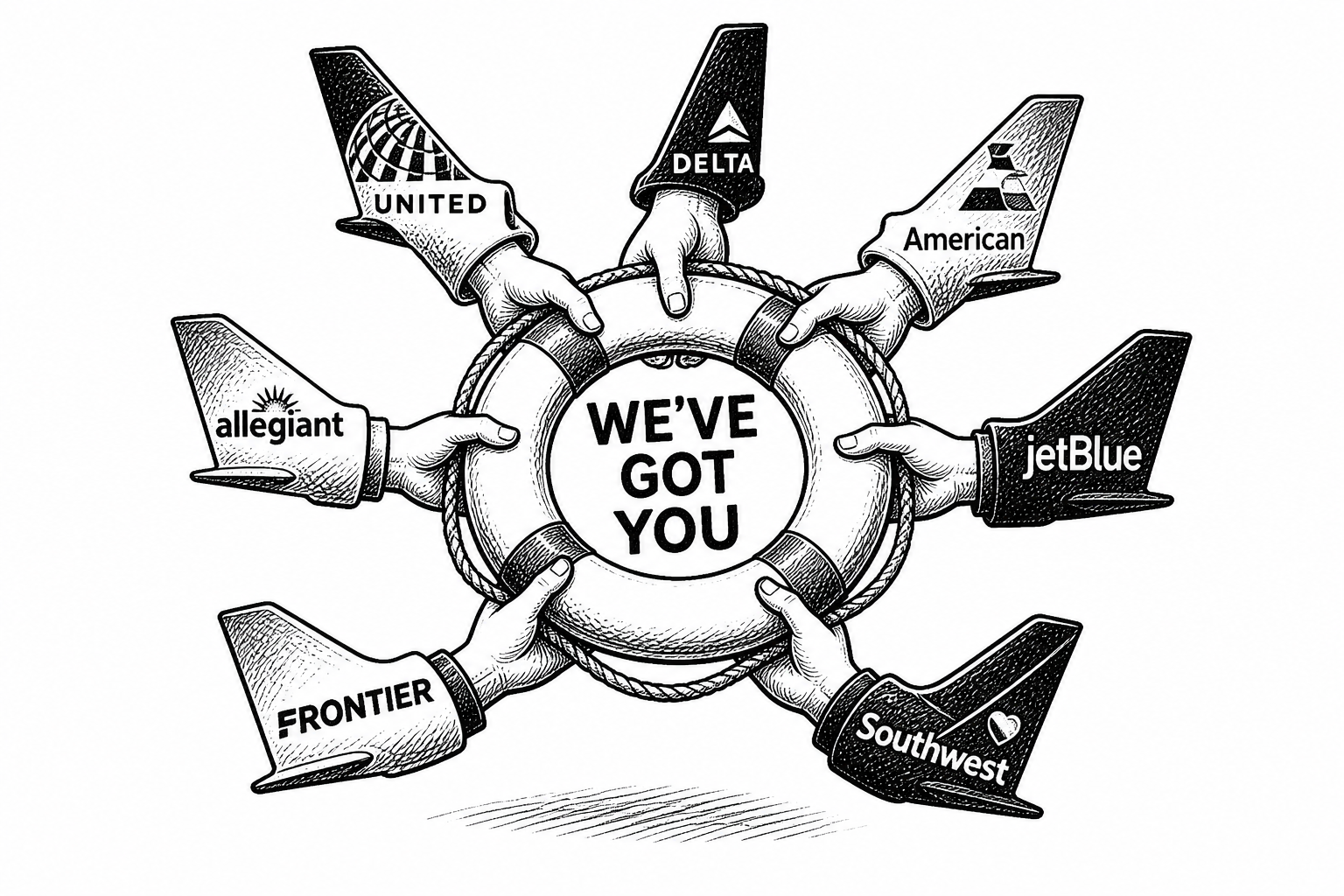
For Spirit customers, that support creates a narrow but important window of options. Travelers with canceled flights can search for capped or discounted fares offered by other airlines, though these are typically time-bound and may require proof of a Spirit booking. Rebooking through alternative carriers is the most immediate path, but it often comes with trade-offs: higher base fares than Spirit’s lowest price points, fewer nonstop options on certain routes, and more restrictive conditions tied to availability. At the same time, customers can pursue refunds or chargebacks through their original payment method if service was not rendered, though processing timelines may vary. For those with flexibility, shifting travel dates, adjusting routes, or departing from nearby airports may provide more affordable alternatives, but these adjustments require a level of adaptability that Spirit’s model previously reduced.
That distinction is where the deeper shift begins to show. The assistance measures are temporary, but the structure they are responding to is not. Spirit’s model didn’t just offer low prices—it established the lower boundary of what airfare could cost, shaping expectations and forcing competitors to price around it. The current response from other airlines functions as an emergency bridge, maintaining continuity without replacing that underlying constraint. Once the fare caps expire and discounted inventory disappears, the system resets without the pricing floor that made travel accessible to a broader range of passengers.
What remains is a system that continues to function, but under different terms. Flights are still available, routes are still active, and capacity is still being managed, but the threshold for participation has shifted upward. The immediate coordination across airlines eases short-term disruption, but it does not preserve the conditions that Spirit created. For travelers—and for the employees now navigating their way back into that system—the difference will not always appear as a single price jump, but as a gradual tightening: fewer ultra-low-cost options, more conditional access, and a growing distance between the ability to move and the cost of doing so.