
ABC News reports that the typical U.S. household could spend an additional $1,300 on gas over the course of a year—a steady increase that doesn’t arrive as a single shock, but as a series of smaller adjustments that accumulate over time. The impact shows up quietly: longer commutes become more expensive, everyday errands are reconsidered, and household budgets tighten in ways that are felt but not always immediately visible. The system is still functioning. Fuel is available. The cost is simply being passed through.
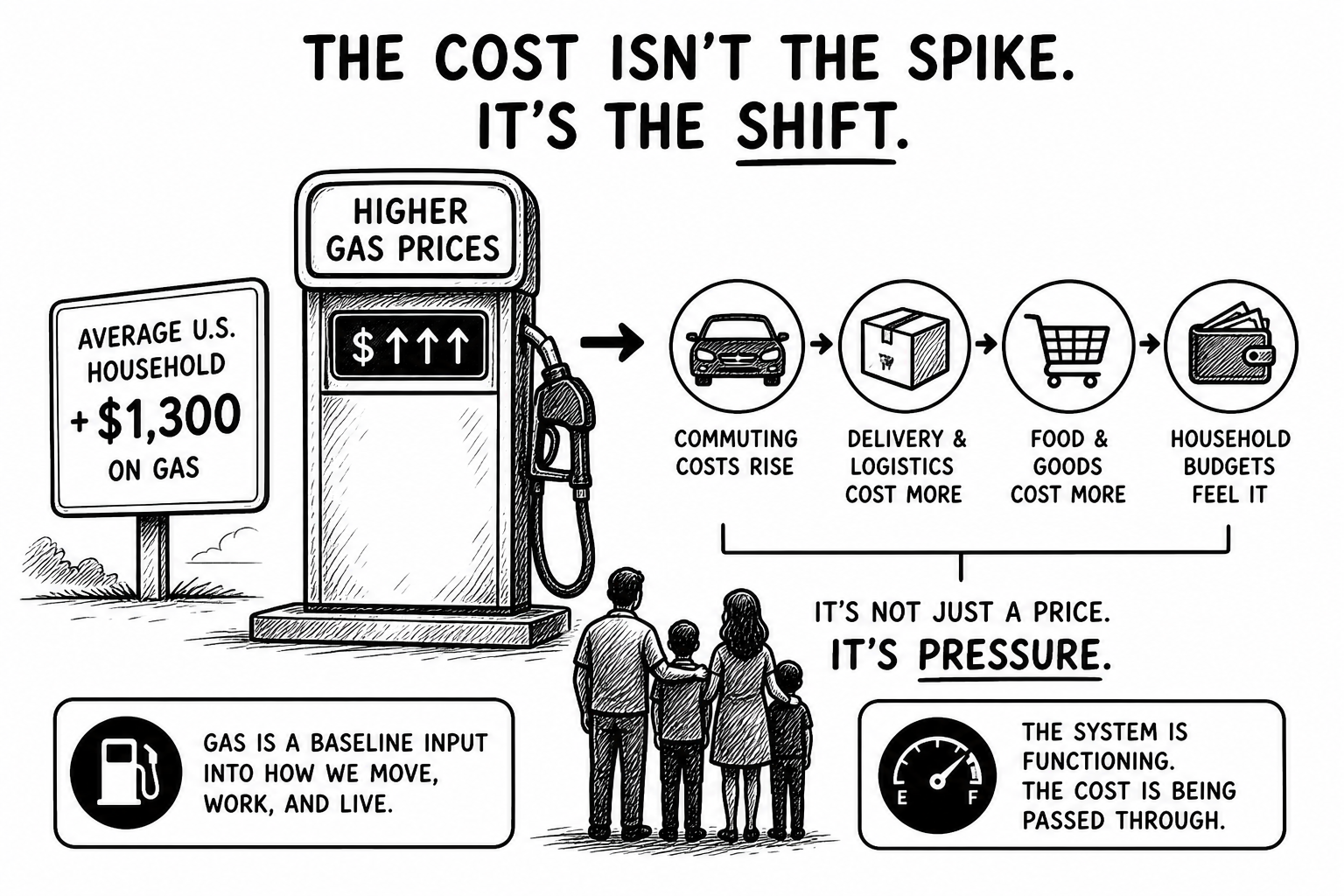
That pass-through is the story. Gas is not just a line item—it is a baseline input into how people move, work, and live. When that input rises, the effects ripple outward into food prices, delivery costs, and broader cost-of-living pressures. The system continues to operate as designed, but the burden shifts downward, concentrating pressure at the household level rather than being absorbed elsewhere.
In Cuba, that same system has moved past pressure and into breakdown. Gas has reached the equivalent of $40 a gallon in informal markets—not as a reflection of demand, but as a signal that supply is no longer stable. Official pricing still exists, but it has become secondary to availability. When fuel cannot be reliably accessed, price stops functioning as a meaningful mechanism. What remains is scarcity, rationing, and a parallel market that determines who can move and who cannot.
The contrast is not about geography. It is about stages.
In the U.S., rising prices signal a system under strain but still intact. In Cuba, extreme prices signal a system that can no longer deliver consistently on its core function. One redistributes cost. The other redistributes access.
Both point to the same underlying reality: energy systems do not fail all at once. They shift first—through higher costs, tighter margins, and reduced flexibility—before they break. By the time the breakdown becomes visible, the underlying conditions have already been in place.
The number—$1,300 more per year, $40 per gallon—draws attention. But the structure underneath is what matters. The system is still working in one place, and no longer working in another. The difference is not in the price. It is in what the price is still able to do.