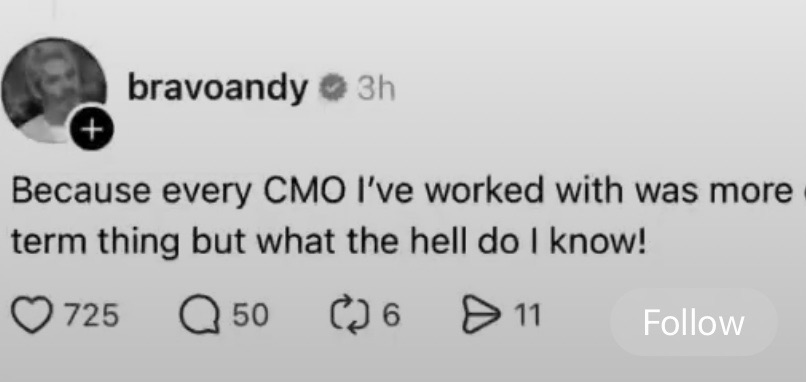
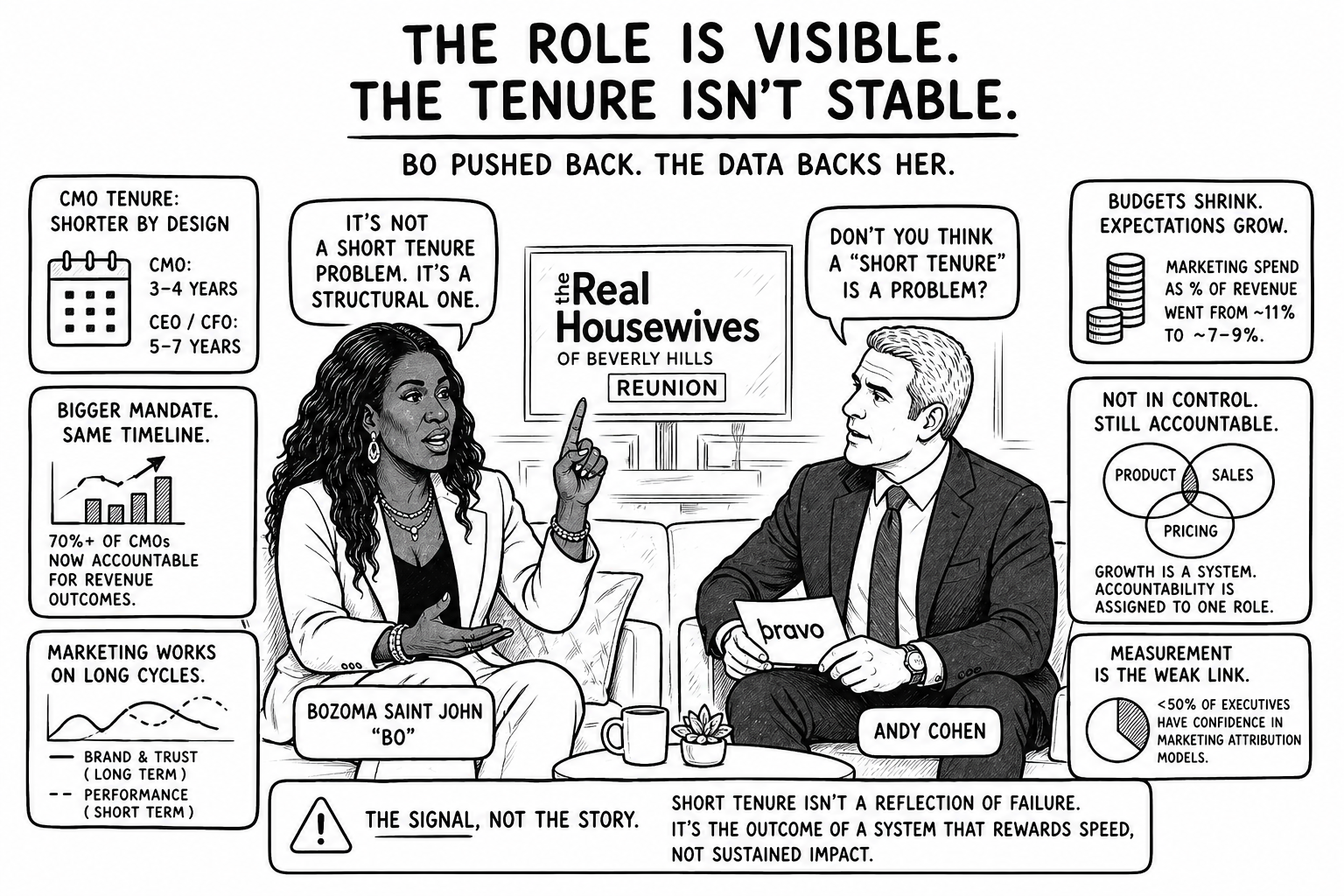
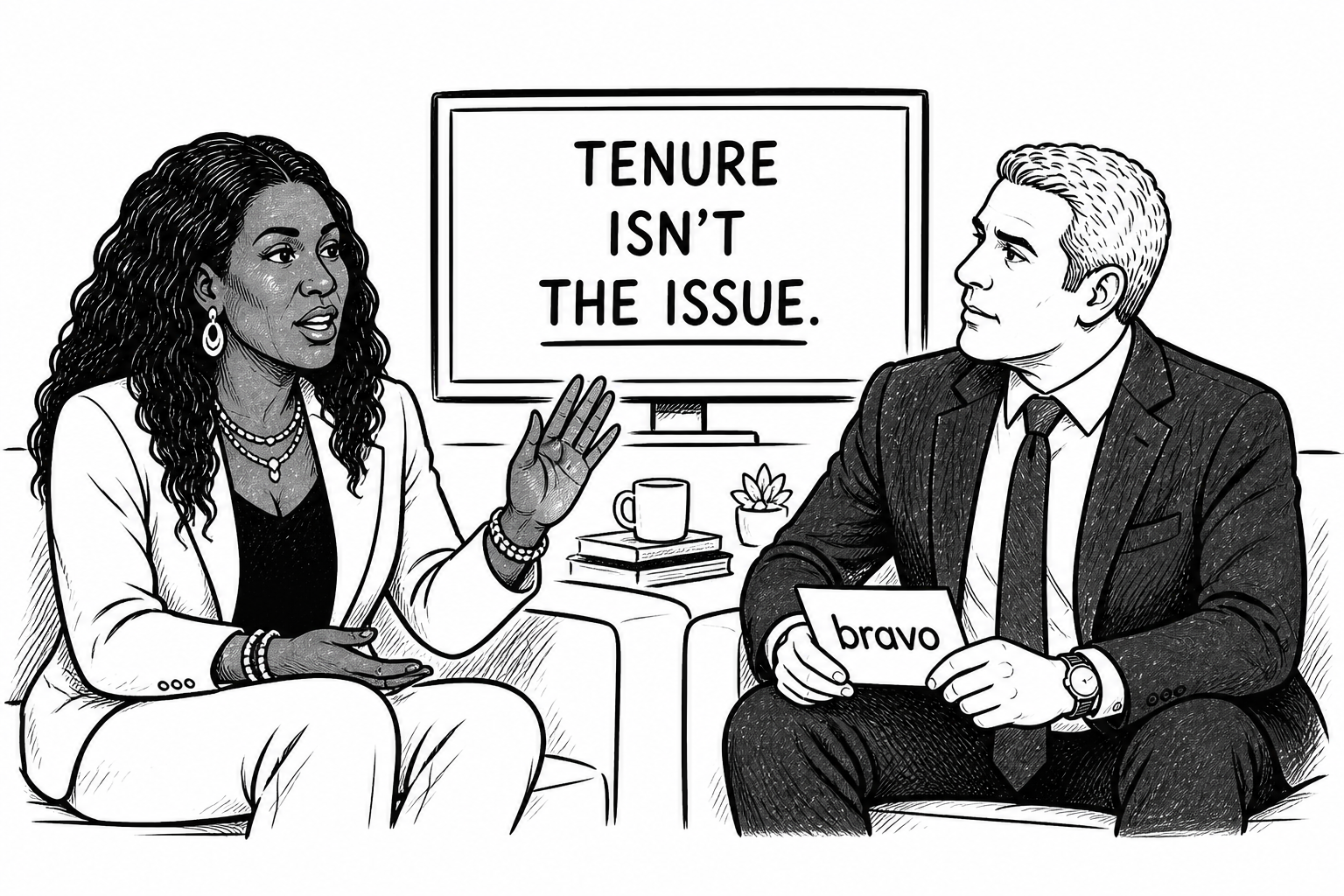
It shows up in boardrooms. It shows up in earnings calls. And now it shows up on reality television. During a recent Real Housewives of Beverly Hills reunion, Bozoma Saint John pushed back after Andy Cohen questioned the idea of a “short tenure” for a Chief Marketing Officer. The moment landed because it surfaced a misunderstanding that exists well beyond television: short tenure at the CMO level isn’t unusual — it’s structural.
The data has been consistent for years. CMO tenure typically sits around three to four years, compared to five to seven years for CEOs and CFOs, with even shorter cycles in high-growth or transition-stage companies. At the same time, the scope of the role has expanded significantly. Over 70% of CMOs are now directly accountable for revenue outcomes — not just brand or awareness. The mandate has widened. The timeline to prove impact has not.
That tension starts with how marketing actually works. Brand, positioning, and audience trust operate on long cycles, often compounding over years. But performance — pipeline, conversions, quarterly growth — is evaluated in real time. Only a small percentage of any market is actively buying at a given moment, yet marketing is judged as if demand should be continuously convertible. The result is compression. Strategy collapses into tactics. Performance marketing absorbs budget because it produces signals faster, even when those signals don’t represent durable growth. The incentive structure rewards speed over substance, and CMOs are left managing the consequences of a measurement framework they didn’t design.
Budgets reinforce the instability. Marketing is one of the first areas adjusted during uncertainty, with industry data showing spend declining from roughly 11% of company revenue to closer to 7–9% in recent years depending on sector. Expectations expand while resources contract. The CMO is left managing growth targets with a shrinking margin for experimentation or long-term investment — and is evaluated against outcomes that the budget no longer fully supports.
The structural dependency of the role makes this harder still. A CMO does not control product quality, pricing, or sales execution, but is accountable for how all three perform in the market. When product misses, marketing reframes. When sales slows, marketing is expected to generate pipeline. When leadership shifts direction, marketing translates it externally. Growth is a system outcome. Accountability is assigned to one function within it.
Measurement compounds the exposure. Less than half of executives report full confidence in their organization’s marketing attribution models. Unlike finance or operations, where outcomes resolve into clearer metrics, marketing influence is distributed across channels and time horizons. Brand lift, share of voice, and multi-touch attribution are inherently probabilistic. In periods of underperformance, that ambiguity makes marketing impact easier to question — and marketing leadership easier to replace.
That’s what the reunion moment actually surfaced. The assumption behind Cohen’s question was that short tenure signals instability or underperformance on the part of the executive. The reality is that the role itself produces churn. In private equity and high-growth environments, marketing leadership turnover can occur within 18 to 24 months if growth targets aren’t met on a timeline the function was never designed to meet. Expectations expand faster than control. Accountability accumulates faster than authority. Timelines compress faster than strategy can deliver.
The pattern extends beyond one executive or one company. As markets fragment and channels multiply, demand for marketing leadership increases. At the same time, the conditions required for that leadership to succeed — alignment, time, and shared ownership of outcomes — become harder to sustain inside organizations optimizing for speed.
The role is not failing. It is being asked to operate inside a system that does not consistently support how the work actually functions. Short tenure is not the story. It is the signal.