
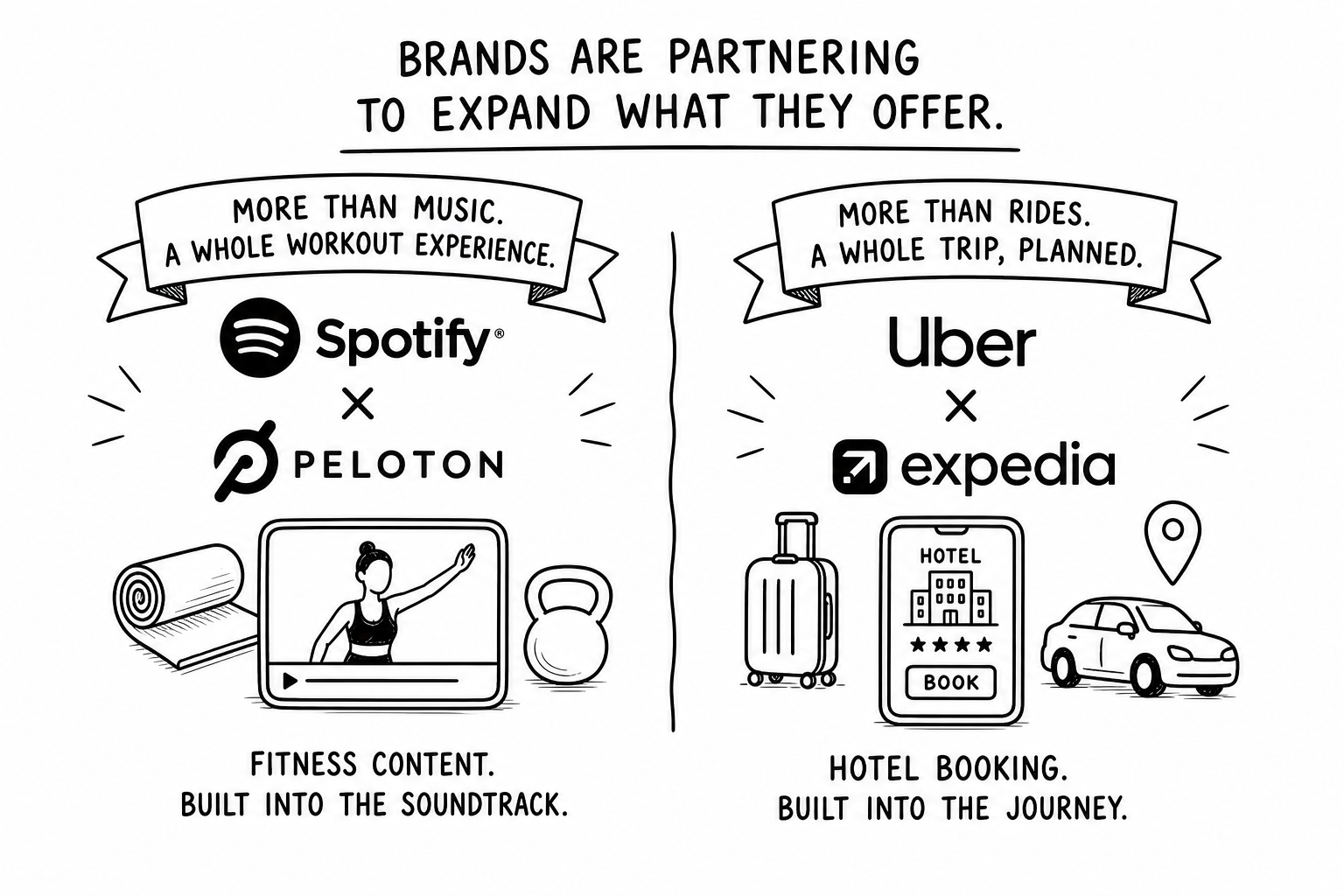
There is a pattern underneath the recent product announcements that gets lost when each one is covered in isolation. Spotify integrating fitness content and Uber integrating hotel booking are being framed as feature expansions — new verticals, incremental growth, platforms doing more. That framing is accurate as far as it goes. What it misses is that both moves are expressions of the same strategic logic, and that logic is not about features at all.
Platforms are no longer trying to serve discrete needs. They are trying to absorb entire categories of behavior.
Listening to music, working out, and traveling used to be distinct activities separated not just by context but by the tools used to navigate them. Different apps, different environments, different decision points. That separation created friction — but it also preserved boundaries. You entered a platform to complete something specific, and then you left. What is happening now is the deliberate removal of that exit. Spotify connecting movement to audio, mood, and data within a single loop. Uber extending its reach from the ride into the trip construction that precedes it. The goal in both cases is the same: continuity. An experience that does not require the user to step outside the platform to complete the next logical action.
As SSC reported, the Spotify-Peloton partnership makes this visible in one direction. Fitness has its own rhythm — it is time-bound, mood-dependent, and already deeply tied to audio. Embedding workout content inside a platform that already owns the soundtrack to people’s days is not an arbitrary expansion. It is Spotify closing a loop that was already nearly closed. The user was already there. The behavior was already adjacent. The integration removes the one remaining moment where the platform lost them.
Uber’s Expedia partnership makes the same move in a different category. The ride has always been the last step of a trip — the thing that happens after the hotel is booked, after the flight lands, after the plan is set. By integrating hotel booking into the app, Uber is repositioning itself at the beginning of that sequence rather than the end. It is no longer the final transaction. It is the environment in which the trip gets assembled. That is a fundamentally different relationship to the user’s behavior — and a fundamentally different claim on their attention and data.
What changes when platforms become environments is not just usability. It is the nature of what gets measured. A platform that handles discrete tasks collects transactional data — what you did, when, how much. A platform that handles sequences collects something more valuable: context. It begins to understand not just actions but the logic connecting them. Where you went after the workout. What you booked before the ride. That contextual data is what powers recommendation systems that feel intuitive — and what makes the platform progressively harder to leave, because leaving means losing the continuity it has built around you.
The structural question this raises is not whether these integrations are convenient. Most of them are. It is who controls the environment once the boundaries between activities disappear — and what it costs users when the platform that anticipated their next move also sets the terms for it.
Why It Matters
The shift from tool to environment is not a UX story. It is a power story. The more behavior that happens inside a single platform, the more that platform functions as infrastructure — and infrastructure, once embedded, is rarely neutral. Spotify and Uber are not unique in this move. They are the current examples of a pattern playing out across every major platform simultaneously. The question worth tracking is not which app added which feature. It is what the world looks like when the environment you move through is owned by someone optimizing it for engagement, retention, and monetization — and when stepping outside it starts to feel like the inconvenient option.