
For years, employers treated credentials as a proxy for competence. A degree didn’t just represent knowledge—it stood in for discipline, reliability, and the ability to operate within structured systems. It was never a perfect signal, but it was a stable one. What’s changing now isn’t just how people acquire credentials—it’s how quickly the underlying assumptions behind them are breaking down.
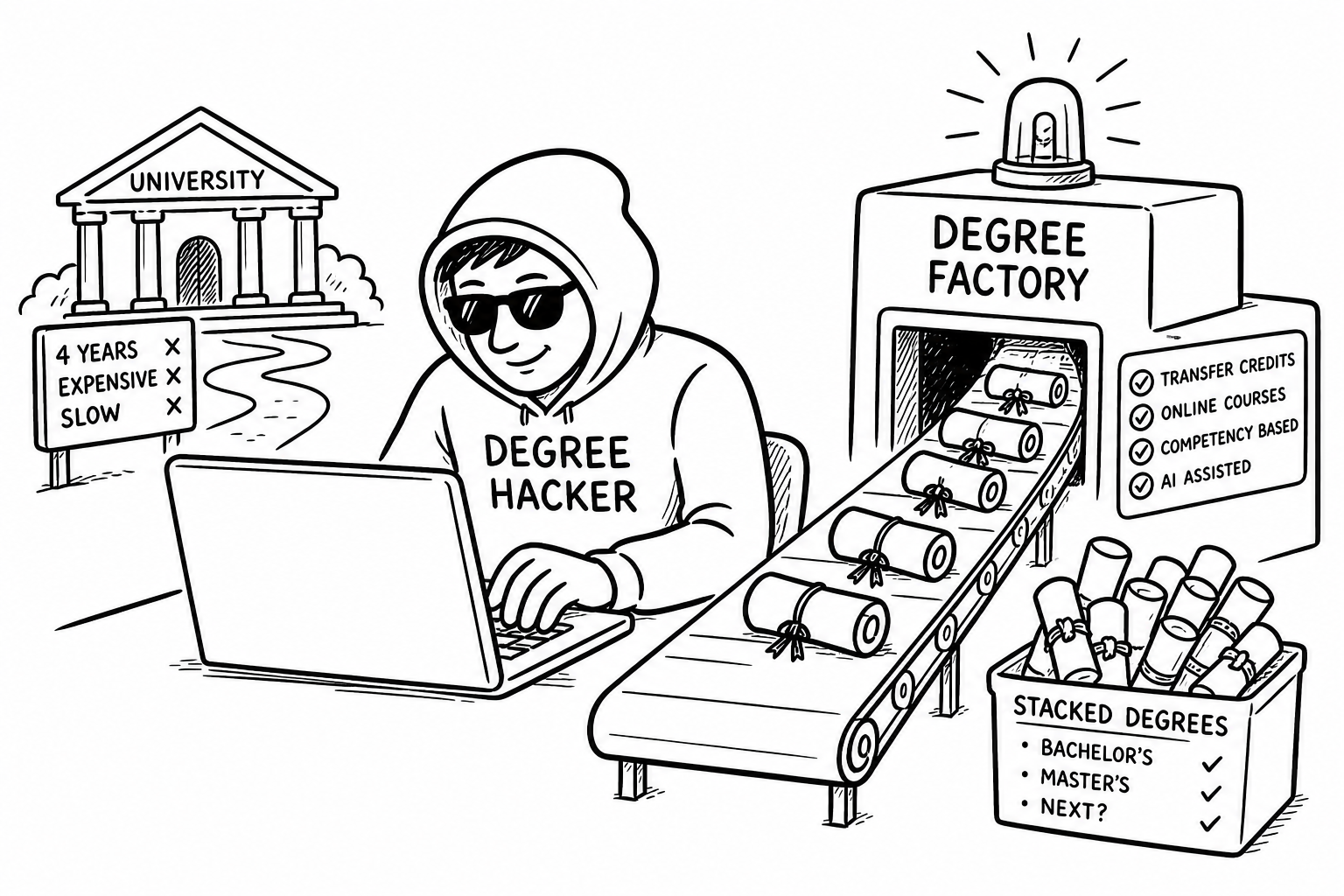
The rise of “degree hacking”—students completing accredited programs in weeks rather than years—has exposed something that was always quietly true. Employers weren’t hiring for the degree itself. They were hiring for what they believed it represented. Once technology made it possible to obtain that credential at speed, the gap between signal and substance became impossible to ignore. The shortcut didn’t break the system. It revealed that the system was already built on abstraction.
As SSC covered recently, that same unraveling is happening inside hiring itself. AI moves deeper into recruitment—screening résumés, conducting interviews, evaluating candidates—the process is becoming faster, more scalable, and, in many cases, less transparent. Candidates are encountering systems they don’t fully understand, often without knowing whether they’re being evaluated by a person or a model. The result isn’t just frustration. It’s a breakdown in trust.
What’s striking is that workers aren’t rejecting AI outright. They’re asking for visibility into how it’s being used and where human judgment still exists. That distinction matters. It suggests the issue isn’t automation—it’s opacity. When the system becomes too abstract, people don’t disengage because it’s new. They disengage because they can’t locate themselves inside it.
At the same time, a parallel shift is happening on the other side of the labor equation. Employers are increasingly turning to skills assessments, work samples, and AI-enabled evaluation tools to get closer to actual capability. In theory, this is a move toward precision—away from proxies and toward direct measurement. In practice, it introduces a new layer of complexity: the tools designed to clarify signal can also obscure it if their logic isn’t understood.
Taken together, these shifts point to something larger than hiring friction. They point to a system trying to replace slow, institutional signals with faster, computational ones—without fully rebuilding the trust infrastructure that made those signals usable in the first place.
That’s where the conversation expands beyond labor—and into science itself.
In a recent interview with Anderson Cooper, Dario Amodei argued that AI could help scientists cure most cancers and potentially double human lifespan. It’s a claim that reads, at first glance, like futurism. But the underlying logic mirrors what’s happening in hiring: AI doesn’t just improve outcomes—it compresses the time it takes to reach them.
Cancer research has always been constrained by complexity. It is not one disease, but hundreds of variations, each with its own biological pathways. Progress has been slow not because the problem is unknowable, but because it is too large for linear human processes. AI changes that by allowing researchers to test, iterate, and model possibilities at a scale that was previously inaccessible. Discovery becomes less sequential and more parallel.
The same principle applies to longevity. If AI accelerates the ability to detect disease earlier, design personalized treatments, and understand the biological mechanisms of aging, then lifespan doesn’t hinge on a single breakthrough. It becomes the cumulative effect of faster iteration across multiple domains.
What connects this back to hiring—and to education—is not the outcome, but the compression. In each case, AI reduces the time between input and result. Degrees can be completed faster. Candidates can be evaluated faster. Scientific hypotheses can be tested faster. The system doesn’t just move more efficiently. It moves on a different timeline altogether.
And that creates a new kind of tension.
Institutions were built for slower signals. A four-year degree made sense in a world where time itself was part of the filter. A multi-stage hiring process made sense when evaluation required sustained human attention. Even scientific progress, measured in decades, aligned with systems designed for gradual validation and consensus.
AI disrupts that alignment. It produces outcomes on timelines that existing systems weren’t designed to interpret, let alone trust.
That’s why the current moment feels unstable. It’s not just that technology is advancing quickly. It’s that the mechanisms we use to verify, validate, and assign meaning to outcomes haven’t caught up. The signal is no longer scarce—but its credibility is.
The risk isn’t that the system breaks overnight. It’s that it continues to function while becoming progressively less reliable. Degrees still get issued. Candidates still get hired. Research still gets published. But the connection between those outputs and what they are supposed to represent becomes thinner over time.
What happens next depends on whether institutions adapt at the level of structure, not just tooling. In hiring, that means defining capability more precisely and evaluating it directly. In education, it means aligning credentials with demonstrable skills rather than time spent. In science and healthcare, it means ensuring that accelerated discovery translates into accessible outcomes—not just theoretical breakthroughs.
The deeper question isn’t whether AI can produce better results. It’s whether we are prepared to rebuild the systems that make those results legible, trustworthy, and usable at scale.
Because once time stops being the constraint, everything that depended on it has to be rethought.