
A new argument emerging from Fast Company reframes the panic around “degree hacking” into something far more structural. The headline behavior—students racing through accredited online programs in weeks, stacking degrees for a fraction of the traditional cost—looks like exploitation. But the deeper claim is harder to ignore: the system isn’t being gamed. It’s being understood.
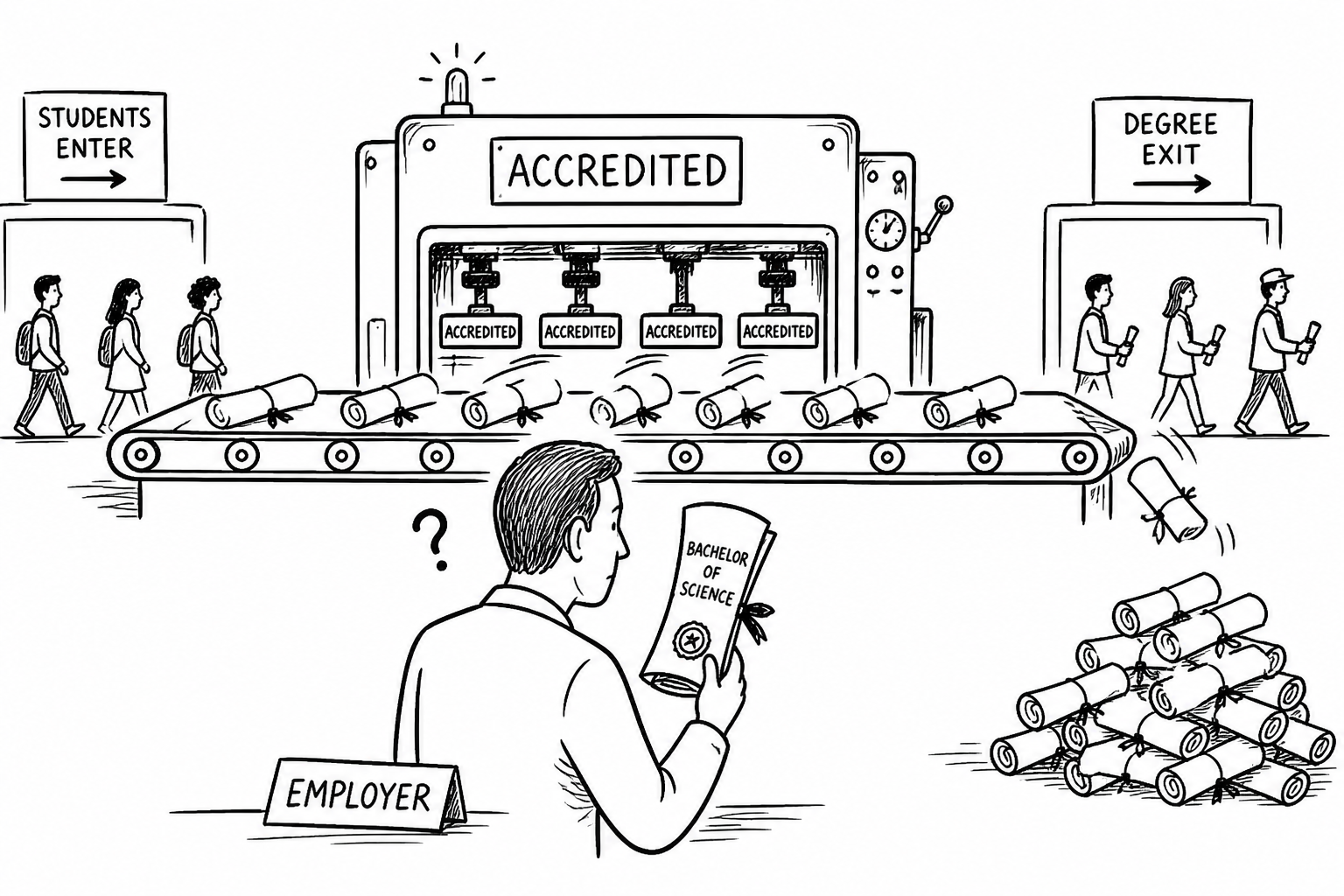
For years, employers treated the college degree as a proxy for competence. Not competence itself, but a signal—a shorthand that suggested a candidate could persist, think, communicate, and operate within institutional norms. That signal worked well enough when the time, cost, and effort required to obtain it made it scarce. What’s changing now is not the desire for that signal, but the speed at which it can be produced.
Technology has compressed what used to take years into months, sometimes weeks. Online platforms, competency-based programs, transfer credits, and AI-assisted coursework have effectively unbundled the degree. The outcome still meets accreditation standards. The timeline simply no longer matches the assumptions employers built their hiring practices around.
That’s why the reaction feels disproportionate. Institutions are alarmed. Accrediting bodies are investigating. Employers are uneasy. But the discomfort isn’t about legitimacy—it’s about loss of confidence in what the credential represents. When someone can complete a bachelor’s or even a master’s degree at a dramatically accelerated pace, it forces a question that was previously easy to ignore: what, exactly, was being measured before?
The answer is uncomfortable because it reveals a misalignment that predates the current moment. An accredited degree certifies that a student completed a curriculum designed within an academic system optimized for research output, not necessarily employer-relevant skill formation. It verifies process adherence—credit hours, coursework completion, institutional standards—not direct capability. Employers, in turn, used that credential as a signal for abilities that were never explicitly measured in the first place.
What’s happening now is a kind of system-wide decoupling. On one side, students are optimizing for efficiency, using every available tool to obtain credentials faster and cheaper. On the other, employers are increasingly bypassing the degree altogether, turning to skills assessments, work samples, and AI-driven screening tools to identify actual capability. Both sides are acting rationally. The system in between—the degree as a trusted proxy—is what’s eroding.
This dynamic resembles a classic arms race. As long as the degree remains a gatekeeping mechanism, people will find ways to obtain it more efficiently. And as those shortcuts become more visible, institutions will attempt to defend the signal—tightening rules, limiting acceleration, reinforcing standards. But without coordination across the ecosystem, those efforts simply shift behavior rather than resolve the underlying issue.
The deeper problem is that the shortcut was always doing too much work. The degree reduced hiring complexity by filtering large pools of candidates quickly. It offered a convenient way to manage volume without requiring employers to define, with precision, what they actually needed. That convenience is now colliding with a reality where the signal can be replicated at scale, forcing employers to confront the work they previously outsourced to higher education.
A real fix would require something most actors have avoided: specificity. Employers would need to articulate the exact capabilities required for a role and assess them directly. Universities would need to design programs around demonstrable competencies rather than time-based progression. Accreditors would need to evaluate outcomes in terms of what graduates can do, not just whether institutional processes were followed. And all three would need to align on standards that are credible enough to be trusted across the market.
Some of that shift is already underway. Employer-designed certifications, apprenticeship models, and competency-based education are gaining traction. But these remain partial solutions—incremental steps within a system that still relies heavily on legacy signals. Until there is a widely accepted mechanism for verifying real capability, the pressure to use proxies will persist.
What “degree hacking” ultimately reveals is not a breakdown, but a recalibration. The system is being forced to distinguish between what is easy to measure and what actually matters. And in that gap, both institutions and employers are being asked the same question they’ve managed to avoid for years:
What does competence actually look like—and how are you willing to prove it?