Cuba’s ongoing economic crisis has a demographic dimension that is not receiving sufficient attention. Persistent blackouts, food shortages, and fuel constraints are shaping daily life across the island — but older residents are bearing the most acute effects as mobility, income, and access to resources narrow simultaneously. The infrastructure behind those failures is not incidental — it is the visible outcome of a system being deliberately constricted, where repeated grid collapses, fuel import restrictions, and cascading failures across transportation and healthcare have left communities without reliable access to the basics that sustain daily life. For younger Cubans, migration offers a pathway out of that instability. For older residents, that option is largely unavailable, which means the population least able to absorb system failure is the one most exposed to it.
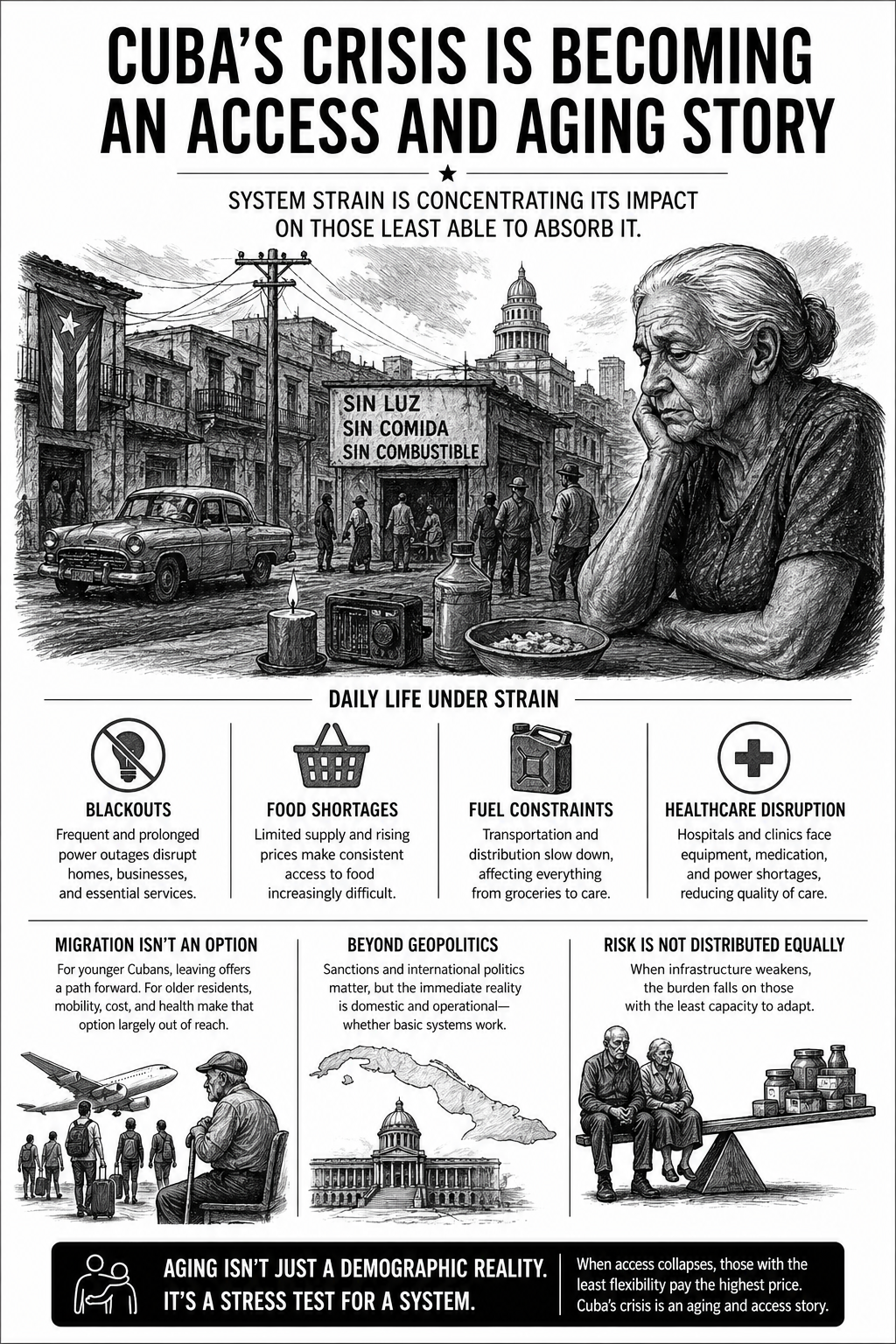
The concentration of impact among aging populations reveals something specific about how systemic breakdown distributes risk. When infrastructure weakens, the burden does not fall evenly — it settles on people with the least capacity to adapt, the fewest resources to substitute private solutions for public failures, and the most acute dependence on consistent access to healthcare, transportation, and food distribution. Cuba’s crisis is often framed through geopolitics — sanctions, international relations, the pressure campaign the U.S. has maintained at varying intensity for decades. Those factors are real and relevant. The selective logic behind them — easing restrictions on some countries when strategically convenient while tightening them on others regardless of humanitarian cost — is a pattern SSC has documented directly. What that framing consistently underweights is the domestic and operational reality: whether basic systems can deliver consistent access to power, food, and care for people who cannot leave and cannot wait for diplomacy to resolve what is already a daily emergency.
Cuba is a majority Black and Afro-Latino nation. That fact is not incidental to who is absorbing the weight of this crisis. The aging population carrying the most acute burden of infrastructure failure is disproportionately Black and Afro-Caribbean — communities with the least access to remittances, the fewest connections to diaspora networks that can provide material support, and the most exposure to the compounding effects of a system under sustained pressure. The diaspora communities most emotionally and financially invested in Cuba’s stability — concentrated in Miami, Houston, and New York — are watching that reality unfold in real time with limited ability to change it.
Aging is not simply a demographic condition in this context. It is a measure of how resilient a system truly is — and in Cuba right now, the answer that measure is producing is not encouraging.