
On April 18, New York State prohibited employers from requesting or using consumer credit history in hiring, compensation, promotion, or termination decisions, with narrow exceptions for positions requiring security clearance, law enforcement roles, and jobs involving significant financial authority. The law, signed by Governor Kathy Hochul in December 2025, amends the New York State Fair Credit Reporting Act and extends statewide a protection that New York City had carried alone since 2015. New York becomes the eleventh state to restrict employer use of credit information, joining California, Illinois, Colorado, Connecticut, Hawaii, Maryland, Nevada, Oregon, Vermont, and Washington. The law also applies to any employer hiring a worker located in New York, regardless of where the company itself is based — meaning a Texas employer hiring a remote New York resident must comply.
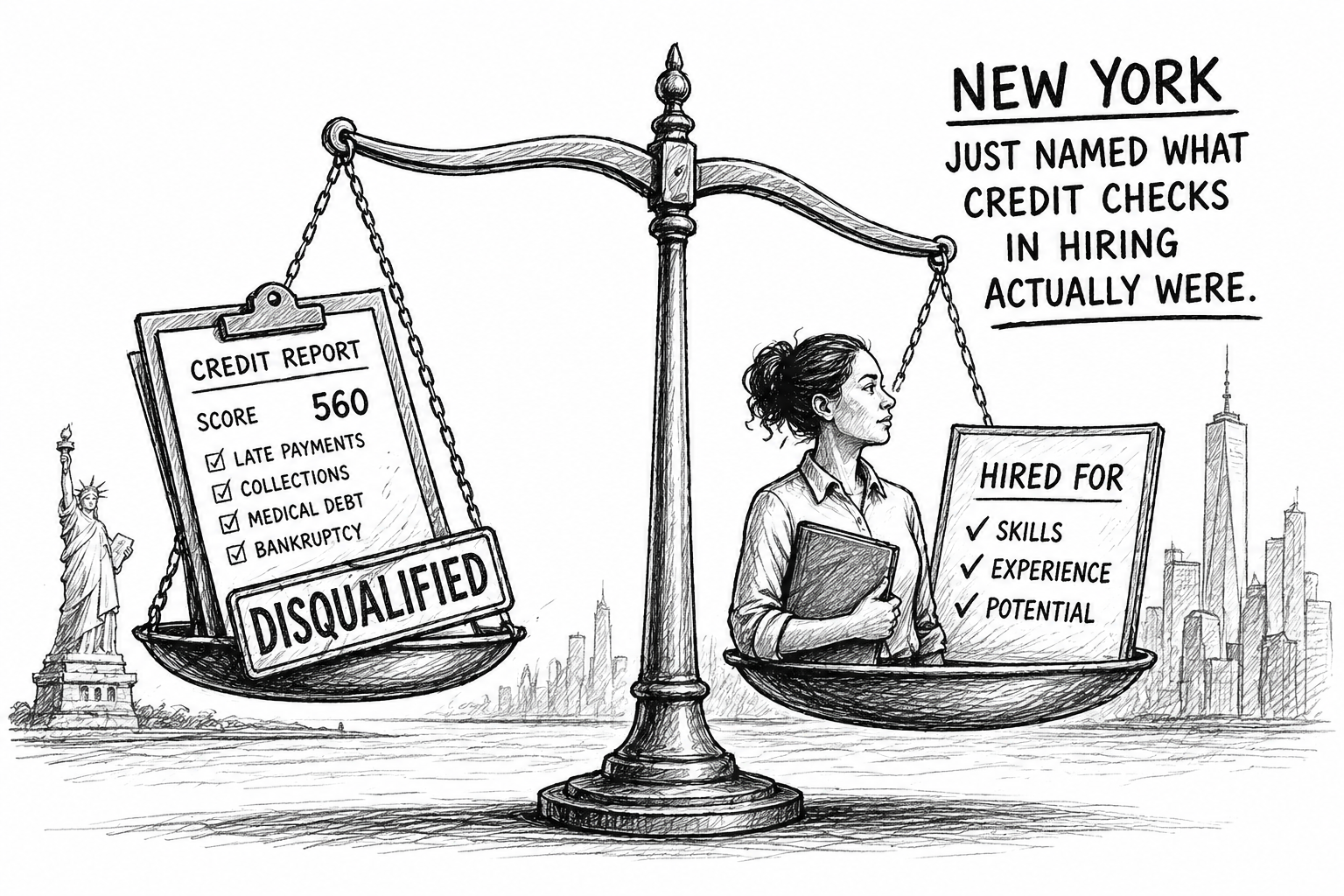
The framing behind the law is worth naming directly. State lawmakers framed the change as a civil rights and workforce issue, arguing that credit history reflects economic hardship rather than job performance. That framing is a departure from how credit checks have typically been defended — as a proxy for trustworthiness, financial responsibility, and character. What the new law does, structurally, is reject that proxy as unreliable and discriminatory. A person’s credit history encodes their experience of the economy — job losses, medical debt, divorce, periods of housing instability — not their professional competence. Using it to determine whether someone gets hired is not a neutral screening decision. It is a decision to penalize people for having been economically vulnerable, which concentrates harm on the people who have the least cushion to absorb it.
The racial dimension of that concentration is not incidental. Black and Latino workers carry disproportionate credit score gaps relative to white workers — a gap that traces to redlining, wage suppression, predatory lending, and a century of structured exclusion from wealth-building mechanisms. The new law closes what one compliance firm described as “the loophole where millions of New Yorkers with imperfect credit could be unfairly screened out of jobs.” The loophole was legal. It was widely used. And its effects were not random. They followed the same patterns that have characterized employment discrimination in the United States for generations — operating through a mechanism that looked procedural while producing outcomes that were structural.
The practical implications extend into how background screening companies operate. Employers are now prohibited from asking applicants about debts, bankruptcies, judgments, or liens, and background screening agencies are barred from supplying credit history information unless a specific exemption applies. Multijurisdictional employers — companies that operate across multiple states — face particular complexity, as the standards vary and the New York law’s employee-location rule creates compliance obligations regardless of company headquarters. Some large employers have already moved to eliminate credit checks entirely except for specifically exempted roles, rather than manage the state-by-state variation.
The broader signal is that the legal infrastructure around hiring is being slowly rebuilt around a different premise — one that asks whether a screening tool is actually predictive of job performance rather than simply traditional. Credit checks survived for decades not because they were accurate predictors of how someone would perform at work, but because they were available, cheap, and legally defensible. As more states close that defense, the screening tools that remain will face the same question. The credit check ban is not the end of this recalibration. It is a marker of where the line is currently being redrawn.