
This finding sits uncomfortably inside one of the most viral consumer moments of the past two years.
Independent laboratory testing commissioned by the Campaign for Uyghurs and confirmed by The New York Times found that clothing from 16 of 20 Labubu dolls purchased from major U.S. retailers — including Amazon, eBay, Shein, and Pop Mart directly — contained cotton traced to China’s Xinjiang region, where the U.S. government has banned imports due to documented forced labor. Pop Mart, the Chinese company behind the dolls, told the Times it would investigate and holds its suppliers to “the highest standards.” That statement is difficult to reconcile with its own record: in 2021, Pop Mart terminated its collaboration with Adidas after Adidas pledged to stop using Xinjiang cotton, filing court documents accusing Adidas of “baselessly smearing Xinjiang” and “hurting the feelings of the Chinese people.”
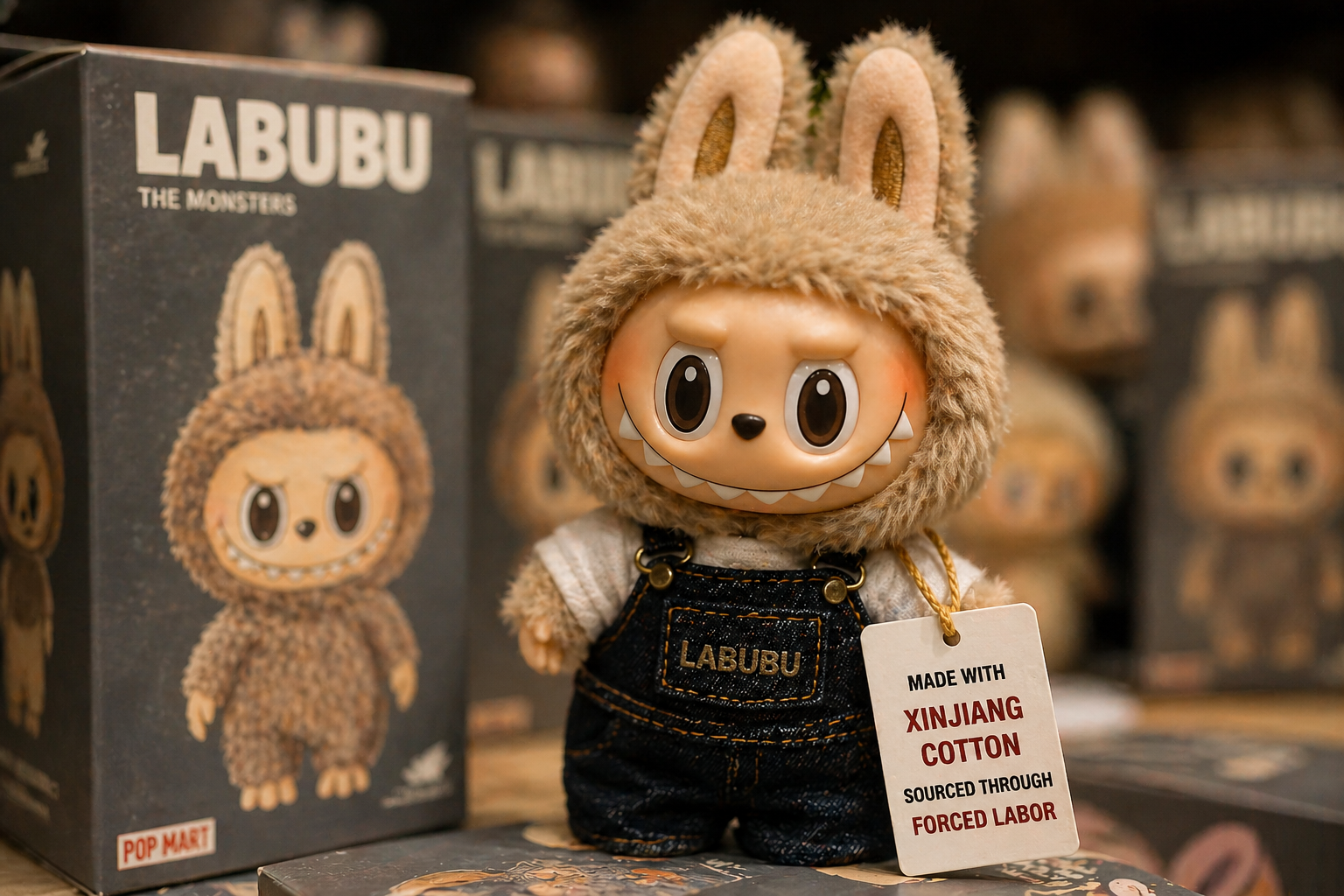
The cultural context makes the finding harder to look away from. Pop Mart’s revenue in the Americas rose more than 700% in the first half of 2025, and the company expanded its U.S. presence from 26 stores to 72 by year’s end, with plans to exceed 100 locations in 2026. Labubu dolls generated hours-long lines at store openings, resale prices reaching thousands of dollars, and a cultural moment that moved well beyond toy collecting into fashion and identity. Xinjiang produces over 90% of China’s cotton and roughly 20% of global supply — making clean cotton supply chains inside China vanishingly rare, according to researchers at the Victims of Communism Memorial Foundation. The supply chain did not change when the cultural status did.
The legal exposure is specific. The Uyghur Forced Labor Prevention Act, co-authored by Marco Rubio — now Secretary of State — creates a rebuttable presumption that goods produced wholly or in part in Xinjiang are prohibited from U.S. import. Pop Mart’s manufacturing is centered in Guangdong province, not Xinjiang directly, which places the dolls outside automatic inspection. The cotton travels from Xinjiang to Guangdong via documented supply chains before entering the finished product. U.S. Customs and Border Protection declined to comment on enforcement. The Trump administration, which has framed trade enforcement as a central priority, is simultaneously planning a presidential visit to Beijing next month.
The Labubu finding is not primarily about one toy company. It is about the gap between the cultural meaning consumers assign to objects and the supply chain conditions those objects carry invisibly. The product circulates as culture. The conditions behind it remain largely out of frame — and whether this administration enforces the law it inherited may depend less on the evidence than on the diplomatic calendar.