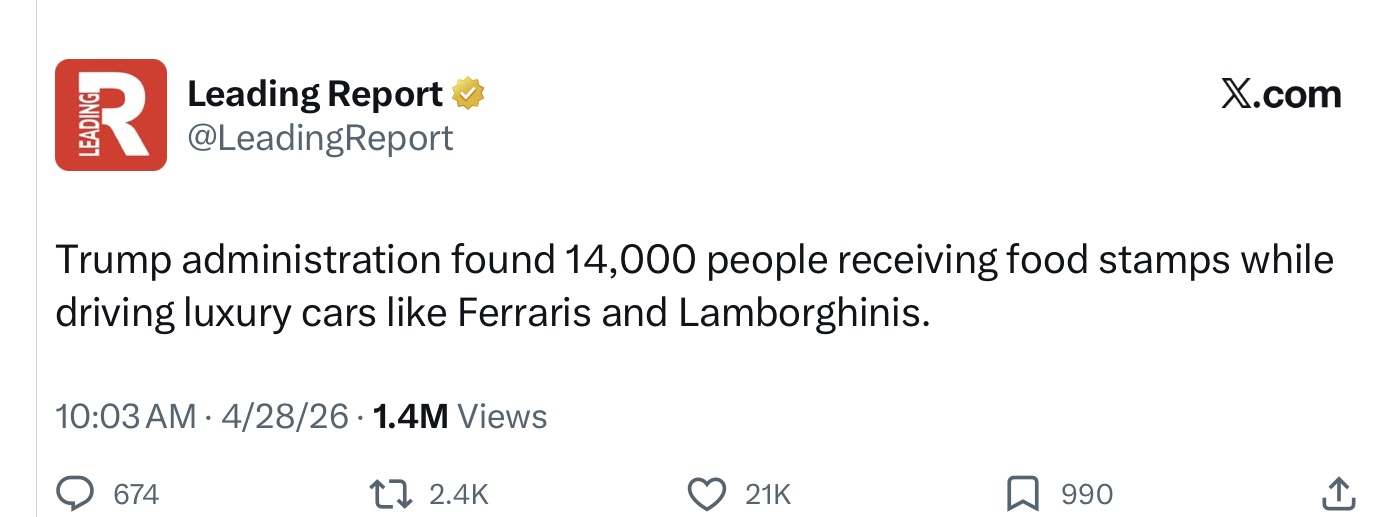
Fourteen thousand. That’s the number being circulated — SNAP recipients in one state allegedly driving “luxury vehicles,” presented as proof that the system is being gamed. The list is specific enough to feel credible: Teslas, Land Rovers, Porsches, Maseratis. The framing does the rest. The conclusion is implied before it is examined. Something must be wrong here. The system must be failing. The people receiving help must not actually need it.
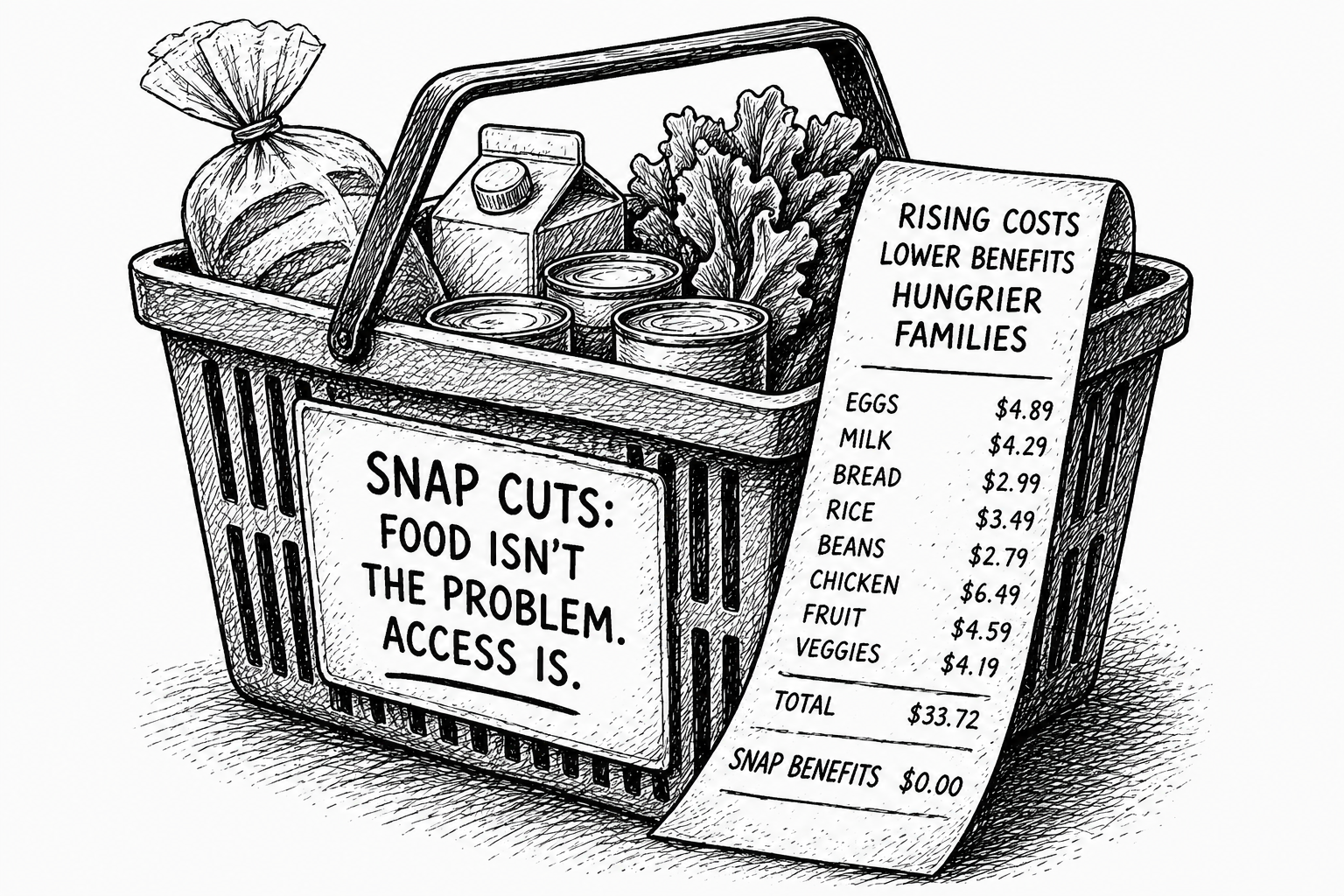
What gets removed from that framing is time. The data presents a snapshot, but the lives behind it are not static. Someone can be employed one month and laid off the next. Someone can purchase a car during a period of stability and find themselves navigating income loss months later. The asset remains visible. The income does not. What looks like contradiction is often just transition — something the system itself is designed to absorb, but the narrative refuses to acknowledge.
The policy confirms this. SNAP eligibility is tied primarily to income, not assets. Vehicles count as a resource for SNAP purposes, but states have wide flexibility in how they assess them — and most states exempt a household’s primary vehicle entirely, regardless of its value. Many states do not count vehicles at all, with policies specifically designed to prevent penalizing households for needing reliable transportation. That is not a loophole. It is intentional design — a recognition that someone can own a car and still not be able to afford food. The narrative circulating about luxury vehicles is not describing a system that has failed. It is describing a system that is working exactly as legislated, being misrepresented to an audience that does not have access to the fine print.
The label “luxury” is doing more work than the data itself. A Tesla is not a Ferrari. A used Land Rover is not a symbol of current wealth. Many of these vehicles depreciate rapidly, are financed over long periods, or were acquired under income conditions that no longer exist. A SNAP recipient may be driving a vehicle they do not own — a family member’s car, a borrowed vehicle — or one whose equity is well below the value implied by its badge. But once grouped under a single label, nuance collapses. The category becomes the argument. The presence of the asset becomes evidence of wrongdoing, regardless of the context in which it was acquired or the circumstances under which it is being maintained.
What this produces is a reframing of need. Instead of asking whether someone currently qualifies for assistance based on their income, the conversation shifts to whether they “look like” someone who should need help. That is a different standard entirely — one rooted not in policy, but in perception. And perception, in this case, is being shaped by selective visibility. You can see the car. You cannot see the job that ended, the income that stopped, or the financial runway that shortened faster than expected.
The selective scrutiny is not being applied evenly. In Arizona, more than 424,000 people have been removed from SNAP since July under a federal law requiring states to tighten eligibility or face financial penalties. At the same time, roughly 20 percent of parents using the state’s school voucher program misspent more than $10 million in tax dollars — buying $1,500 gift cards, electric dirt bikes, and other prohibited items — while the state’s Republican-controlled legislature resisted adding oversight. One system is being aggressively audited and cut. The other is being actively protected from accountability. The difference is not fraud rate. It is who the beneficiaries are.
This is where the contradiction becomes structural. The same system that encourages people to build stability — to secure employment, finance reliable transportation, and participate in the economy — then uses the remnants of that stability as evidence against them when conditions change. Past success becomes a liability. The proof that someone was once doing well becomes the argument that they should not need support now. For people like Jenny Duncan, a disabled Arizona resident who relied on roughly $300 a month in SNAP benefits to cover basic food costs, the removal was immediate and painful. The data circulating about luxury vehicles did not describe her situation. It shaped the political environment that ended her benefits anyway.
That contradiction is not abstract. It is lived. There are people navigating job transitions right now, making adjustments in real time, calculating how long they can maintain their current obligations before they need to seek assistance. The decision to apply for help is not taken lightly. It is often delayed, negotiated, and avoided until it becomes necessary. When it does become necessary, the system is supposed to be there. That is its function. What is happening instead is a shift in how that function is perceived — data being framed in a way that prioritizes reaction over understanding, a number presented without context, a category applied without precision, a conclusion hardened before the underlying reality has a chance to surface.
This is not a story about widespread fraud. The USDA itself allocates roughly $5 million annually to state fraud detection grants — meaningful oversight, but a fraction of the program’s overall budget — because actual recipient fraud, while it exists, is not the defining feature of the system. The defining feature is that it provides food access to millions of households navigating income volatility in an economy where that volatility is the norm. The visibility of a car is being used to override the invisibility of lost income. And in that gap, a system designed to provide support is being recast as something to be questioned rather than something to be understood.