The City of Miami has opened pre-applications for four newly constructed homes priced at $400,000 for income-eligible, first-time buyers. Four. In a city where the average home now sells for $672,000 and the luxury segment has effectively redefined its own floor with $1 million considered a fairly average price tag, the program is being positioned as an effort to expand affordable housing access. The math makes the positioning difficult to sustain. Four units is not a housing initiative. It is a waiting list with a finish line.
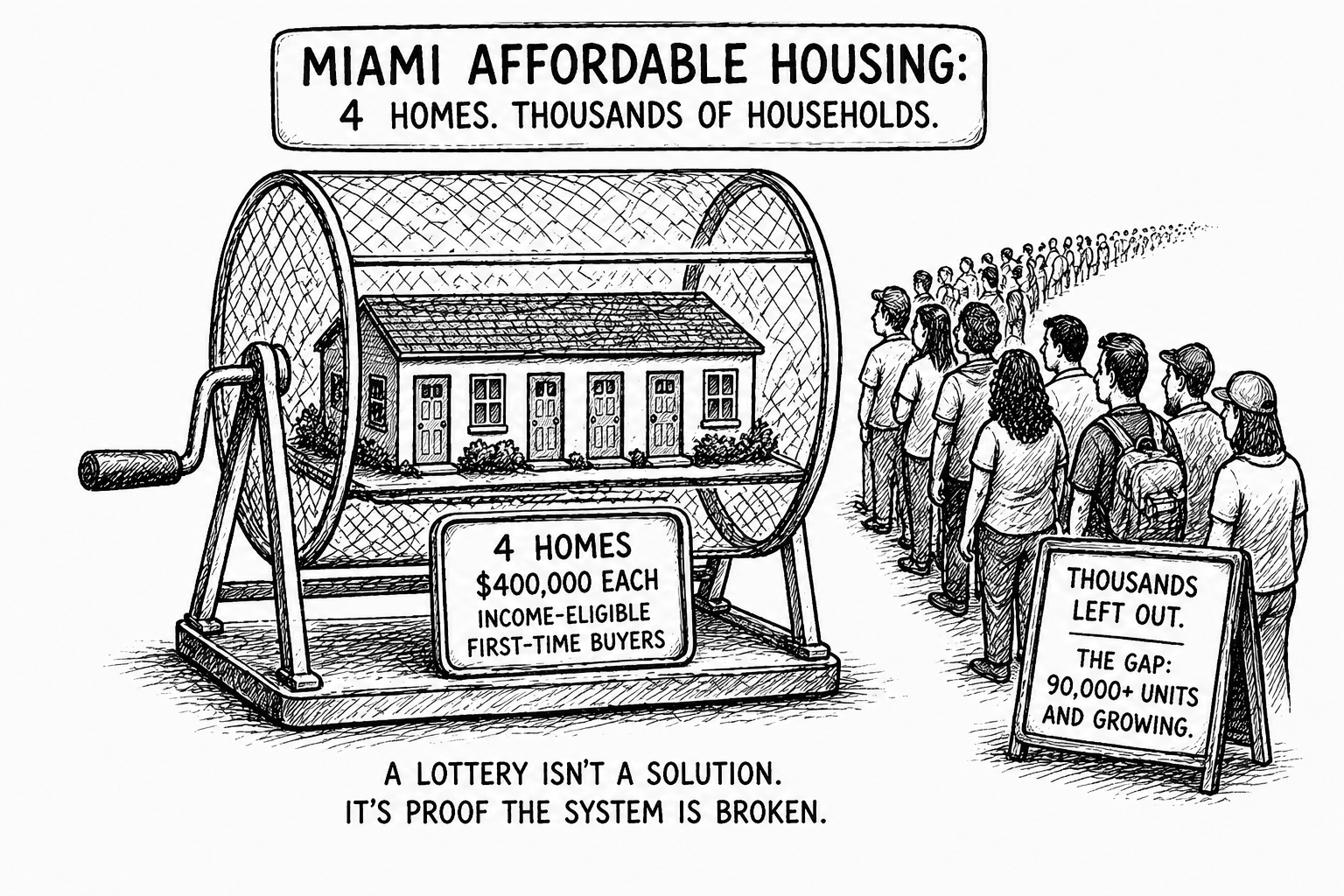
The eligibility structure adds another layer of complexity. Miami’s first-time homebuyer programs require applicants to have household incomes at or below 80% of the area median income, maintain good credit history, demonstrate 24 months of employment in the same line of work, and contribute personal funds toward closing costs. Those requirements are not unreasonable in isolation. In the context of a market where three-quarters of households earning below $75,000 per year are already cost-burdened and the county has a gap of more than 90,000 affordable and available rental units, they describe a system where the people most in need of housing assistance are also the most likely to be disqualified from accessing it. The program is technically available. It is practically inaccessible for most of the households it claims to serve.
What makes this moment notable is not the program itself — it is what the program reveals about how access is being structured. Affordable housing is not disappearing entirely from Miami. It is being delivered in quantities so limited that it functions more like a lottery than a solution. The county’s affordable housing gap is projected to grow to nearly 116,000 units by 2030. Against that projection, four homes is not progress. It is documentation that progress has not arrived.
The tension between policy intent and outcome is structural, not incidental. Programs designed to expand access are constrained by funding, land availability, zoning, and development timelines — resulting in incremental interventions that are consistently outmatched by market forces. As SSC has documented in its City Signals coverage of Miami, much of the city’s housing crisis stems from developers prioritizing luxury and higher-cost units for newly arrived high-net-worth individuals, leaving the affordable segment chronically underserved while the political language of affordability remains intact. The word survives the policy. The housing does not follow.
The implications are direct. For the four households who secure access, the benefit is real — a pathway to homeownership in a market that would otherwise be permanently out of reach. Miami’s first-time homebuyer assistance programs provide zero-percent deferred loans, meaning qualifying buyers can access ownership without the compounding burden of interest on their assistance amount. That is meaningful for the individuals who clear every eligibility threshold. For the tens of thousands who do not, the existence of those four homes highlights the gap between what is needed and what is available with a precision that broader policy language tends to obscure.
This pattern is not unique to Miami. Across high-cost cities, affordable housing initiatives consistently operate at scales that cannot meaningfully alter market dynamics — functioning as targeted interventions within a system that requires structural change. What Miami’s four-home program illustrates is how affordability can exist as a policy category while remaining functionally out of reach for most of the people who need it. The program is real. The access is rationed. And in a city where the cost of staying is already rewriting who belongs, four units is not a solution to a crisis. It is evidence that one exists.