
For the 2026 London Marathon, more than one million people applied through the public ballot — a record that shattered the previous high of 840,000 set just one year earlier. Of those UK applicants, 49% were women, a figure that reflects an 103% increase in female applicants since the 2024 entry ballot. With only 1.5% of applicants earning a place, the ballot acceptance rate has become one of the most selective in recreational sport. What is being sought is not only the race. It is the structure surrounding it — the routine, the community, the identity that training for something this difficult produces.
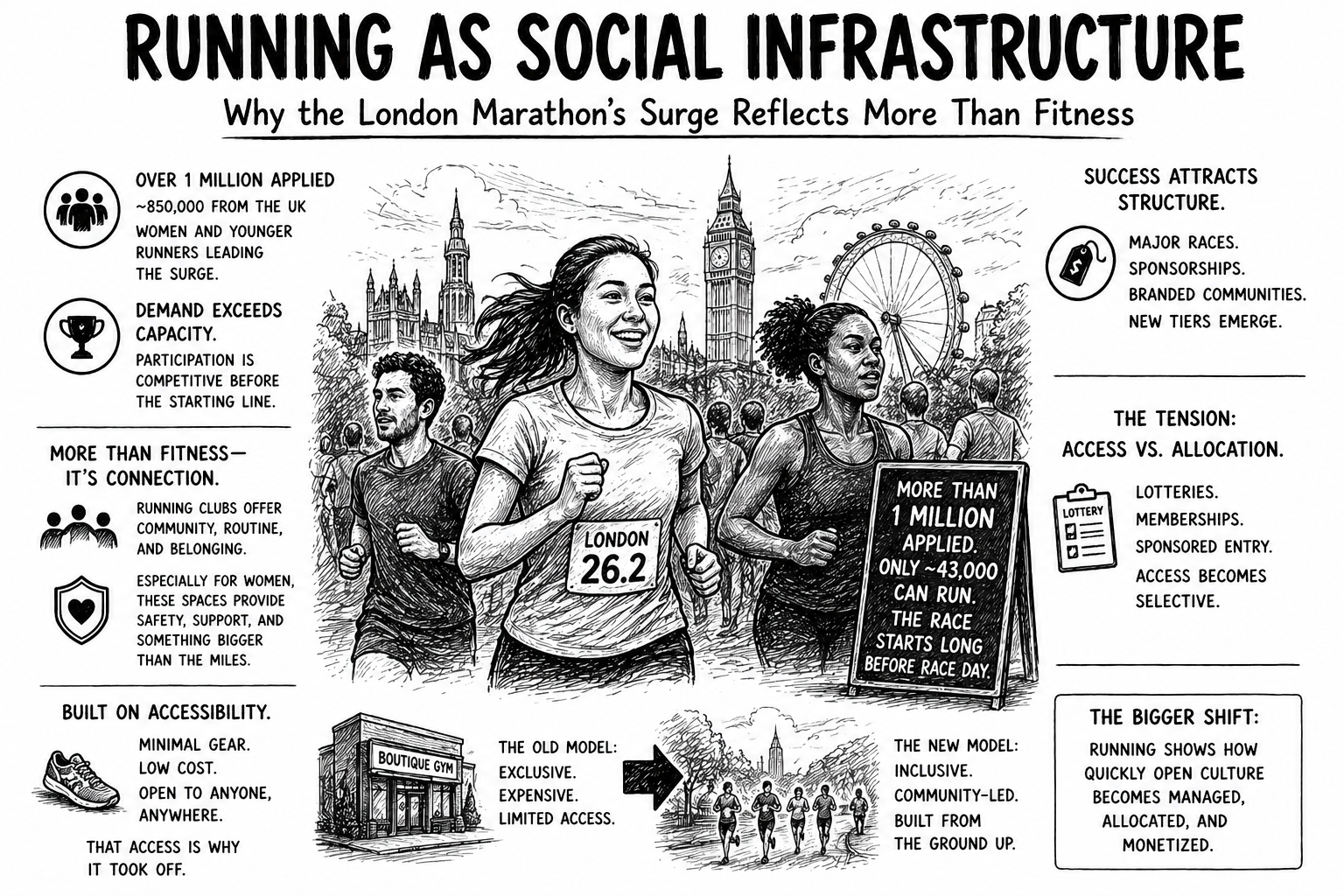
The numbers behind the marathon surge are inseparable from a broader shift in how people are using running. Running club memberships on Strava increased 59% in 2024, and the number of new clubs tripled compared to the year prior. Strava saw an 89% increase in women joining the app in 2024 compared to the previous year, and women are now 16% more likely than men to participate in weekend group runs. More than half of active fitness consumers say social interaction is the primary reason they join and stay engaged with their fitness communities. Running has not simply become more popular. It has become a vehicle for something the gym and the nightclub were not delivering: low-cost, low-barrier access to consistent human connection.
The safety dimension is particularly significant for women and goes largely unacknowledged in how the running boom gets covered. Research from the University of Manchester found that nearly 70% of women have experienced some form of abusive behavior while running alone. All-female run clubs have emerged as a direct response — organized spaces that offer the social benefits of group exercise while removing the vulnerability of running solo. The community is not incidental to the fitness. For many women, it is the prerequisite for it.
Gen Z runners are driving much of this growth, with 64% saying they would rather spend money on new gear than a night out, and 22% describing run clubs as the new dating app. Among Gen Z, 65% list improved mental health as a primary goal for running — higher than any other demographic. What is being described is a generation using running to construct the social infrastructure that other institutions — bars, offices, religious communities — have historically provided. The marathon is the aspirational endpoint of that infrastructure. The run club is the daily architecture.
This represents a meaningful departure from previous fitness trends defined by exclusivity and cost. Boutique gyms and specialized training programs created barriers through pricing and location. Running requires minimal equipment and can be organized collectively without institutional backing. That accessibility has driven its growth — and it has also attracted commercial interest that is beginning to reshape what made it accessible in the first place. Major brands are integrating themselves into running communities through events, sponsorships, and loyalty programs, leveraging the communal identity runners have built to generate revenue streams that the communities themselves did not originally require.
The tension is already visible in the marathon itself. As demand increases, access becomes more selective — through lotteries with sub-2% acceptance rates, charity entry requirements, membership structures, and sponsored spots that effectively create a market for places that were originally distributed randomly. The ballot acceptance rate has dropped below 1.5%, and the race organizers are now planning a two-day festival format for 2027 — a development that signals the institutionalization of what began as mass participation. The system begins to replicate the dynamics it initially disrupted.
The London Marathon’s million-person ballot is a measure of demand. What that demand is reaching toward — community, safety, routine, belonging — is something the race itself can only symbolize. The infrastructure that delivers it daily is still free, still informal, and still being absorbed by markets that have learned to monetize what they did not build.