
Between July 2024 and July 2025, Los Angeles County recorded the largest population decline of any county in the United States, with roughly 54,000 residents departing in a single year, according to newly released U.S. Census Bureau estimates published March 26. The county has now fallen from approximately 10 million residents in 2020 to roughly 9.7 million today — a decline that reflects a decade-long trend, accelerated by the convergence of wildfire displacement, rising housing costs, and the social disruption that immigration enforcement brought to neighborhoods across the region. The people leaving are not a monolith. But the pattern they form together is.
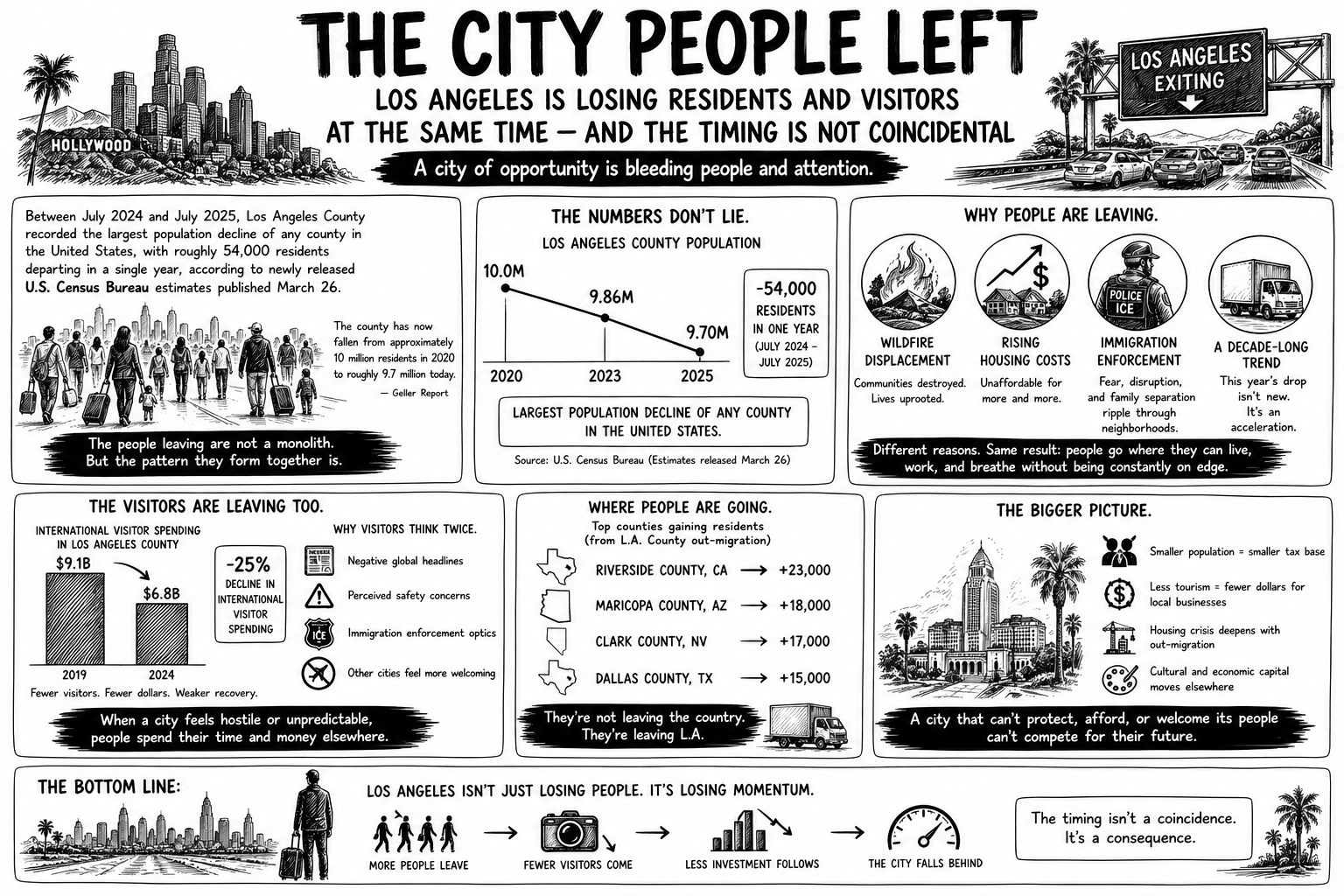
That exodus matters to the tourism story because the two are structurally connected. A city losing residents at this scale is also losing the workforce, the neighborhood stability, and the cultural texture that make a destination function. Tourism is one of the top five employers in Los Angeles County, supporting more than 540,000 Angelenos, and in 2023 the industry generated more than $40 billion in local business sales. That base does not hold when the people who run it are leaving, displaced, or staying home out of fear.
The visitor numbers tell the parallel story. Direct travel spending in Los Angeles County fell for the first time since the pandemic in 2025 — down 0.1% against an annual average growth rate of nearly 3% over the previous decade, and well below the 2.7% statewide growth California recorded that same year. International air arrivals to Los Angeles County fell more than 30% between August and November 2025. Canadian visitors alone dropped nearly 38% year-over-year. The number of tourism jobs shrank by roughly 1,000, and an 8% decline in visitor air spending amounted to approximately $188 million lost.
Three overlapping forces drove this. The January wildfires dominated national media for weeks, creating a perception of widespread destruction that led consumers to believe that half of Los Angeles County had burned — when in reality less than 2% of the region was directly affected. Perception moved faster than fact, and the tourism industry spent months trying to close that gap. Visit California convened its first emergency board meeting in five years and deployed a $4.3 million crisis recovery fund toward a marketing campaign aimed at countering misinformation and restoring visitor confidence.
The second force was immigration enforcement. ICE operations in the city over the summer forced people to stay home out of fear — a dynamic that compressed activity in neighborhoods where hospitality, food service, and retail depend heavily on workers and patrons from immigrant communities. Those workers did not disappear from the data cleanly. They show up as reduced foot traffic, shortened hours, and shuttered storefronts.
The third force was geopolitical. Increasing reports of European tourists facing lengthy detentions at U.S. border checkpoints dampened international enthusiasm, and Canadians pulled back sharply following repeated statements from U.S. leadership that strained bilateral relations. Visit California projected a 9% annual decline in international tourism for 2025, attributing the drop to weakening consumer sentiment, reduced airlift from key global markets, and a strong U.S. dollar that made travel more expensive for foreign visitors.
What makes Los Angeles distinctive — and more exposed — is its reliance on that international segment. International visitors represent 23% of overnight visitation in Los Angeles but account for more than 49% of overnight visitor spending. When that group contracts, the revenue loss is disproportionate to the headcount. The math is unforgiving.
The near-term outlook holds some recovery. Hotel room revenue in the county was up 4% year-over-year in the first quarter of 2026, and Visit California points to the FIFA World Cup this summer and the 2028 Olympics as sustained global attention that will change the city’s trajectory. Those events are real anchors. But they do not address the structural conditions that drove residents out or the enforcement environment that reshaped community behavior in tourism-adjacent neighborhoods. A city can host a World Cup and still be contracting. The events and the exodus are not mutually exclusive — and treating one as the answer to the other is how cities end up surprised by their own fragility.
The broader shift is that brand alone no longer insulates a destination. Los Angeles has global recognition, iconic infrastructure, and a pipeline of marquee events. What 2025 revealed is that stability — environmental, social, and political — has become a prerequisite for converting that recognition into consistent economic return. When all three are disrupted simultaneously, even the most visible cities discover how quickly demand can be redirected somewhere safer.