A federal appeals court blocked an executive order from Donald Trump that sought to suspend asylum access at the U.S.-Mexico border, ruling that the move exceeded presidential authority and conflicted with existing immigration law. The order, issued on Inauguration Day 2025, attempted to halt asylum processing entirely by framing the border situation as an “invasion,” a designation used to justify emergency powers. The court’s decision reinforces that individuals arriving at the border retain the legal right to apply for asylum, regardless of how the situation is described politically.
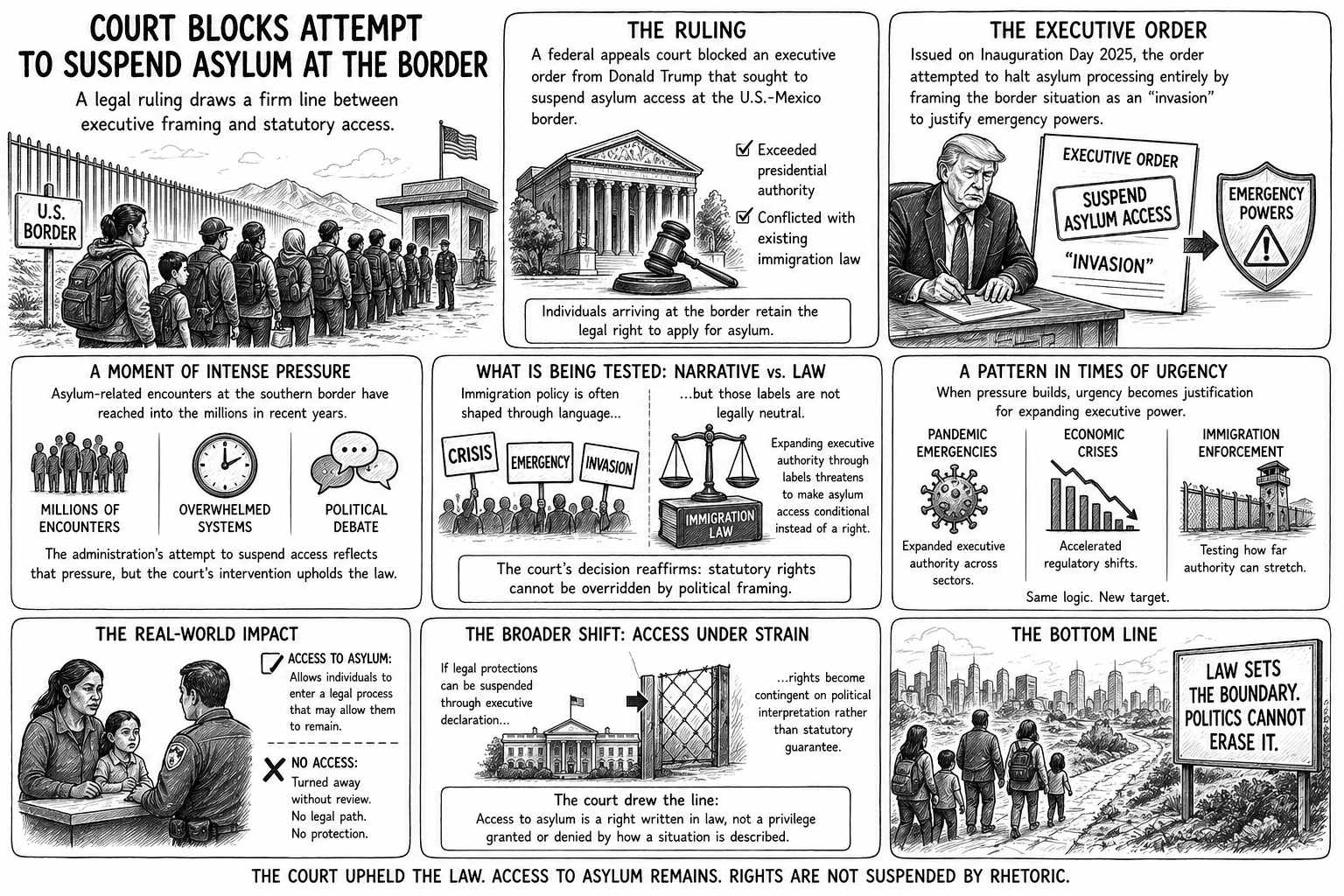
The ruling arrives at a moment when immigration enforcement has become one of the most contested areas of executive authority, with policy often shifting through administrative action rather than legislative change. Asylum-related encounters at the southern border have reached into the millions in recent years, placing sustained pressure on processing systems and intensifying political debate. The administration’s attempt to suspend access reflects that pressure, but the court’s intervention clarifies that legal rights embedded in statute cannot be overridden through executive framing.
What is being tested is the boundary between narrative and law. Immigration policy is often shaped through language — crisis, emergency, invasion — but those labels are not legally neutral. They are attempts to expand the scope of what the executive branch can do without congressional approval. If successful, that expansion would allow access to asylum to become conditional, dependent on how a situation is defined rather than on what the law guarantees.
The tension mirrors patterns seen in other domains where urgency becomes justification for structural change. Emergency declarations during the pandemic expanded executive authority across multiple sectors, and economic crises have similarly accelerated regulatory shifts. Immigration is now operating within that same logic, where pressure on the system is being used to test how far authority can stretch.
For individuals at the border, the implications are immediate and concrete. Access to asylum determines whether someone can enter a legal process that may allow them to remain in the country or whether they are turned away without review. A suspension would have removed that entry point entirely, altering not just outcomes but the structure of the system itself.
The broader shift is about how access is governed under strain. If legal protections can be suspended through executive declaration, they become contingent on political interpretation rather than statutory guarantee. The court’s decision reinforces a different boundary: that access, once codified, cannot be rewritten through narrative alone, even in moments framed as crisis.