
Los Angeles is preparing to lay off approximately 284 workers from the Los Angeles Homeless Services Authority as the county moves to create a new, centralized department to oversee housing and support programs. The layoffs come as part of a broader restructuring effort aimed at addressing long-standing criticism of how homelessness services are coordinated and delivered. LAHSA has managed outreach, shelter, and service distribution for decades, making the scale of the transition significant not just administratively, but operationally.
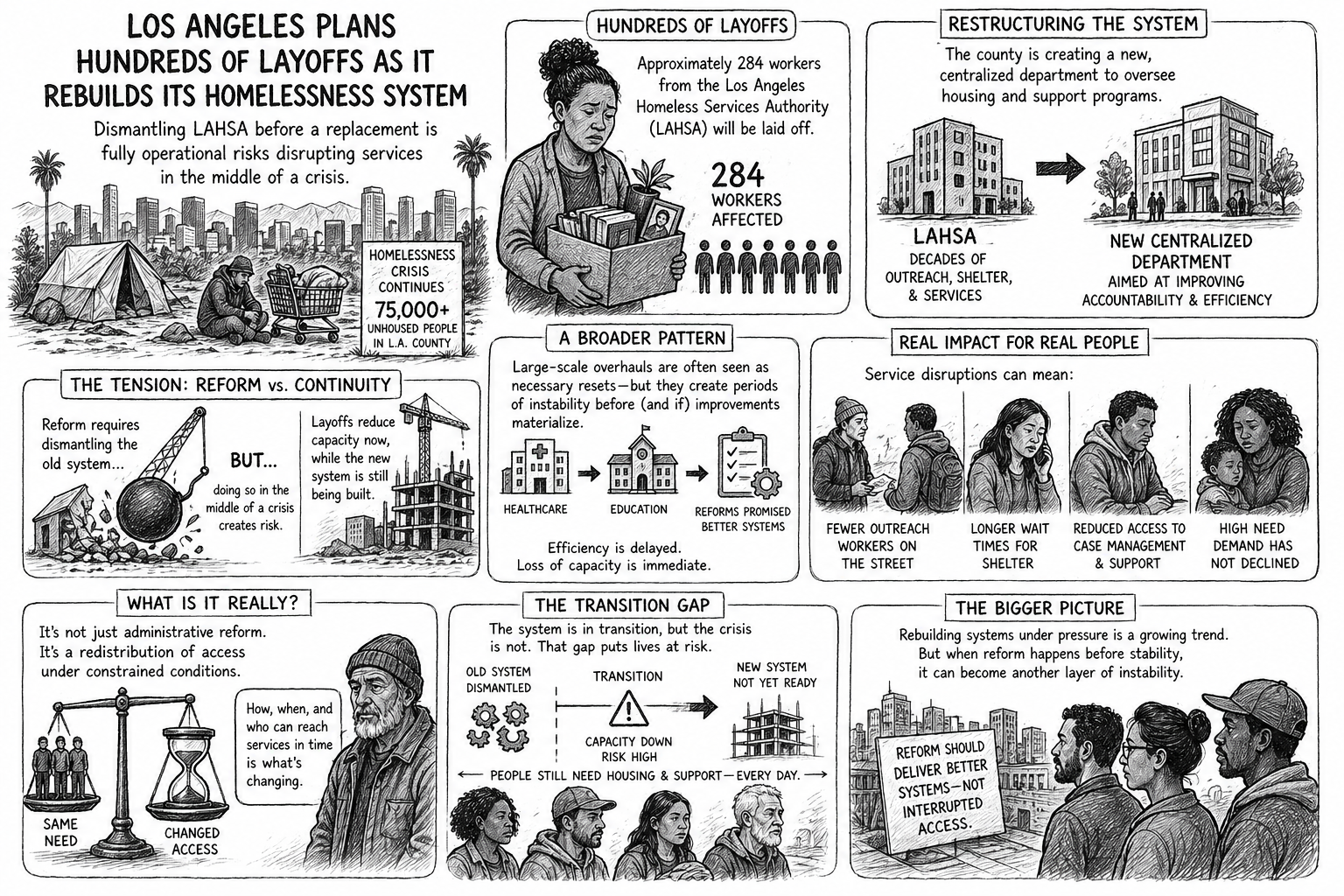
The decision unfolds in the context of a homelessness crisis that remains among the largest in the country. Los Angeles County’s unhoused population has exceeded 75,000 people in recent counts, placing sustained pressure on both public systems and political leadership. The restructuring is intended to improve accountability and efficiency, but it is occurring while demand for services remains high and immediate, creating a timing gap between system redesign and system need.
The tension is between reform and continuity. Rebuilding a system often requires dismantling parts of the existing structure, but doing so in the middle of an ongoing crisis introduces risk that is not evenly distributed. Layoffs reduce capacity in the short term, even as the new system is still being designed and implemented, meaning that the people most dependent on services are the ones most exposed to disruption during the transition.
This pattern reflects a broader institutional instinct toward structural overhaul when incremental reform fails to deliver visible results. In sectors like healthcare and education, large-scale reorganizations are often framed as necessary resets, but they frequently produce periods of instability before improvements materialize, if they materialize at all. The assumption is that a new system will operate more efficiently, but that efficiency is delayed, while the loss of existing capacity is immediate.
For those experiencing homelessness, the impact is not theoretical. Service disruptions can mean fewer outreach workers on the street, longer wait times for shelter placement, and reduced access to case management and support programs. The system continues to operate during the transition, but it does so with fewer people and less coordination at a moment when demand has not declined, creating a gap between need and response.
What is often framed as administrative reform is, in practice, a redistribution of access under constrained conditions. The restructuring does not reduce the number of people who need housing or services. It changes how and when those services are delivered, and who is able to reach them in time. The shift is not just organizational. It is experiential for the people navigating the system.
The broader pattern is a move toward rebuilding systems under pressure rather than stabilizing them first. Los Angeles is not unique in this approach, but the scale of its homelessness crisis makes the stakes more visible. As cities pursue structural resets in response to persistent failures, the risk is that reform becomes another layer of instability, reshaping access at the same time it attempts to improve it.