
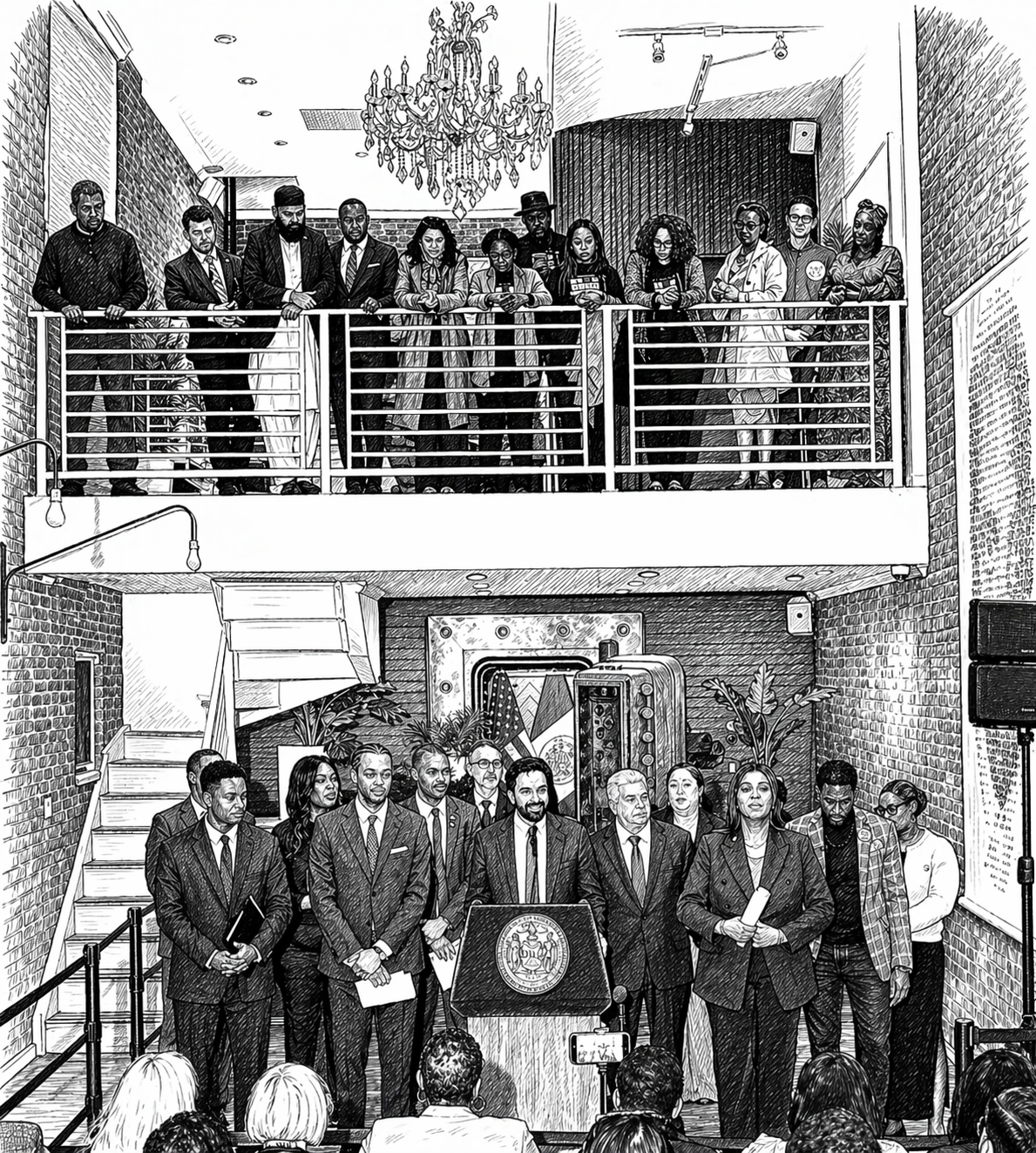
The press conference was held in Bed-Stuy for a reason. Mayor Zohran Mamdani announced New York City’s first Office of Deed Theft Prevention on April 24, appointing Peter White — a longtime homeowner assistance attorney at Access Justice Brooklyn — as its director. The announcement came two days after Council Member Chi Ossé was arrested outside a brownstone at 212 Jefferson Ave. while attempting to stop the eviction of a resident who said her home had been stolen through fraudulent paperwork. The location, the timing, and the political coalition assembled on that stage — including Attorney General Letitia James, Public Advocate Jumaane Williams, Brooklyn DA Eric Gonzalez, and the NAACP New York State Conference — were not incidental. They were a statement about who this crisis belongs to and who has been absorbing it.
The numbers make the targeting pattern explicit. More than 3,500 deed theft complaints were filed in New York City between 2013 and 2023, concentrated primarily in Brooklyn and Queens. In 2025 alone, 517 complaints were registered — more than three times the 149 filed in 2023, a 240% increase in two years. Council Member Ossé’s district, which includes Bed-Stuy and Crown Heights, is one of several historically Black areas where rising property values have made homes both more valuable and more vulnerable to predatory speculation. The scammers are not choosing these neighborhoods randomly. They are choosing them because that is where the equity is — and where the legal protection infrastructure has historically been thinnest.
Deed theft is paperwork fraud at its most violent. Scammers forge signatures, falsify documents, manipulate elderly homeowners into signing transfers they do not understand, or exploit gaps in verification systems to transfer ownership without the homeowner’s knowledge. Once the deed moves, the legal system treats the new document as presumptively valid — forcing the original owner into a prolonged, expensive, and emotionally devastating fight to prove fraud in a court that begins from the wrong starting assumption. By the time that process resolves, the property may already have been sold, mortgaged, or stripped of equity. “Central Brooklyn has become a war zone for solicitors, shady LLCs and bad actors who circle legacy homes like vultures,” Ossé said at the press conference.
The new office is a meaningful institutional response. It will be housed within the Department of Finance — which records property documents — and coordinate across the Sheriff’s Office, the Commission on Human Rights, the Department of Consumer and Worker Protection, and the Department of Housing Preservation and Development. Its three mandates are deed fraud identification, prevention, and correction and remediation. The city has also paused tax lien sales for six months while reviewing the system. The pause matters. Tax lien systems are designed as enforcement mechanisms for unpaid debts, but in practice they create an additional entry point for property transfer pressure on owners who are already financially vulnerable. Layering enforcement on top of a fraud-prone recording system does not protect homeowners. It accelerates their exposure.
What the office cannot fix alone is the verification architecture that makes deed theft possible in the first place. The core problem is that property ownership in New York — and across most of the United States — is recorded through a document system that was not designed with digital-era forgery capabilities in mind. A deed is a piece of paper. Its legitimacy is determined by its form, not by real-time verification of the signer’s identity or consent. That gap is not a bug that scammers have discovered. It is a structural feature of a recording system built in an era when document fraud required physical access and significant effort. Both of those barriers have collapsed.
Mamdani’s preliminary budget allocates $500,000 to the office in the current fiscal year and $1 million annually afterward — well short of the $10 million he originally promised during his campaign. That gap between promise and appropriation is worth naming, because the scale of the problem and the scale of the response are not matched. Assembly Member Stefani Zinerman argued that the tax lien sale should be abolished altogether, not just paused — pointing to a fundamental policy question about whether a system that creates financial pressure pathways into property transfer belongs in a city already navigating a generational wealth crisis in its Black communities. The land bank legislation passed in January 2026 that would replace the Tax Lien Trust by 2029 is a meaningful reform — but its implementation details remain undefined, and 2029 is three years from now.
The structural argument underneath all of this is one SSC has been tracking across multiple beats: ownership, in America, has never been as absolute as the political mythology of property rights suggests. What this crisis makes visible is that for Black homeowners in Brooklyn and Queens specifically, ownership has always been conditional — conditional on the integrity of systems they did not design, administered by institutions that have not historically prioritized their protection, and vulnerable to financial actors with far greater legal resources than the families they are targeting. Deed theft did not create that condition. It exploits it.
Mamdani said at the press conference that “city government has too often stood idly by while deed theft occurs, rather than acting to prevent it.” That is accurate and worth saying out loud. It is also a description of a pattern that extends well beyond this administration’s predecessors. The communities being targeted built their equity over decades, often as the first generation in their families to own property in New York City, in neighborhoods that were redlined, disinvested, and systematically devalued for most of the twentieth century. The equity they accumulated is real. The system protecting it has never been proportionate to the threat.
The Office of Deed Theft Prevention is a necessary institution. The question is whether it is the beginning of a structural fix or a well-resourced acknowledgment that the system has a problem it is not yet committed to solving at the root.