
Norway announced plans to introduce legislation banning social media access for children under 16, following a similar move in Australia, where violations could carry fines up to $49.5 million for companies that fail to enforce age restrictions. The proposed law would shift responsibility for enforcement away from parents and onto platforms themselves, requiring companies to verify user age and prevent underage access. What was once framed as a question of digital parenting is now being formalized as public policy.
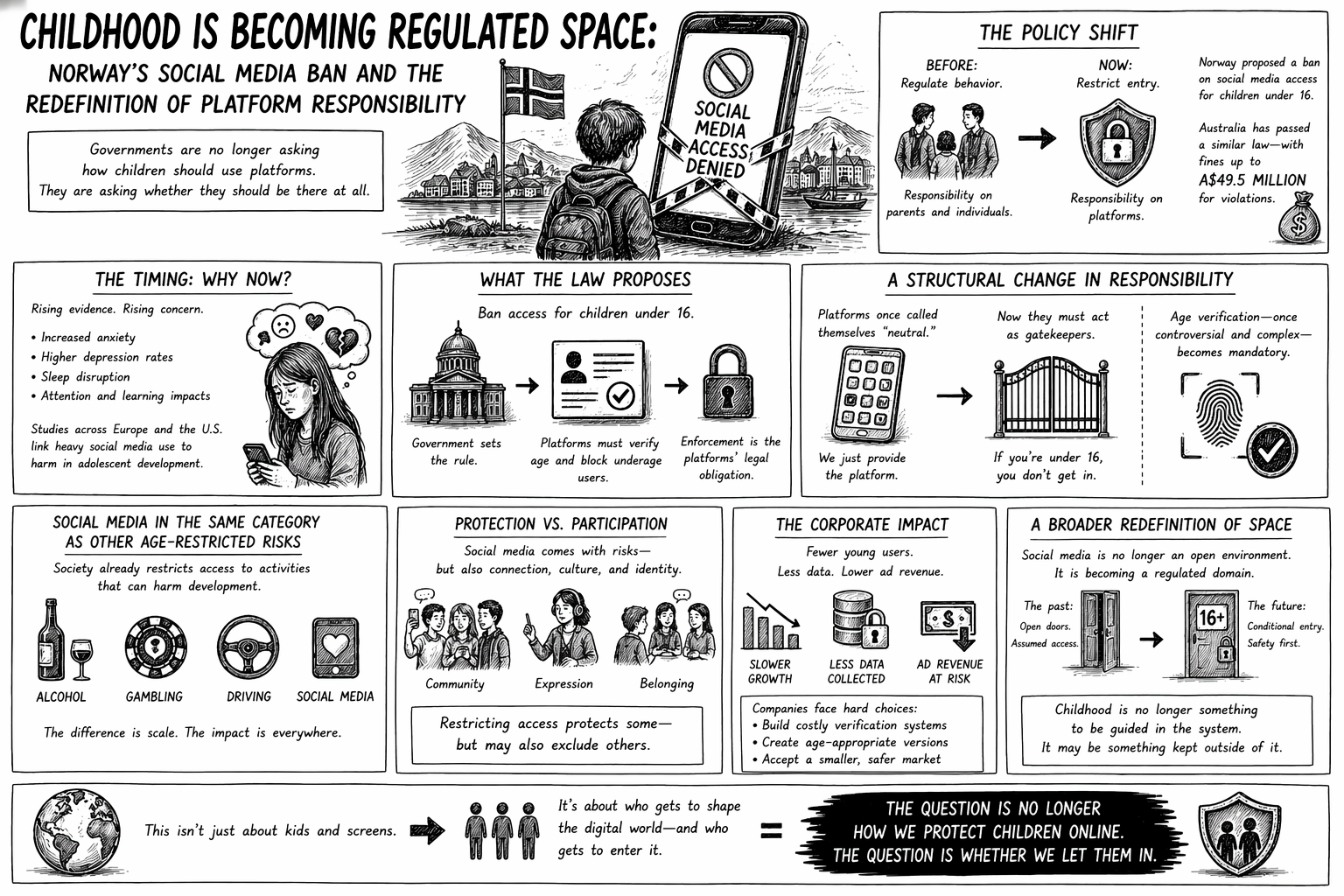
The timing reflects growing concern over the impact of social media on mental health, attention, and development. Studies across Europe and the United States have linked increased screen time and algorithmic exposure to rising levels of anxiety, depression, and sleep disruption among adolescents. Governments are responding not by adjusting content standards, but by redefining access altogether. The move from regulation of behavior to restriction of entry marks a significant escalation in how platform risk is understood.
This shift introduces a structural change in how responsibility is assigned. For years, technology companies have positioned themselves as neutral platforms, placing the burden of use on individuals and families. Norway’s proposal challenges that model by requiring companies to actively prevent certain users from participating. Age verification, long considered technically and ethically complex, becomes a requirement rather than an option. The platform is no longer just hosting interaction. It is gatekeeping it.
There is also a broader comparison to other regulated environments. Alcohol, gambling, and driving are all restricted based on age due to their potential impact on development and safety. By placing social media within that category, governments are signaling that digital exposure carries similar risks. The difference is scale. Social media is embedded in daily life, education, and social interaction in ways that traditional regulated activities are not. Restricting access therefore reshapes not just individual behavior, but social norms.
The policy also exposes a tension between protection and participation. Social media is not only a source of risk; it is also a space where identity, community, and cultural engagement are formed. For many young people, platforms are a primary means of communication and expression. Removing access raises questions about how those functions will be replaced, and whether alternative spaces will emerge or whether exclusion will create new forms of digital inequality.
From a corporate perspective, the implications are significant. Age-restricted access reduces user growth, limits data collection, and disrupts advertising models that depend on scale. Companies will need to invest in verification systems, potentially redesign platforms for different age groups, or accept reduced reach. The economic incentives that have driven platform expansion are now being countered by regulatory frameworks that prioritize user protection over growth.
What this moment signals is a broader redefinition of digital space. Social media is no longer treated as an open environment where access is assumed. It is becoming a regulated domain where entry is conditional, and where the responsibility for managing risk is shifting from users to the platforms themselves. Childhood, once seen as something to be guided within the system, is now being positioned as something that may need to be kept outside of it altogether.