
The Illinois House passed legislation this week in a 72–35 vote restricting the placement of new immigration detention centers within 1,500 feet of homes, schools, parks, and places of worship. The bill targets future facilities, effectively using zoning and proximity as tools to limit how and where federal immigration enforcement infrastructure can expand. It does not change enforcement authority. It changes its location.
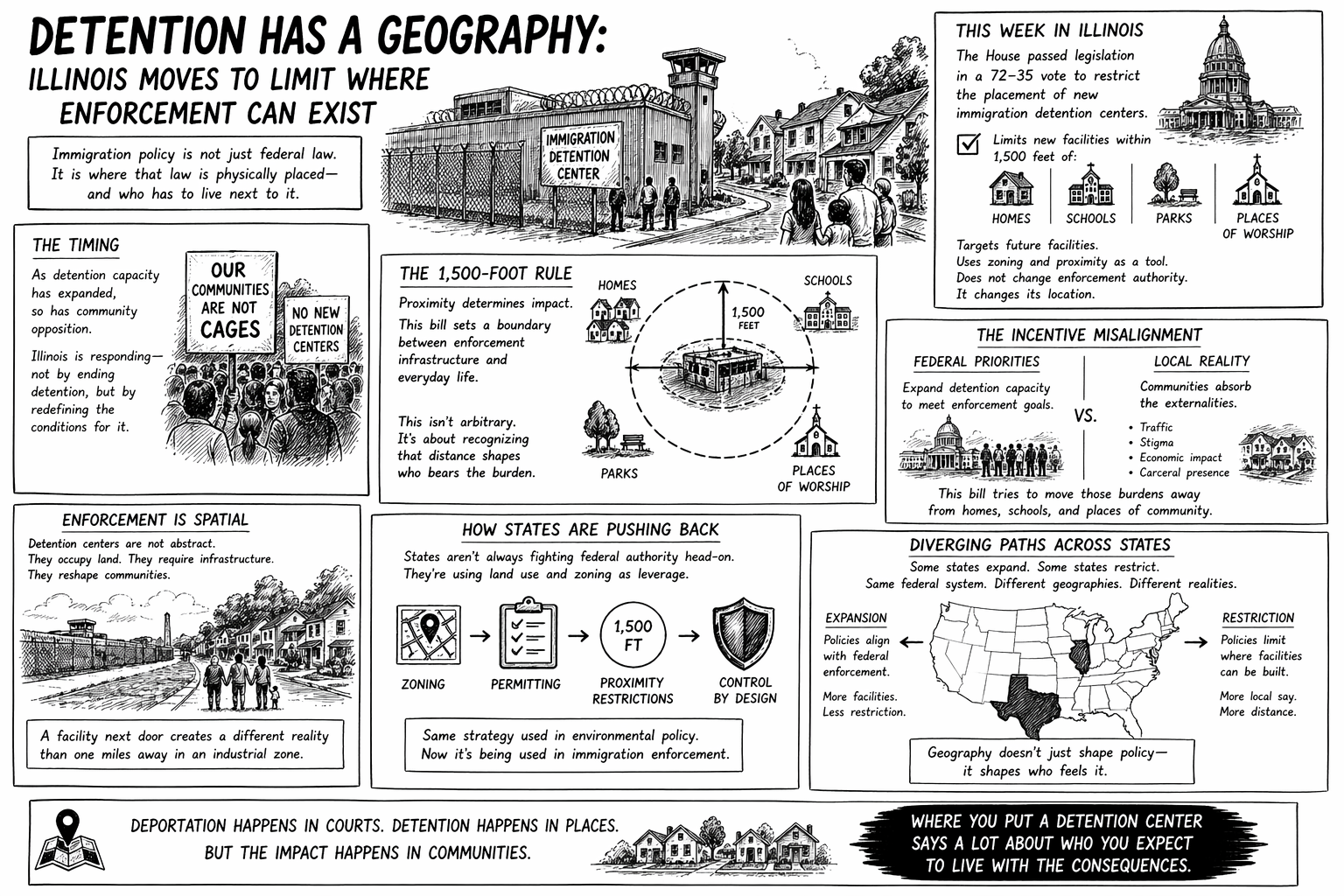
The timing reflects growing tension between federal immigration priorities and local control. As detention capacity has expanded in recent years, so has opposition from communities that find themselves adjacent to those facilities. Illinois is responding not by challenging the existence of detention centers outright, but by redefining the conditions under which they can be built. The distinction matters. It shifts the debate from legality to placement.
That shift reveals something often overlooked in immigration policy: enforcement is spatial. Detention centers are not abstract systems. They occupy land, require infrastructure, and reshape the communities around them. A facility placed within walking distance of a neighborhood introduces a different set of daily realities than one located miles away in an industrial zone. The 1,500-foot restriction is not arbitrary. It reflects an understanding that proximity determines who absorbs the social and psychological cost of enforcement.
There is also a broader pattern at play in how states are engaging with federal systems. Rather than attempting to override federal authority directly, states are increasingly using land use, zoning, and permitting as leverage points. This mirrors strategies seen in environmental policy, where local governments restrict industrial activity through permitting constraints rather than outright bans. Immigration enforcement is now being negotiated through similar mechanisms, where control is exercised indirectly but effectively.
The bill also highlights an incentive misalignment between federal and local priorities. Federal agencies seek to expand detention capacity to meet enforcement goals, while local communities are left to manage the externalities—traffic, stigma, economic impact, and the presence of carceral infrastructure. By restricting where facilities can be placed, Illinois is attempting to redistribute those externalities away from residential areas. The question is not whether detention exists, but who lives near it.
This approach stands in contrast to states that have moved in the opposite direction, facilitating the expansion of detention infrastructure through policy alignment with federal enforcement. The divergence underscores how immigration is being fragmented across state lines, with geography determining not just enforcement intensity, but lived experience. Two communities under the same federal system can encounter entirely different realities based on local policy choices.
What this moment makes clear is that immigration policy is no longer confined to statutes and executive orders. It is embedded in physical space. Where detention centers are placed, who they are placed near, and how communities respond to that placement are becoming central to how the system functions. Enforcement does not just operate through law. It operates through location, and location determines who feels its presence most directly.