
There’s a version of this story that gets framed as novelty — younger men dating older women, positioned as something unexpected or unconventional. But what’s becoming clearer is that the shift is less about who is dating whom and more about what people are looking for. For a growing number of younger men, the appeal is being described in practical terms: emotional clarity, direct communication, and a level of stability that feels increasingly difficult to find elsewhere. What once might have been explained as preference is now being shaped by conditions.
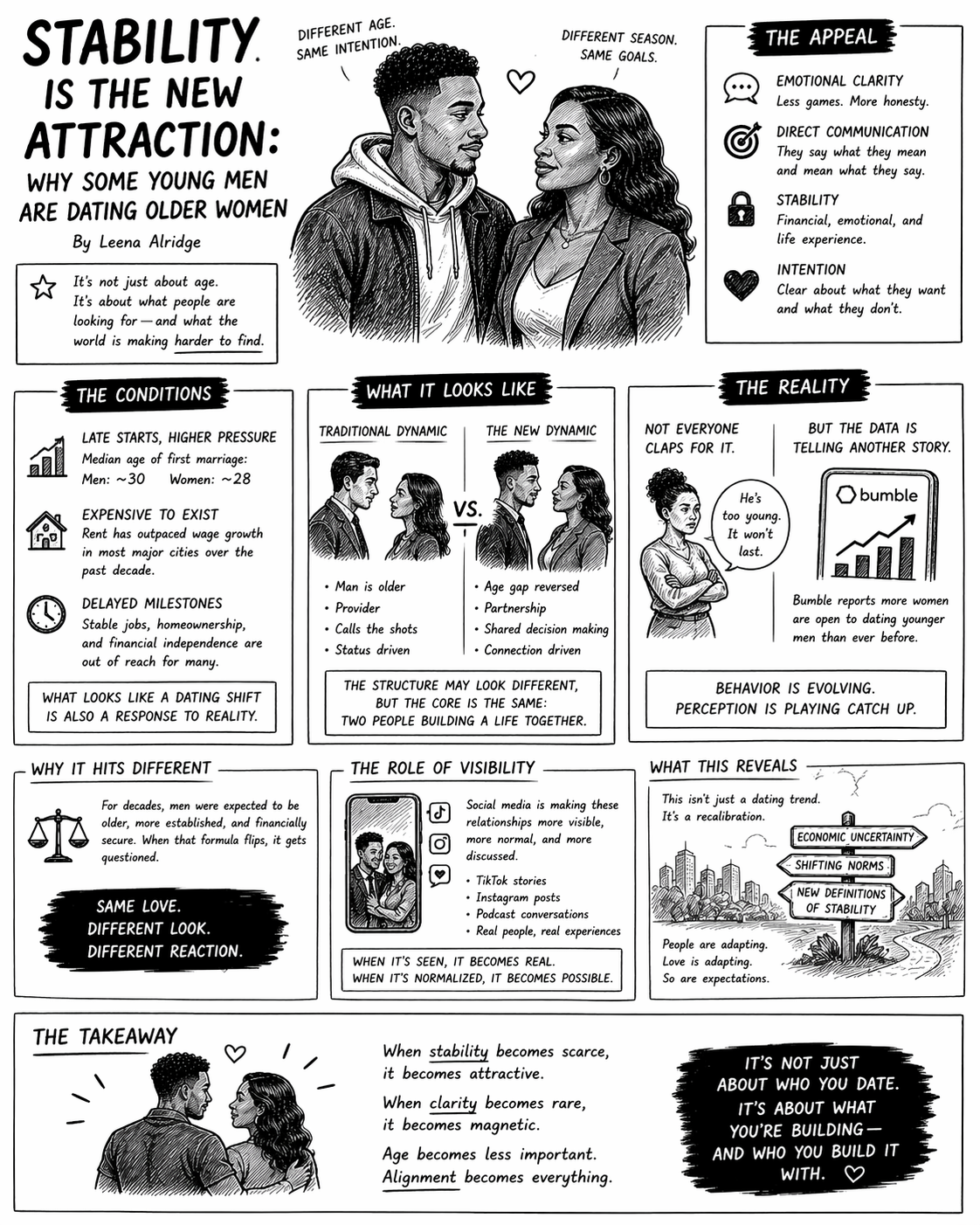
Those conditions are structural. Younger generations are entering adulthood at a moment defined by economic volatility, rising housing costs, and delayed financial independence. The median age of first marriage in the United States has risen to roughly 30 for men and 28 for women, reflecting a broader delay in traditional life milestones. At the same time, housing affordability has shifted dramatically, with rent growth outpacing wage growth in many major cities over the past decade. The markers that once signaled readiness for long-term partnership — stable employment, independent living, predictable progression — are less accessible than they were for previous generations at the same age. What looks like a change in dating behavior is also a response to a changing baseline.
For younger men navigating that landscape, dating older women is not necessarily about reversing traditional dynamics. It is often about stepping into relationships where expectations are clearer and less performative. Many describe interactions that feel more direct, less ambiguous, and less tied to status signaling. That difference matters in a dating culture where ambiguity has become normalized and where intention is often implied rather than stated. Stability, in this sense, is not just financial. It is relational — defined by how communication, time, and expectations are structured in ways that reduce uncertainty.
At the same time, the shift exists within a broader cultural tension. For decades, heterosexual relationship norms positioned men as older, more established, and financially secure, reinforcing a dynamic where age aligned with economic and social power. Relationships that inverted that structure were often treated as exceptions or framed as deviations. As younger men and older women increasingly enter similar pairings, that asymmetry becomes more visible. The underlying structure of the relationship may not be fundamentally different, but the cultural interpretation of it is. What is normalized in one direction remains noteworthy in another, revealing how gender continues to shape perception even when behavior begins to converge.
That does not mean the shift is universally embraced. For many women — particularly those already established in their careers and personal lives — dating younger partners is not always an intuitive or desirable change. The expectation that men should be older, more stable, and positioned as providers remains deeply embedded, even as the conditions that support that expectation become less consistent. At the same time, dating platform data suggests a measurable shift in openness, with companies like Bumble reporting increased willingness among women to consider younger partners. Behavior is evolving, but perception is moving more slowly. The result is a moment where multiple frameworks for understanding relationships are operating simultaneously.
Visibility is accelerating that tension. Social media has made these relationships easier to see, discuss, and normalize, even for those who do not personally relate to them. Platforms like TikTok and Instagram have turned what was once private into something more legible, with users openly sharing their experiences and preferences. That visibility does not create the behavior, but it lowers the barrier to it. What becomes visible becomes easier to imagine, and what is easier to imagine becomes easier to pursue.
What this moment reveals is not simply a change in dating patterns, but a broader recalibration of how relationships are structured under shifting economic and cultural conditions. As stability becomes less predictable, it becomes more valuable — and more actively sought. For some, that search is leading in directions that challenge long-standing assumptions about age and partnership. For others, it remains outside the realm of consideration. Both responses exist within the same system, and both reflect how that system is changing in real time.