
Earlier this week, Social Storytellers Collective reported that Meta will begin tracking employee keystrokes, mouse movements, and on-screen activity to train its artificial intelligence systems. At nearly the same time, a separate federal policy trajectory pointed in a parallel direction: new vehicles sold in the United States could soon be required to monitor driver behavior, using sensors and cameras to detect impairment. On the surface, these are two different developments, one inside the workplace and one on the road. But together, they reveal a shared shift in how institutions are beginning to understand human activity.
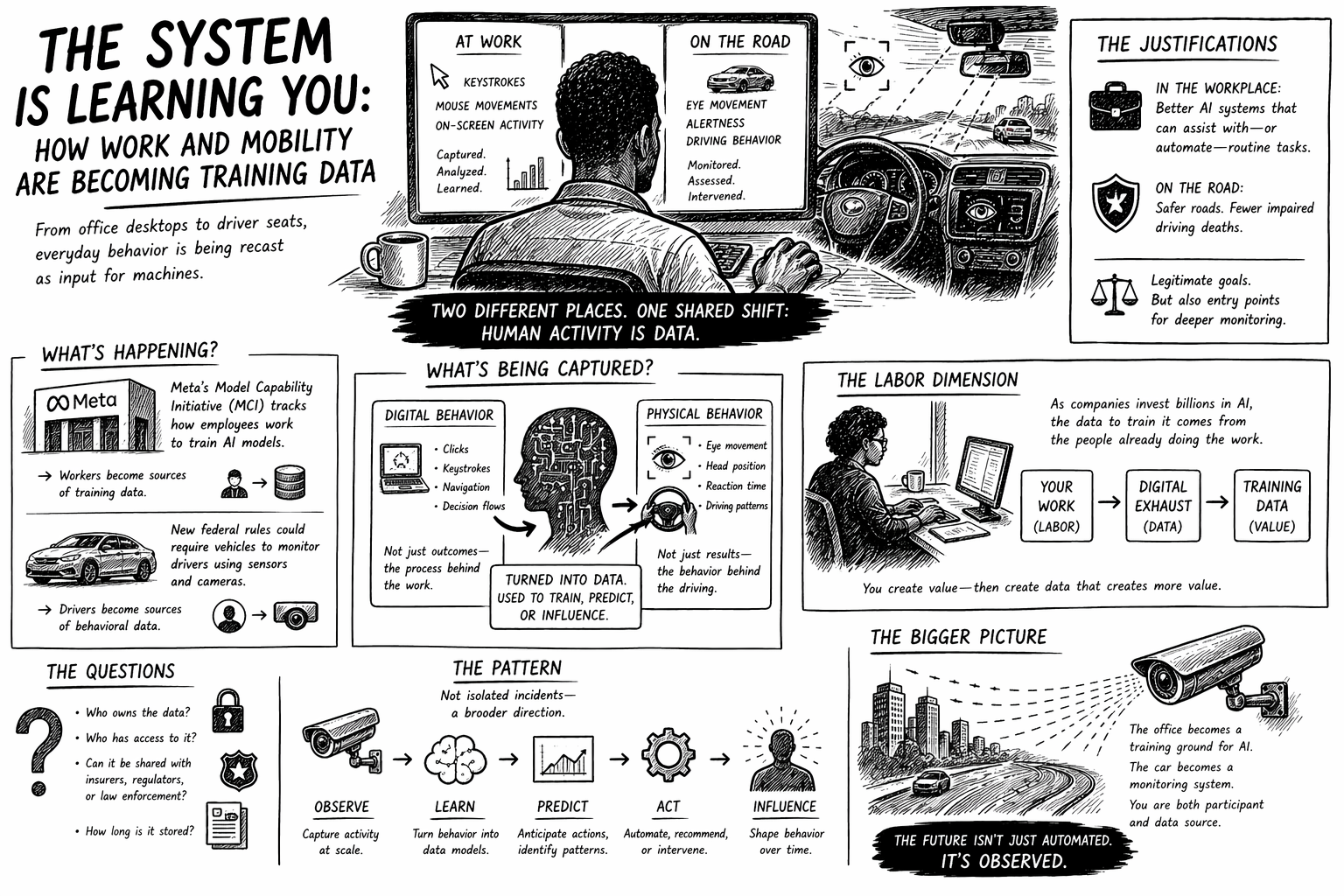
In both cases, the core change is not simply technological. It is conceptual. Work is no longer just work. Driving is no longer just driving. These are being redefined as streams of data that can be captured, analyzed, and fed back into systems designed to replicate or regulate human behavior. Meta’s internal tracking tool, known as the Model Capability Initiative, is explicitly designed to observe how employees complete everyday digital tasks so that AI systems can learn to perform them. The company has made clear that its models “need real examples of how people actually use computers,” a framing that positions workers not just as employees, but as sources of training data.
What makes this shift significant is the way it is being introduced. It is not framed as surveillance. It is framed as improvement. In the workplace, the justification is better AI systems that can assist with or automate routine tasks. In transportation, the justification is safety, specifically the reduction of impaired driving deaths. These are legitimate goals. But they also serve as entry points for a broader expansion of monitoring into environments that were previously considered ordinary and unremarkable.
The pattern becomes clearer when you look at what is actually being captured. In Meta’s case, it is the smallest units of digital behavior: clicks, keystrokes, navigation patterns, and decision-making flows. In the automotive context, it is physical behavior: eye movement, alertness, and driving patterns. In both cases, the system is not just recording outcomes. It is recording process. That distinction matters because process data is what allows systems to not only understand what people do, but how they do it, which is the foundation for both replication and intervention.
There is also a labor dimension embedded in this shift. As companies invest heavily in artificial intelligence, the data required to train those systems has to come from somewhere. Increasingly, it is coming from the people already doing the work. Reports indicate that companies are moving beyond traditional productivity monitoring to capture what some analysts describe as “digital exhaust,” the byproduct of everyday tasks that can be repurposed into institutional knowledge and machine training data. In that sense, employees are producing value twice: once through their labor, and again through the data generated by that labor.
The same dynamic is beginning to emerge in mobility. As vehicles become more software-driven, driving itself is being converted into a continuous feedback loop. The stated goal may be to prevent accidents, but the infrastructure required to do that necessarily involves persistent observation. Once that observation exists, new questions follow. Who owns the data? Who can access it? Can it be shared with insurers, regulators, or law enforcement? The technology does not answer those questions. It creates them.
None of this is happening in isolation. Meta’s tracking initiative is part of a broader, multi-billion-dollar push into artificial intelligence, accompanied by layoffs and restructuring as the company reorients around automation. The automotive shift is part of a longer trajectory toward vehicles that are not just mechanical products, but connected systems. What links these developments is not the industry, but the direction. Systems are being designed to learn from continuous exposure to human behavior, and that requires turning everyday activity into something that can be observed at scale.
The result is a subtle but consequential redefinition of the environment. The office becomes a training ground for AI. The car becomes a monitoring system for behavior. And the individual, whether working or driving, becomes both participant and data source within systems that are increasingly built to watch, learn, and act.
What looks like progress in isolation begins to look like a pattern in aggregate. Not because each individual development is unprecedented, but because they are converging around the same idea. The future is not just automated. It is observed.