
England’s Renters’ Rights Act 2025 comes into force on May 1, delivering the most significant overhaul of the private rental sector since the late 1980s. The legislation converts all assured short hold tenancies to periodic tenancies with no fixed end date, abolishes Section 21 no-fault evictions, bans rental bidding wars, limits rent increases to once per year with two months’ minimum notice, and prohibits landlords from discriminating against tenants receiving benefits or those with children. Landlords who fail to provide a mandatory information sheet by May 31 face fines of up to £7,000.
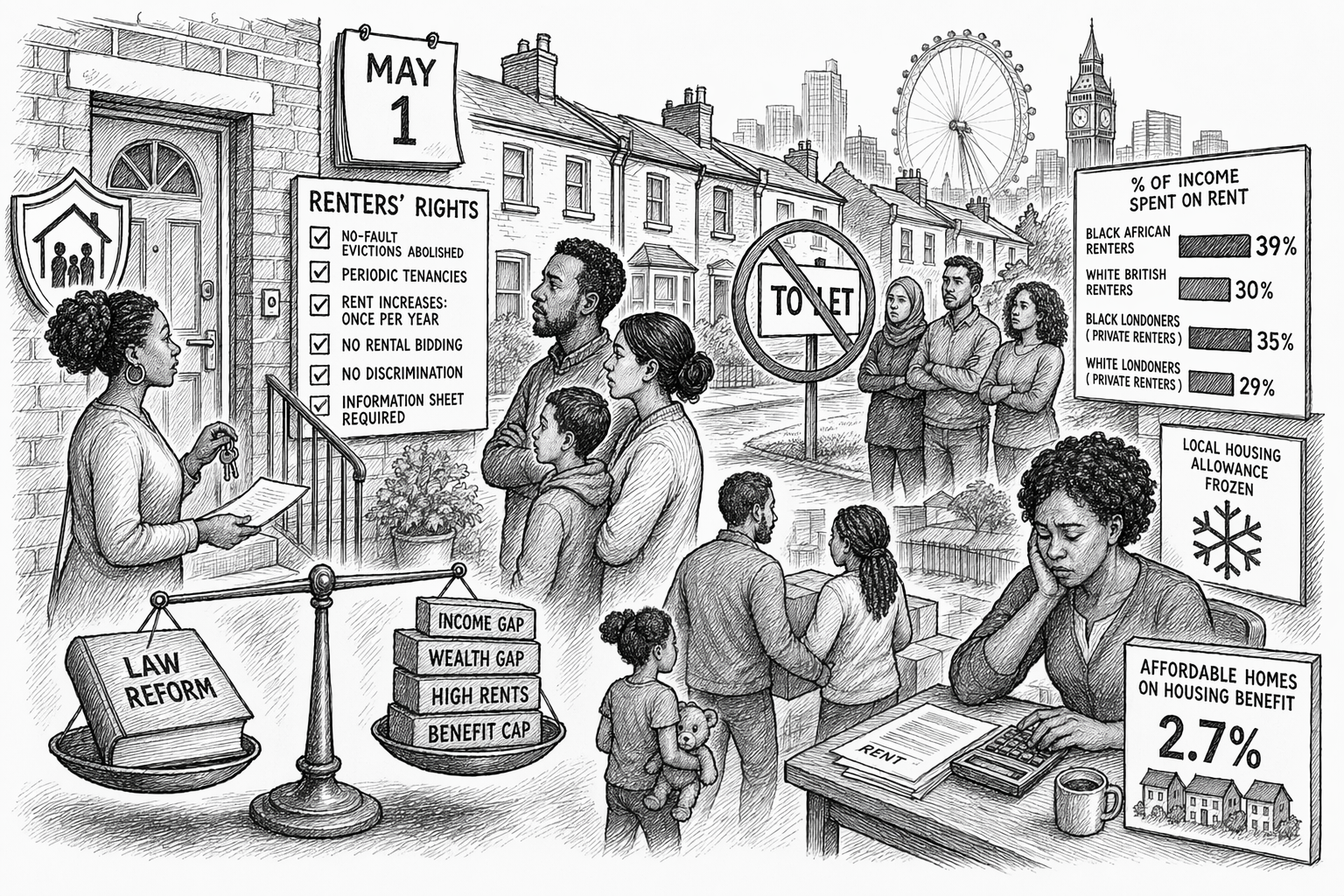
The reform is real. The abolition of no-fault eviction alone represents a structural shift in the balance of power between tenants and landlords — particularly for the approximately 11 million people renting privately in England who have historically been most vulnerable to displacement without cause. The legislation addresses the legal tools of displacement. What it cannot fix is the affordability crisis underneath the legal one.
The average UK house price sits at approximately £270,200, with first-time buyer properties costing roughly 5.9 times the average salary. In London, average rents have reached over 50% of typical earnings for some tenants. And that burden is not distributed equally. Black African renters in England spend an average of 39% of their income on housing, compared to 30% for White British renters. In London, Black Londoners who rent privately spend 35% of their income on housing compared to 29% for White Londoners. The disparity is documented in government data. The same government data, according to housing researchers, does not investigate why those figures are so extreme.
In Bristol, private renters are spending 45% of their monthly income on rent — well above the 30% affordability threshold — with some data suggesting figures closer to 57% for many. The average home in the city now costs £353,000. Advocates working with Black and racialized communities in Bristol have noted that housing policy discussions consistently treat racial disparity as context rather than cause — a framing issue SSC has tracked domestically in coverage of housing access across Houston, Miami, and Charlotte, where the same pattern holds: reform language advances while the structural income and wealth gaps that determine who actually secures stable housing remain largely untouched.
Local housing allowance rates remain frozen, with only 2.7% of homes in Great Britain currently affordable to people relying on housing benefit. That number does not improve on May 1. The legislation changes the legal framework of the rental relationship. The economic conditions that determine who can participate in that relationship — and at what cost — remain what they were. For Black and ethnic minority renters in England, the Act is a meaningful floor. The ceiling is still the same distance away.
Access Shift | Structural Reality | News Desk