
Disney is laying off roughly 1,000 employees less than a month into CEO Josh D’Amaro’s tenure, marking another significant round of cuts in an industry still recalibrating after the streaming boom. In a memo to staff, D’Amaro framed the decision as a structural adjustment rather than a reflection of performance, emphasizing that those affected had done “meaningful work” and that the company remains confident in its long-term direction. The language is familiar to anyone who has followed corporate layoffs over the past two years: optimize resources, streamline operations, reinvest in core priorities.
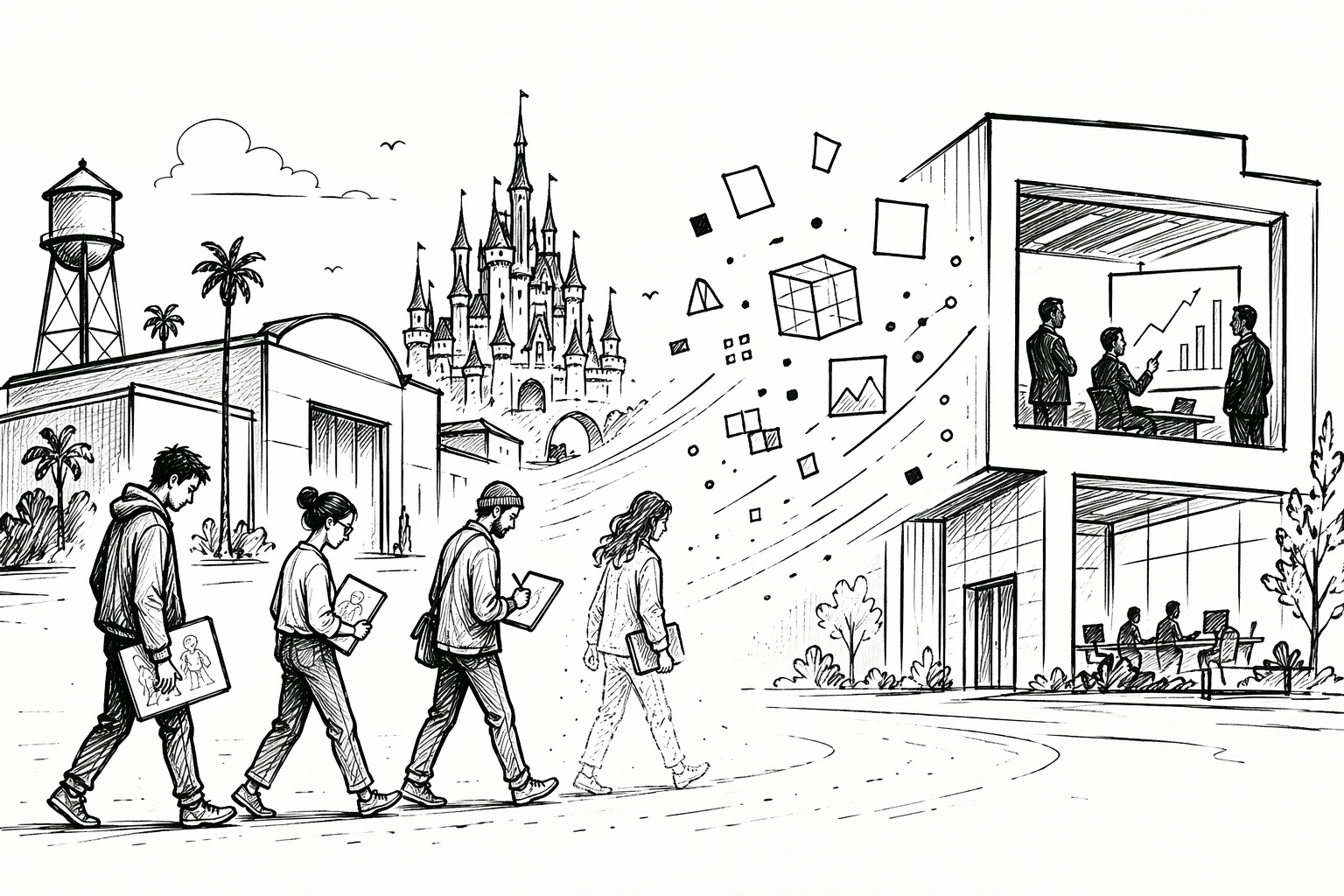
What the memo makes clear is that this is a business story before it is anything else. Disney is under pressure to improve streaming profitability while managing the slow decline of traditional television revenue. At the same time, its parks division continues to perform strongly, creating an internal imbalance that requires reallocation rather than expansion. The cuts largely target the marketing department, which was recently consolidated under Asad Ayaz — named chief marketing and brand officer in January — marking the first time Disney brought all of its divisions under a single marketing chief. In that context, the layoffs read less like a sudden shift and more like a continuation of an ongoing restructuring strategy that predates D’Amaro’s first week.
But outside the company, the story is being told differently.
On social media, the layoffs have already been linked to artificial intelligence. Viral posts claim that Disney is replacing artists with AI systems trained on their work, collapsing a complex set of decisions into a single cause-and-effect narrative. The fuller picture is more complicated. The cuts span marketing, studios, television, ESPN, product and technology, and corporate functions — not a targeted clearance of creative roles. And the financial logic driving them is straightforward: Disney’s stock has fallen roughly 45% over five years, and despite a 21% recovery in the past year, the company remains under significant investor pressure. The day the layoffs were announced, shares rose 1.6%. Wall Street approved.
And yet the instinct to connect these dots is not random — because one part of what happened deserves closer scrutiny.
Among the hardest-hit areas was Marvel Studios’ visual development department. The cuts were described as significant, with Marvel retaining only a skeleton crew to coordinate the hiring of artists on a project-by-project basis — a shift from full-time staff to outside contractors going forward. The team’s longtime director, who helped shape the visual identity of more than 40 films over 16 years, announced his departure on social media, writing that it was “the end of an era.” Former Marvel artists told outlets that the move toward contractors could fundamentally alter the visual consistency the MCU spent a decade building. Whether that turns out to be a creative liability or an opportunity to break out of the franchise’s much-criticized aesthetic sameness remains to be seen. What is clear is that the structural model that built one of the most successful visual franchises in history has been dismantled in a single week.
That specificity — an Academy Award-winning in-house creative team replaced with a rotating contractor model — is what gives the public response its charge, even when the broader AI attribution is imprecise.
The Industry Frame
Disney’s restructuring is not happening in isolation. Across the entertainment landscape, every major studio is making some version of the same calculation. Sony Pictures announced plans to eliminate several hundred positions across its film, television, and corporate divisions, and shut down Pixomondo, its visual effects and virtual production studio. At Condé Nast, the CEO explicitly cited the “rapid advancement of AI” as the rationale for reorganizing its technology division — language that was notably absent from D’Amaro’s memo but very much present in the broader industry conversation.
Netflix, meanwhile, is making moves that signal where the industry is heading rather than where it currently stands. The company acquired Ben Affleck’s production startup InterPositive in a deal valued at up to $600 million, expanding generative AI-powered tools available to its creative partners. And while Netflix CEO Ted Sarandos continues to publicly frame AI as a resource for human artists rather than a replacement, the acquisition of an AI production company sends its own signal. Netflix’s $82.7 billion purchase of Warner Bros. also gives it access to a massive archive of intellectual property that industry insiders say could serve as training material for future AI-powered media experiences. Disney, for its part, announced tools for Disney+ subscribers to create AI-generated short-form video using Disney’s IP, with the company in discussions with AI firms to develop those capabilities while protecting its intellectual property.
The studios are not replacing artists tomorrow. But they are building infrastructure — legal, technological, and organizational — that will enable them to rely on fewer of them over time.
Where the Tension Actually Lives
AI is already present in the background of the industry. Studios are experimenting with generative tools in pre-visualization, concept development, and content iteration. The technology is not yet replacing entire creative teams wholesale, but it is beginning to change how work gets done. Fewer early drafts. Faster iteration cycles. Greater emphasis on refinement and oversight rather than origination. These shifts do not always register as job losses in a single moment, but they alter the long-term demand for certain kinds of labor.
The layoffs are not being driven by AI in a direct, immediate sense. They are being driven by financial pressure, organizational restructuring, and a broader industry correction after years of aggressive expansion. But AI is arriving at exactly the moment when companies are already looking to do more with less — and it becomes a tool that reinforces those decisions, making leaner teams more viable and, over time, more permanent.
That compounding effect is where the tension lives, and where the public’s instinct to connect the dots — however imprecisely — reflects something real.
A sudden replacement narrative suggests a clean break, a moment where human labor is swapped out for machines. What is happening instead is more gradual and harder to track. Roles evolve. Headcounts shrink incrementally. Expectations shift. The same amount of output is produced with fewer people, supported by tools that reduce the need for certain types of work while increasing demand for others. The change is distributed across time, which makes it easier to deny and harder to measure.
There is also a labor question that rarely enters the executive memo. The workers who built Marvel’s visual identity over 16 years were not contractors managing a portfolio of clients — they were institutional knowledge made human. That knowledge is now being dispersed, and the transition to a project-by-project contractor model does not just affect those individuals. It reshapes the conditions under which the next generation of creative workers will enter the industry: fewer staff roles, less institutional protection, more exposure to the market’s volatility. Legislators are beginning to take notice. Pending bills like the TRAIN Act would allow creators to subpoena AI developers to determine whether their work was used as training data — a direct response to what workers in these industries are experiencing as their labor gets absorbed into systems that compete with them.
What Comes Next
D’Amaro’s memo closes with a note of optimism about Disney’s future, a reminder of the company’s cultural and creative identity even in a moment of contraction. That optimism is not necessarily misplaced. Disney remains one of the most powerful storytelling institutions in the world, with assets and infrastructure that few competitors can match. But the path forward it is describing is not just about what the company creates. It is about how that creation happens and who gets to be part of it.
The layoffs, in that sense, are not the full story. They are one visible moment in a longer transition that is reshaping the economics of creative work across the entire industry — who gets hired, under what terms, and for how long.
AI did not cause this shift. But it is arriving at exactly the right time to shape what comes next. And the industry’s accelerating investment in AI tools, training data acquisition, and contractor models is making one thing increasingly clear: the infrastructure being built right now is not designed to bring these roles back. It is designed to make their absence permanent.
The real shift is not simply that jobs are being cut. It is that the definition of creative work inside large media companies is being quietly rewritten — and the workers who built these franchises are watching it happen in real time, with little structural protection and fewer places to land.
News Desk | Social Storytellers Collective