
A landmark legal reform closes the bail mechanism that historically functioned as a deterrent to reporting sexual violence — and its architect is someone who survived what the law is designed to prevent.
Zambia has enacted the Criminal Procedure Code Amendment Act No. 4 of 2026, making all sexual offenses non-bailable — meaning suspects accused of rape, child sexual abuse, and incest must remain in custody until their cases are concluded by the courts. The reform was introduced by a ministry led by Princess Kasune Zulu, a former child bride and HIV activist who publicly disclosed her HIV status in the late 1990s at a time when doing so carried enormous personal and professional risk. The law closes a specific and consequential gap in the accountability architecture for sexual violence cases — the gap created when accused perpetrators were released on bail and returned to the communities where complainants lived while cases proceeded through a court system that can take months or years to reach resolution.
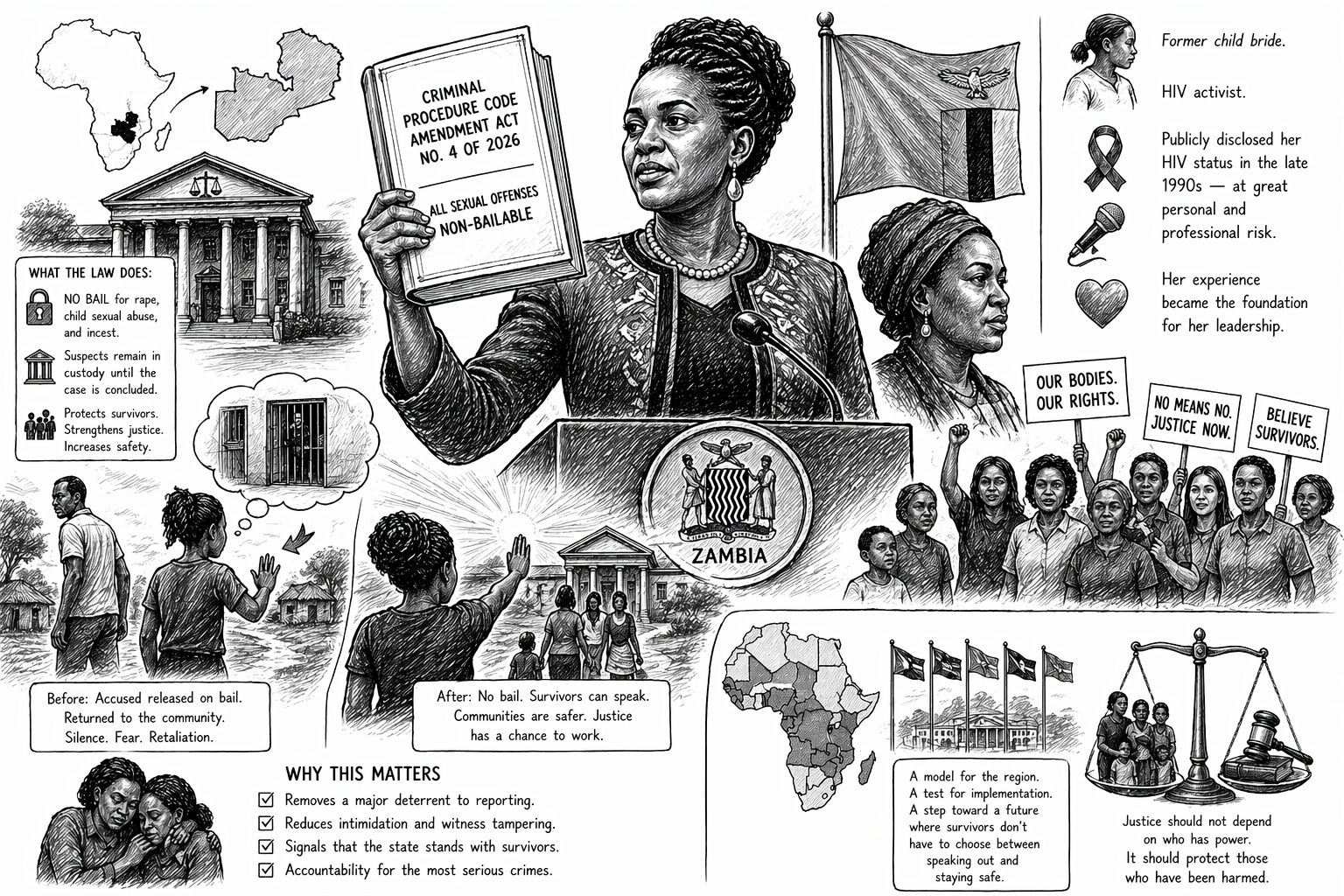
That gap was not simply a procedural inconvenience. It functioned as a structural deterrent to reporting, shaping how survivors evaluated risk before ever entering the legal system. When filing a complaint meant the accused could return to the same community within days, the possibility of retaliation, pressure on witnesses, or the erosion of daily safety made silence a rational response rather than a failure to act.
In sub-Saharan Africa, that deterrent operated within an already complex social environment, where survivors often face pressure not to bring perceived shame to families or communities through formal legal processes. The bail mechanism did not create those conditions, but it intensified them by introducing a legal pathway that could quickly return accused individuals to the same setting. Zambia’s reform does not remove those social pressures, but it does eliminate the barrier embedded within the legal system itself.
The origins of the reform are what extend its significance beyond the policy change. Princess Kasune Zulu approached the issue through lived experience, including child marriage and HIV exposure, grounding the policy in a direct understanding of the system’s failures. That perspective shifts the focus from abstract compliance to practical protection, offering a model of how survivor-led policy can reshape institutional response.
The regional context underscores the stakes. Child marriage rates across sub-Saharan Africa remain high despite decades of reform, and accountability systems for sexual violence are often under-resourced and structurally weak. Low conviction rates are not only a matter of evidence, but of systems that fail to support reporting or sustain cases once they begin.
Zambia’s decision to make sexual offenses non-bailable represents a significant intervention in that structure. By removing a mechanism that enabled early release, the reform addresses one of the points where the system weakened its own ability to produce accountability. Whether it leads to increased reporting and stronger case outcomes, and whether other countries follow, will determine if it becomes a regional model or remains a national exception.