
Tim Cook announced Monday he will step down as Apple CEO in September, with John Ternus — the company’s senior vice president of Hardware Engineering — named as his successor effective September 1, 2026. Cook will remain with the company as executive chairman, transitioning out of daily operations after fifteen years leading what is now a $4 trillion company. The board approved the succession unanimously, describing it as the result of a thoughtful, long-term succession planning process. Cook succeeded Steve Jobs in 2011 — stepping into what many considered the most impossible shoes in business — and leaves a company that has grown from approximately $350 billion in market capitalization to $4 trillion during his tenure. That growth is the headline. The choice of who succeeds him is the argument.
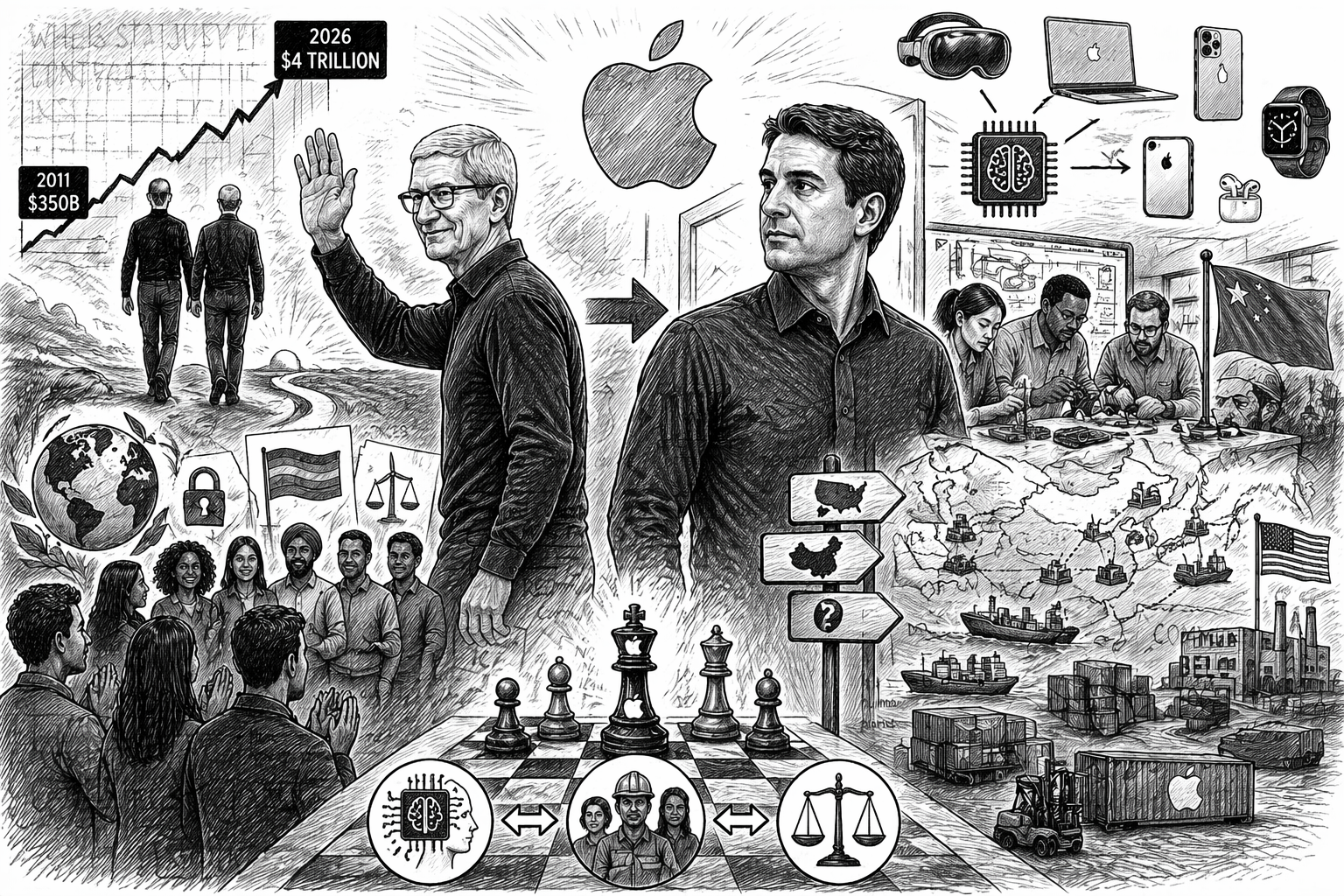
The decision to elevate a hardware engineering chief rather than an AI, services, or software leader is a strategic signal worth decoding. Apple’s next competitive decade will be defined by how aggressively and effectively it integrates artificial intelligence into its hardware ecosystem — into the iPhone, the Mac, the Vision platform, and whatever comes next. The choice of Ternus says the company believes product design discipline and engineering execution will differentiate it more than AI-first strategy. That is a specific and contestable bet. The companies that have moved fastest on AI integration — Google, Microsoft, Meta — have done so by treating AI as a platform layer that restructures everything beneath it. Apple’s succession choice suggests it intends to treat AI as a feature set delivered through hardware rather than as the organizing logic of the business. Whether that bet is right will define the next decade of the most valuable company in the world.
The diversity and workforce dimension of the transition is the part most coverage has not addressed. Cook was Apple’s most publicly visible executive on the intersection of corporate values and social equity — on climate, on privacy, and on workforce inclusion. His public statements and the company’s stated commitments on diversity were not simply rhetorical. They were part of Apple’s institutional identity and its global brand positioning, particularly in markets where those commitments carry specific commercial weight. Ternus, 50, joined Apple in 2001 and has led hardware engineering since 2021. His public record on workforce diversity, DEI commitments, or the social equity dimensions of corporate leadership is essentially blank — not because he has opposed those commitments, but because they have not been the domain of hardware engineering leadership. As the administration’s rollback of DEI requirements for federal contractors reshapes what corporate America is willing to say and do publicly on equity, the incoming CEO of the most valuable company in the world will face immediate and consequential choices about whether to maintain, recalibrate, or quietly deprioritize the commitments his predecessor built into Apple’s public identity.
Cook’s tenure also produced the supply chain architecture through which Apple built and maintained its $4 trillion valuation — a global network centered substantially in Asia, particularly China, that is now under severe pressure from the tariff regime and the administration’s push for domestic manufacturing. Ternus inherits both the hardware engineering expertise to potentially navigate that transition and the challenge of doing so without disrupting the production relationships that make Apple’s product quality and margin structure possible. The manufacturing geography question, the AI integration question, and the corporate values question are all landing simultaneously on an incoming CEO whose public profile has been almost entirely internal to Apple. The company is betting on operational excellence. Whether that is enough for a moment that requires strategic reinvention across multiple dimensions at once is the question the succession raises and cannot yet answer.