
The headline reaches for something dramatic. “Radicalism among young women.” It suggests a departure, a break from norm, a shift that needs to be explained as movement toward an extreme. But the data underneath tells a quieter, more structural story. Polling of British adults under 30 shows a widening gap between young men and women, not because both are moving in opposite directions at equal speed, but because young women are moving more decisively toward positions that reflect their lived conditions. The language of radicalism frames that movement as unusual. The context suggests it may be responsive.
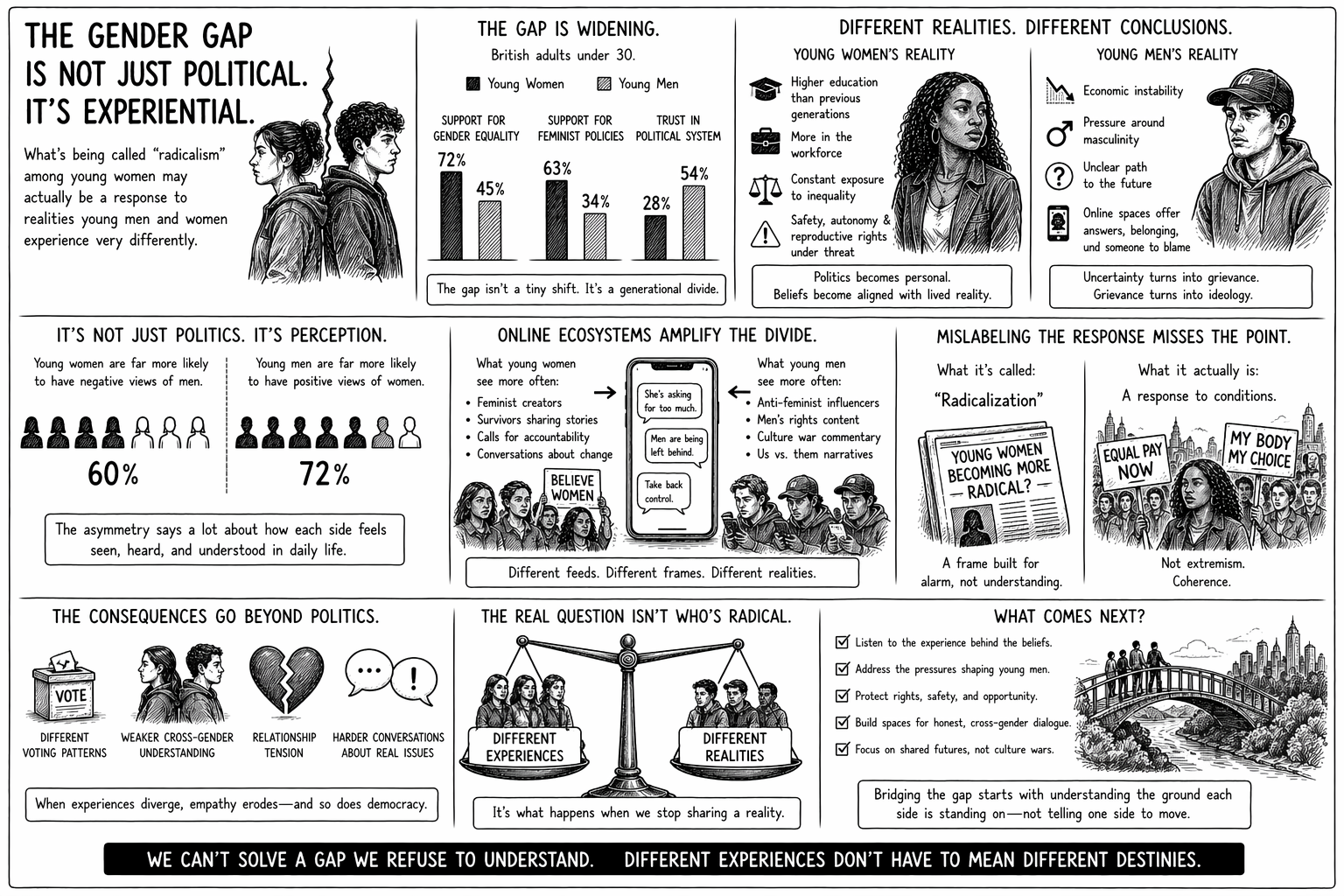
What is being described as a political divide is, at its core, an experiential one. Young women today are more educated than previous generations, more present in the workforce, and more exposed to conversations around inequality, safety, and autonomy. These are not abstract issues. They are embedded in daily life, from wage disparities to policy decisions around reproductive rights to the social expectations that shape how women move through public and private space. When political identity begins to align with those realities, it is not necessarily a move toward extremity. It is a move toward coherence.
Young men, by contrast, are navigating a different set of pressures, many of which are less clearly named. Economic instability, shifting expectations around masculinity, and a sense of diminished certainty about traditional roles have created conditions where identity feels less anchored. In that vacuum, online ecosystems have become influential, offering narratives that translate uncertainty into grievance and reposition personal struggle as systemic displacement. The result is not simply ideological drift, but a divergence in how problems are defined and who is understood to be responsible for them.
The polling data reflects this divergence not just in political alignment, but in interpersonal perception. A significant share of young women report negative views of men, while young men are far more likely to report positive views of women. That asymmetry is telling. It suggests that the gap is not only about policy or ideology, but about lived interaction and expectation. For one group, the system is producing friction that feels personal. For the other, the same system may feel less directly contested, even if it is still unstable.
The risk in framing this moment as “radicalization” is that it collapses structural response into individual behavior. It treats shifts in perspective as ideological excess rather than as signals of changing conditions. It also simplifies a more complex reality, where both young men and women are adapting to a world that no longer offers clear pathways to stability, but are doing so through different interpretive frameworks.
What is emerging is not just a political gender gap. It is a widening distance in how reality itself is being experienced and explained. And that distance is beginning to shape everything from voting behavior to relationships to the baseline assumptions people carry about each other. The question is not whether one group is becoming more radical than the other. It is what happens when shared understanding becomes harder to sustain at all.