
Austin’s Project Connect light-rail initiative encountered a setback when a proposed $47 million downtown headquarters was paused following criticism from city leadership. The proposal included $32 million in lease costs and $15 million for build-out, raising concerns about priorities within a project already facing financial scrutiny. The decision reflects a broader challenge facing large infrastructure efforts: maintaining public trust while navigating complex development processes that require significant administrative investment before a single track is laid — and before the communities the project is supposed to serve have seen anything that looks like progress.
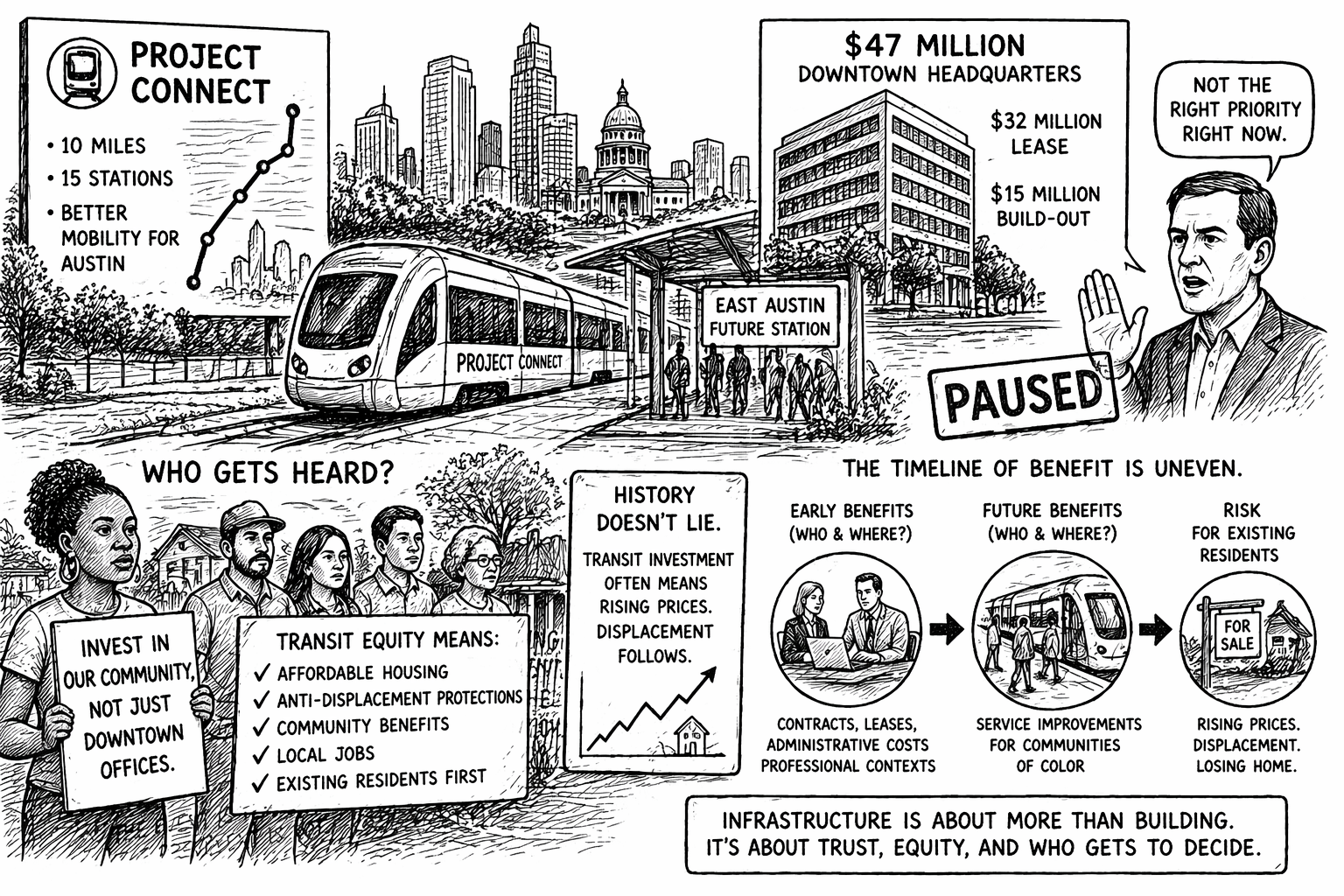
The project itself is ambitious, with plans for a 10-mile, 15-station line designed to reshape mobility within the city. Large-scale transit initiatives require significant upfront investment and extended timelines, making them vulnerable to shifts in public perception. When administrative costs become more visible than tangible progress, skepticism can emerge quickly. But the narrative control problem this moment reveals is not only about communications strategy or fiscal optics. It is partly a story about which residents’ concerns get centered in the public debate — and in Austin’s case, the criticism that stalled the headquarters proposal came from city leadership, not from East Austin community members who have been raising equity and displacement concerns about Project Connect since its inception.
That distinction matters because the East Austin corridor — which Project Connect is designed to serve — is a historically Black and Latino neighborhood that has already experienced significant gentrification pressure over the past decade. Light-rail investment in communities of color has a documented pattern across American cities of accelerating displacement rather than improving access for existing residents. When transit infrastructure arrives in a neighborhood where land values are already rising, the people most likely to benefit from improved mobility are also the people most at risk of being priced out before the line opens. A $47 million administrative headquarters proposed before track is laid is a concrete illustration of who benefits from infrastructure investment at the planning stage versus who benefits from the infrastructure itself. The communities Project Connect is supposed to serve are not the ones who would occupy that leased office space. The disconnect between administrative spending and community benefit is not just a perception problem. It is an equity problem with a specific racial dimension.
The structural issue is not simply cost management or narrative alignment, though both are real. It is the question of whose concerns shape the project’s direction at each stage of development. Large infrastructure projects generate administrative, contractual, and real estate activity in majority-white professional contexts long before they generate service improvements for the majority-Black and Latino communities that need transit access most and have the least alternative. That asymmetry — who benefits early and who benefits eventually, if at all — is the equity story underneath the governance story, and it is a pattern visible across SSC’s primary markets from Los Angeles to Chicago to New York, where transit investment has repeatedly produced this same sequence.
This dynamic is amplified in environments where fiscal pressures are already high and public trust is already thin. Competing demands for public resources make large projects more sensitive to scrutiny, particularly when administrative decisions become visible before outcomes do. The pattern is not unique to Austin. Transit projects across the country face the same challenge, where public support fluctuates based on how the project is communicated and perceived — and where the communities with the most at stake in the outcome are often the least represented in the public debate that determines whether the project continues. What this moment reveals is that infrastructure is as much about trust as it is about construction, and that trust is not distributed evenly across the communities a project claims to serve. Projects succeed when they maintain confidence in their direction and purpose across all of those communities — not just the ones with the most institutional access to shape the narrative.