
Zoom is taking a step that would have sounded unnecessary just a few years ago: verifying that the people in your meeting are actually human. Through a new partnership with World, the platform is introducing tools designed to confirm that participants are real individuals rather than AI-generated replicas. What was once an assumption baked into video calls is now being treated as a vulnerability.
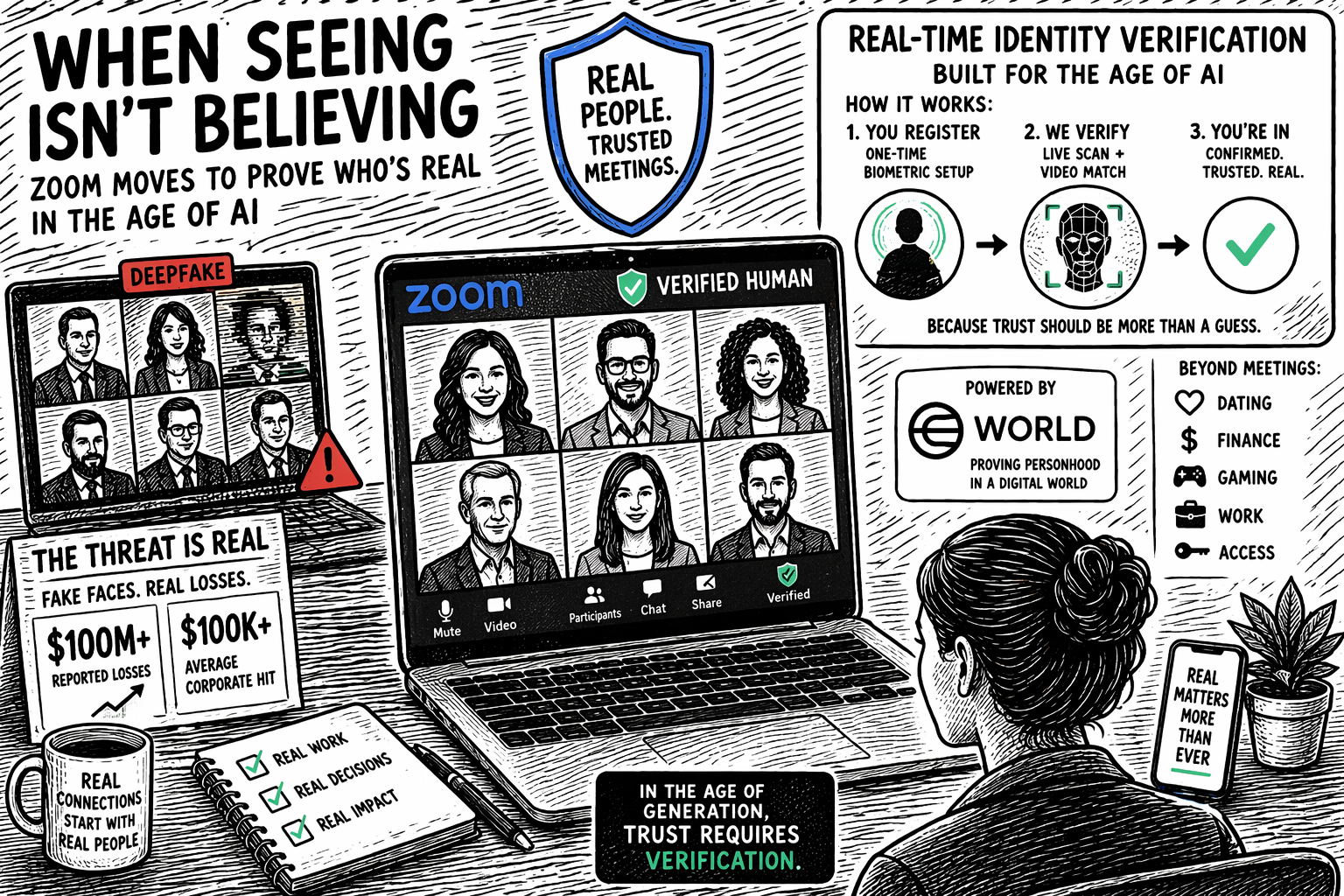
The shift is being driven by a growing class of fraud that exploits the realism of AI-generated video and voice. In one widely cited case, an employee at a global engineering firm approved millions in transfers after joining what appeared to be a routine executive call. The faces, voices, and interactions all seemed legitimate. They were not. Similar incidents have followed across regions, with reported losses climbing into the hundreds of millions and average corporate hits reaching into six figures. The threat is not hypothetical anymore. It is operational.
What makes this moment different is not just the existence of deepfakes, but their quality. Earlier detection methods focused on spotting visual inconsistencies, subtle glitches in lighting, facial movement, or timing. That approach is becoming less reliable as generative models improve. The gap between what looks real and what is real is narrowing, and platforms built on visual trust are being forced to rethink their foundations.
The system being introduced relies on layered verification rather than visual analysis alone. A user’s identity is tied to an initial biometric registration, then checked against a live scan and the current video feed during a meeting. When those elements align, a visible confirmation is applied. Hosts can require this verification before entry or request it mid-conversation, effectively turning identity into something that can be challenged and confirmed in real time.
This is not happening in isolation. Sam Altman’s World has been extending similar identity systems into other parts of the digital economy, from dating platforms to financial transactions. The logic is consistent across use cases: as AI agents become more capable of acting on behalf of users, platforms need a way to distinguish between automation and personhood at critical moments of interaction.
What’s emerging is a broader redefinition of trust online. For years, the assumption was that presence equaled authenticity. If someone appeared on your screen, spoke in real time, and responded to cues, that was enough. That assumption no longer holds. Verification is becoming a layer that sits beneath communication itself, quietly determining who gets recognized as real and who does not.
The deeper implication is that identity, once passive and taken for granted, is becoming something that must be continuously proven. In a system where AI can convincingly simulate participation, the burden shifts from platforms to users to establish credibility. The meeting is no longer just about what is said, but about who can prove they are the one saying it.