
The promise was simple enough to understand. Artificial intelligence would remove friction from work, automate repetitive tasks, and give people back time. That time, in theory, would translate into deeper thinking, better decision-making, or simply less strain. Instead, something quieter has taken hold. The tools have arrived, but the structure of work around them has not changed. The result is not relief. It is compression — a tightening of expectations around what a worker can produce, how quickly they can produce it, and what counts as an acceptable baseline once the tools that make speed possible have been absorbed into the workflow.
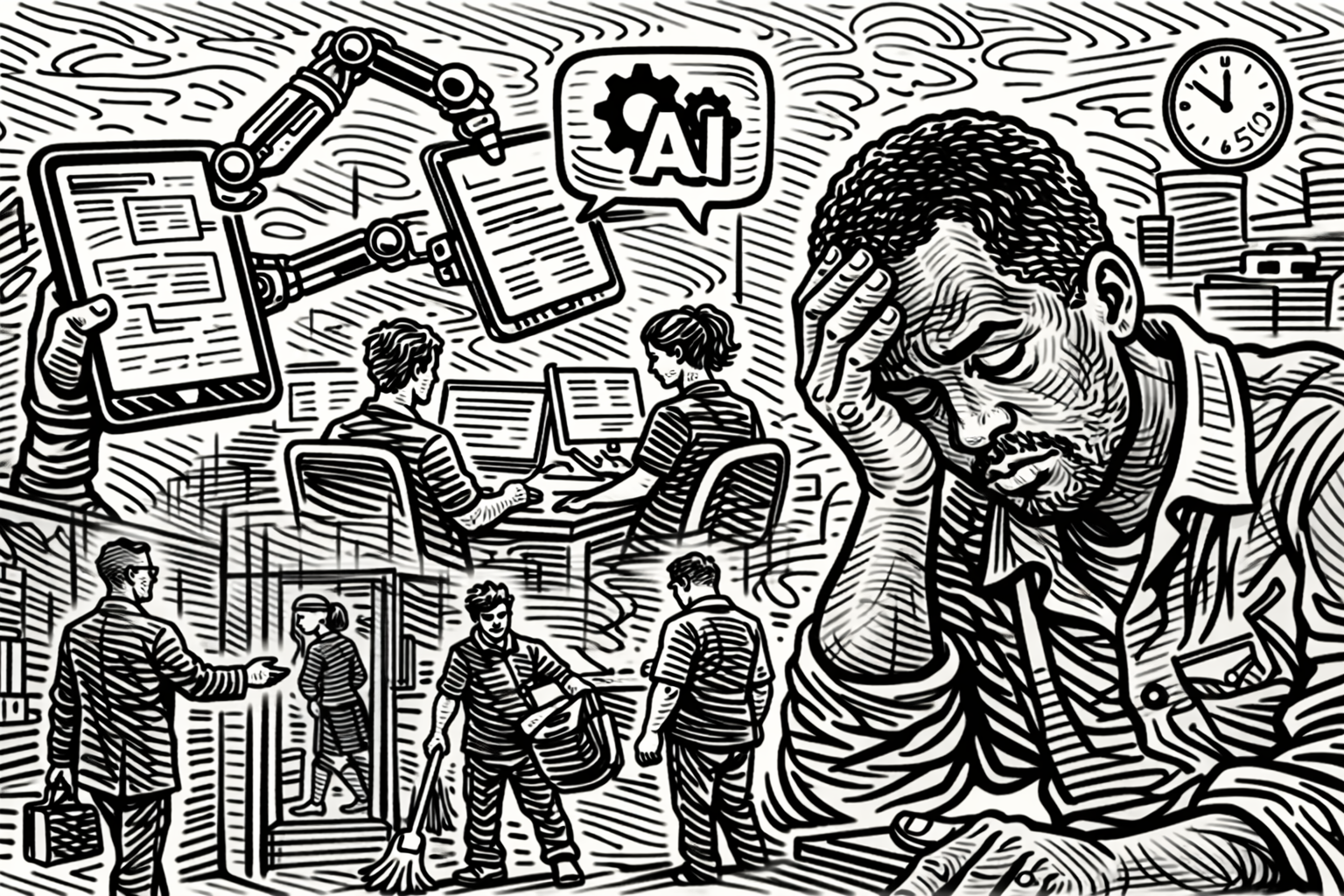
Across industries, AI has been layered into existing systems rather than used to redesign them. Meetings still happen at the same pace. Expectations around responsiveness remain intact. Deadlines have not moved. What has changed is the speed at which tasks can be completed, and with that speed has come an implicit recalibration of what counts as enough. When output becomes easier to produce, it does not reduce demand. It expands it. The efficiency gain does not return to the worker as time or autonomy. It returns to the organization as capacity — and capacity, in most workplace systems, is immediately converted into additional expectation.
The data makes the scale of this shift visible. Gallup reports that roughly half of U.S. employees now use AI at work, with nearly 30 percent using it frequently and 13 percent using it daily. At the same time, concern about job displacement tied to technology has climbed to 18 percent overall and even higher in workplaces where AI has already been implemented. The pattern is not simply adoption. It is uneven integration paired with rising anxiety — a combination that tends to increase pressure rather than relieve it. Workers are using the tools and worrying about being replaced by them simultaneously, which is its own form of cognitive load that does not appear in any productivity metric.
The contradiction becomes clearer when looking at how organizations actually deploy these tools. AI is rarely introduced alongside a reduction in meetings, a reevaluation of workload, or a rethinking of performance metrics. Instead it is absorbed into systems that already reward constant availability and high output. The logic is consistent with how every major workplace technology has been adopted over the past three decades. Email did not reduce communication. It multiplied it. Messaging platforms did not simplify coordination. They made it continuous. The pattern holds because the underlying incentive structure has not changed — organizations benefit from increased output and have no structural reason to convert efficiency gains into worker relief unless they are pressured to do so.
This creates a new kind of labor dynamic where efficiency becomes invisible. When a task takes less time because of AI, that time is not returned to the worker. It is reallocated to additional tasks, faster turnaround, or expanded scope. The worker becomes more productive by every measurable standard and no less burdened by any lived one. In some cases the burden intensifies, because the baseline has shifted without acknowledgment — what took a day now takes an hour, and the implicit expectation is that the remaining time will be filled. The compression is not announced. It accumulates. And it accumulates most acutely for workers whose output is most visible and most easily quantified, which tends to correlate with the workers who were already carrying the most. As SSC has reported in its coverage of the credential economy and workplace access, the structural pressures of modern work do not distribute evenly — and AI adoption, absent intentional design, is following that same pattern.
What is unfolding is not simply a story about technology. It is a story about how systems respond to increased capacity. When new tools emerge, organizations convert that capacity into higher expectations rather than shared relief. AI may be making work faster. Without structural change, faster does not mean lighter. It means tighter — and the workers absorbing that tightening are doing so without acknowledgment, without compensation, and without a framework that names what is actually happening to them.